Mom’s Marinated and Grilled Lamb

Mom had two ways of cooking roasted lamb, the Easter Sunday wayor marinated and grilled, the everyday and sometimes Easter Sunday way. The marinade recipe she used was from a cousin, Lynn Alpert.
DSC_0221

We all know how you get a good recipe, “Mom, this lamb is soo good. How did you make it?” you say as you look for a piece of paper and a pen. Being the recipe keeper for the family, I usually traveled with my Recipe Collector’s Notebook published by Workman Publishing in the early 1980s. If there was ever a book filled with Dirty Pages, it is this one.
DSC_0252

I used it to record recipes Mom cooked during summer and holiday trips. Cooking fresh vegetables in beautiful ways was Mom’s thing; I learned from the master.
Boca

Please refer to the post Mom’s Roasted Lamb with Herb and Goat Cheese Topping for detailed instructions for another way to cook lamb.

Ingredients:
DSC_0185

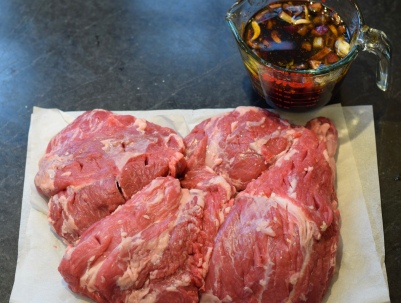
1  3 to 5-pound boned leg of lamb
¼ cup onion, diced
½ cup Major Grey’s Chutney
⅓ cup extra virgin olive oil
3 tablespoons balsamic vinegar
6 cloves garlic, smashed
1 teaspoon garlic pepper

Mise en Place:
DSC_0182

Instructions:

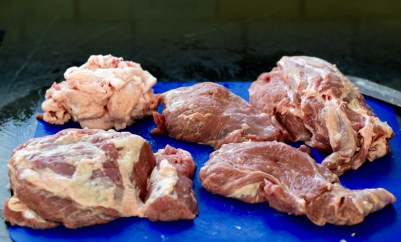
Trim fat from lamb per instructions from the previous post.
DSC_0157 DSC_0176

Pierce meat with a sharp knife to allow marinade to seep into the tough leg muscles.
DSC_0195

Mix marinade ingredients together in a small measuring cup.
DSC_0191

Put lamb and marinade in a gallon-sized plastic bag and turn bag all around until the meat is well-coated. Refrigerate for 24 hours, turning regularly.
DSC_0199

Grilling Meat

This is not my domain. My stepfather is the master griller in our family. My husband, brothers, and sons have all learned from him. Because he IS so good, wherever he goes, he gets tasked with the job of grilling.
joel

While my experienced stepfather doesn’t need a meat thermometer to know when meat is cooked, those in training might want to start with one. The key to grilling meat is to remember that food continues to cook and reabsorb juices for a good fifteen minutes after it comes off the grill. You can read about allowing meat to rest here.

Back in Nashville, my husband turned the meat many times as it cooked. When the meat thermometer read 140º in the thickest piece, he removed it from the grill, covered it with foil, and let it rest for 15 minutes before slicing. The results were amazing.
DSC_0227

For a list of recipes to make for Easter and Passover, check out this link.

For a list of fun activities to do over the Easter holiday, check out this link:

How about a bunny cake?!

LET’S STAY CONNECTED!

Follow my photos of vegetables growing, backyard chickens hanging out, and dinner preparations on Instagram at JudysChickens.

Never miss a post: sign up to become a follower of the Blog.

© 2014-2020 Judy Wright. All rights reserved. Photos and text may only be used with written consent.

Mom’s Roasted Lamb with Herb and Goat Cheese Topping

My mother had two ways of cooking lamb: roasted, over a bed of vegetables with a herb and goat cheese topping, or marinated and grilled. On Easter, we often had the roasted version because it was more complex and, therefore, more special for a holiday meal.

DSC_0830

The first time I made this recipe, on my own, I felt like such an accomplished cook as I had never made anything with so many layers of flavor. My success inspired me to experiment with new ingredients, especially with a variety of herbs and vegetables. Even today, as I taste one last spoonful of the creamy broth leftover in the bottom of the storage container that held this lamb meal, I am reminded of one of the reasons I love to cook — when it works, when what you have cooked is delicious, it is thrilling.

My mother’s cardinal rule for cooking lamb was that I had to trim off as much fat and connective tissue as possible. I never thought to ask her why. Serendipitously, as I was writing this post, my friend and fabulous cook, Lou Ann Brown, suggested I listen to a podcast from Sunday’s The Splendid Table titled “Why does lamb taste like lamb?” It was perfect timing for this post and helped me understand why Mom insisted on trimming off the fat. The quick answer to the question, according to Molly Birnbaum of America’s Test Kitchen, was “it all comes down to [lamb’s] fat and a particular type of fatty acid that lamb has that beef doesn’t have. It’s called branched-chain fatty acids, which humans can detect at tiny levels. It’s what gives lamb this gamy, and more earthy taste than beef.” If you ever needed the motivation to spend a little more time trimming fat, this is it.

There are three layers of ingredients in Mom’s recipe for roasted lamb: the bottom layer which consists of a bed of vegetables and herbs, the middle layer which is the lamb meat, and the top layer which is an herbed goat cheese topping. This top layer helps keep the meat moist while it cooks since most of the fat has been trimmed.

The first step is to prep the lamb and get it started marinating. You can do this step up to one day before. I’ll walk you through trimming the fat in the Instructions section.

Ingredients:

Lamb Marinade:

DSC_0712
1  3 to 5 pound boned leg of lamb
⅓ cup extra virgin olive oil
1 teaspoon salt
20 twists of cracked pepper

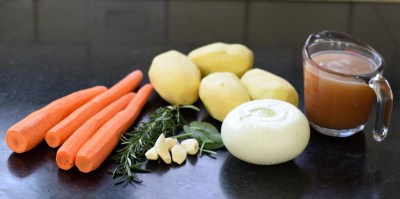
Bed of Vegetables:

DSC_0731
4 potatoes (1½ pounds), sliced
4 carrots (½ pound), sliced
6 cloves garlic (½ oz), smashed
1 medium onion (½ pound), diced
5 fresh sage leaves
1 stem fresh rosemary leaves
1 cup beef stock
salt and pepper

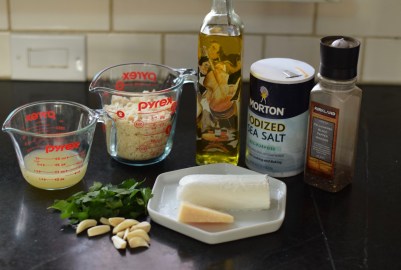
Herb and Cheese Topping:

DSC_0773
⅓ cup freshly squeezed lemon juice
1½ cup plain homemade breadcrumbs
¼ cup extra virgin olive oil
the leaves of 8 stems of parsley
6 garlic cloves (½ ounce)
5 ounces goat cheese
½  cup grated Reggiano Parmesan
½ teaspoon salt
¼ teaspoon pepper

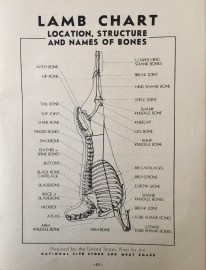
FYI: Lamb Cuts 101 (from my 1942 manual — I like the graphics):

IMG_6024 IMG_6025 IMG_6027

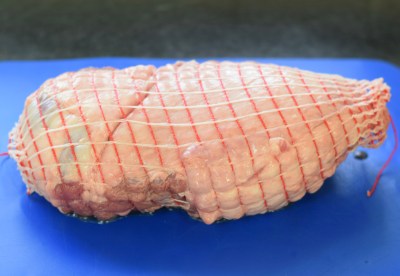
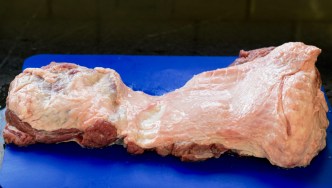
This is a 4½ pound boned leg of lamb. After trimming it of fat, it weighed 3¾ pounds. The netting is used to keep the meat together once the bone has been removed.

DSC_0703

Once you remove the netting and unroll the meat, you’ll have two sides of meat to trim of fat and connective tissue.

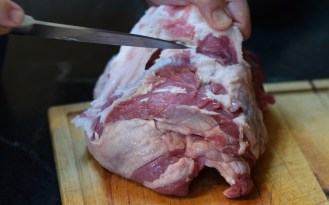
DSC_0705 DSC_0707

Trimming off fat is a little time consuming and a bit of a pain, but as I described earlier, it is necessary if you don’t want that gamy taste that tends to be a turn-off for many when it comes to eating lamb.

DSC_0166 DSC_0164

I removed 11 ounces of fat.

DSC_0714 DSC_0716

My husband trimmed a leg of lamb, too, and did a much better job!

DSC_0157 DSC_0176

How to Prepare Each Layer:

In a medium-sized bowl, mix the marinade ingredients: oil, salt, and pepper, with the lamb. Stir and make sure every chunk of meat is well-coated with oil. Set aside for an hour, or up to 24 hours.

DSC_0719

Prep the vegetables and herbs for the bottom layer and set aside.

DSC_0745

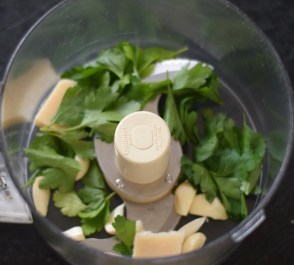
Using a food processor, prep the topping layer: first, add the garlic, Parmesan, and parsley and pulse.

DSC_0779 DSC_0782

Next, add the breadcrumbs, goat cheese, lemon juice, oil, salt, and pepper and pulse until the mixture is well blended, but still has lots of texture. Set aside.

DSC_0787 DSC_0791

Putting It All Together

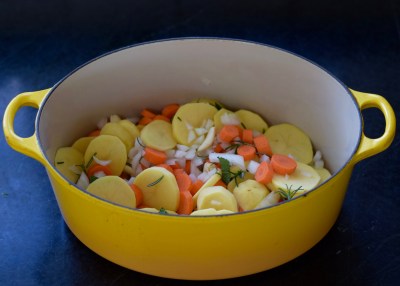
Layer 1: The bed of veggies moistened with a cup of beef broth and a few shakes of salt and pepper.

DSC_0754

Layer 2: The marinated lamb is spread out over the veggies.

DSC_0762

Layer 3: The herb and cheese topping is spread out over the meat with a spatula.

DSC_0796

Bake in a 5-quart roasting pan in a preheated 400º oven for approximately one hour and 15 minutes, or until a meat thermometer inserted into the thickest chunk of the meat reads 140º. Take the roasting pan out of the oven, cover, and let the meat rest for 20 minutes before serving. *The lamb will continue to cook to 145º (for medium).

If the topping isn’t lightly browned enough, you may want to leave the roast in the oven for five more minutes until it browns. If you are worried about overcooking the meat, put the roast under the broiler for a few minutes. One of the nice things about roasting a leg of lamb is there will automatically be some pieces of meat that will be well done, some that will be medium-well, and some that will be medium, due to the varying degrees of thickness of the meat.

DSC_0798

*If you need a little refresher course on the concept of heat transfer when cooking meats, look no further than here.

Here’s how the roast looked when served for dinner. The potatoes were amazing, per my family. The goat cheese infused broth is delicious!

DSC_0848

Related Posts for Easter Day

Fun to do with Children:
To Dye For: Making Naturally Dyed Easter Eggs
How to Tell If an Egg Is Fresh or Hard-Boiled
Test Your Sense of Smell with Jellybeans

Brunch:
50 Ways to Make a Frittata
Quiche Lorraine with Bacon and Kale
Mom’s Monkey Bread, circa 1970
Fruit and Nut Bread

Sides:
Grandma’s Italian Fried Cauliflower
Amazingly Delicious Sautéed Carrots
Cauliflower: Roasted, Blanched, and Mashed
Roasted Butternut Squash, Brussels Sprouts, and Cranberries

Desserts:
Italian Ricotta and Lemon Cookies
Strawberry Rhubarb Pie

LET’S STAY CONNECTED!

Follow my photos of vegetables growing, backyard chickens hanging out, and dinner preparations on Instagram at JudysChickens.

Never miss a post: sign up to become a follower of the Blog.

© 2014-2017 Judy Wright. All rights reserved. Photos and text may only be used with written consent.

The History of the Peanut Butter and Jelly Sandwich

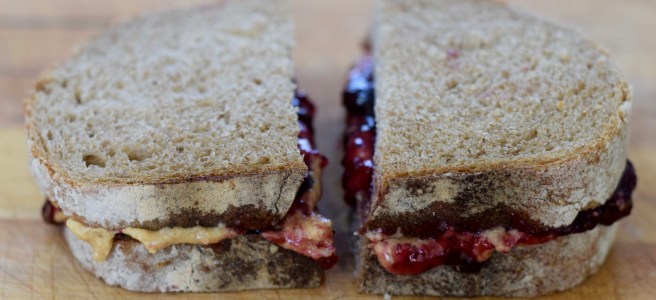
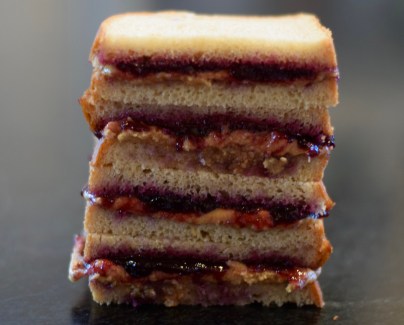
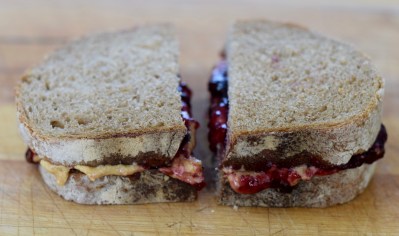
🎧Pea-nut, peanut butter, and jelly.🎧  Barney sang it, and so do the Boy Scouts. Peanut butter and jelly sandwiches are, after all, a Made in America sandwich.

DSC_0976

Growing grapes last year led to me making my first batch of grape jelly, the thought of which brought me back to my childhood, and an Internet rabbit hole of learning the history of the PB&J sandwich. Portions of this history of the PB&J sandwich were first described in another post I wrote, How to Make Grape Jelly (and grow the grapes).

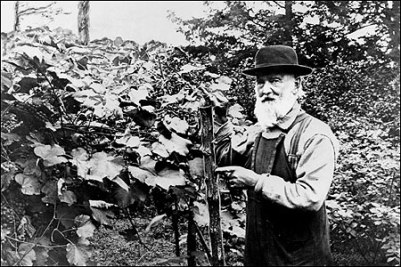
1843: Horticulturist, Ephraim Wales Bull, chose a wild grapevine that thrived in his backyard, to begin work on cultivating a purple grape that would grow well in harsh New England weather.
1114273530_1134

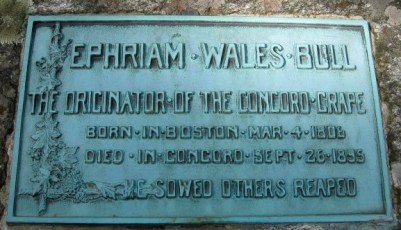
1854: After many years of research, Bull developed a cultivar he liked and named it the Concord grape after his hometown of Concord, MA. He sold his vines for $5 each and made a small fortune as Concord grapes became a popular strain. Since plant varieties were not patent-protected at the time, nurserymen were free to grow and sell their own plants made with cuttings from his original vine and Bull died a poor man. Here is a good story about it. His gravestone read: “Ephraim Wales Bull, the Originator of the Concord grape . . . He Sowed Others Reaped.”  I digress.
104288367.HIki4tCb

1869: Dentist and clergyman, Dr. Thomas Welch, sought to create a non-alcoholic communion wine for his parishioners using the newly popular Concord grape. In his home kitchen, Dr. Welch prepared a batch of grape juice, bottled it, and using the new sterilization technique developed by Louis Pasteur, he pasteur-ized it. Pasteurization killed the yeast which would have created fermentation. Welch marketed the juice as “Dr. Welch’s Unfermented Wine.”  Grape juice became popular for years to come with the ongoing Temperance Movement and later with Prohibition.
1869_expanded

1880: Dr. Ambrose Straub, another physician, who, in an attempt to get calories into his elderly patients who were unable to chew meat, started crushing peanuts into a nutritious peanut paste. Now, the Aztecs made a peanut paste hundreds of years before, but it was Straub who ran with the idea of a peanut butter product. Oh, and George Washington Carver, the famous botanist, and inventor, he was responsible for encouraging sharecroppers to grow alternative crops to cotton, such as peanuts and soybeans. Carver then went onto to invent and demonstrate hundreds of uses for peanuts to help increase demand for the product. He is considered by many to be the father of the peanut industry.

1893: Dr. Straub attended the Chicago World’s Fair to hawk his peanut paste for medicinal uses. Concurrently, Dr. Thomas Welch’s son, Dr. Charles Welch, brought his new product, Welch’s Grape Juice, to the Fair to introduce it to the masses. Thousands of people sampled these two new products. Little did Drs. Straub and Welch know that together, their products would one day lead to the most popular sandwich in America.
Poster advertising the World's Columbian Exposition

1901: Ms. Julia Davis Chandler, a writer for The Boston Cooking-School Magazine of Culinary Science and Domestic Economics, may have been the first person to introduce the peanut butter and jelly sandwich to the nation. She wrote, “For variety, some day try making little sandwiches, or bread fingers, of three very thin layers of bread and two layers of filling, one of peanut paste, whatever brand you prefer, and currant or crabapple jelly for the other. The combination is delicious, and as far as I know, original.” Imagine PB&J as an elegant tea sandwich.
bostoncookingsch19hill_1-1 image

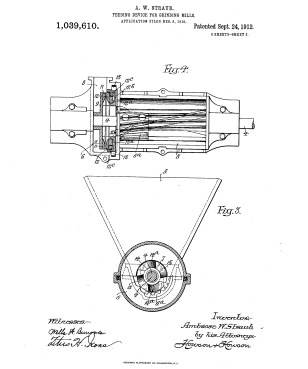
1903: Dr. Straub invented the peanut mill and took out a patent on it. He sold all commercial rights to the peanut spread to Mr. George Bayle, owner of Bayle Food Products, who became the first commercial vendor of peanut butter. Straub continued to perfect his grinding mills. Mr. Bayle took his “peanut butter” product to the St. Louis World’s Fair in 1904 and sold out in three days.
US721651-0US1039610-1-2

1918: The Welch family developed a grape jam spread and called it Grapelade. 100% of their initial production was bought by the military for WW1 soldiers’ meal rations. After the war, the soldiers, now civilians, requested more grape jam for home use and in 1923, Welch’s introduced Concord Grape Jelly to meet that increased post-war demand.

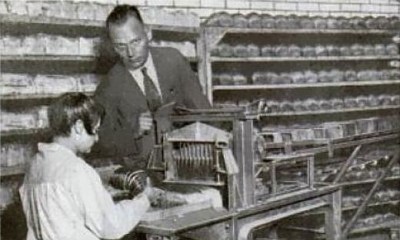
1928: “The best thing since sliced bread.” Otto Frederick Rohwedder, an engineer from Davenport, Iowa, invented the bread-slicing machine that automated the production of pre-sliced bread in commercial bakeries.
v17OQ

1930: Wonder Bread started selling the sliced bread commercially. This surely helped lead to the rise of sandwich-making in the American household.

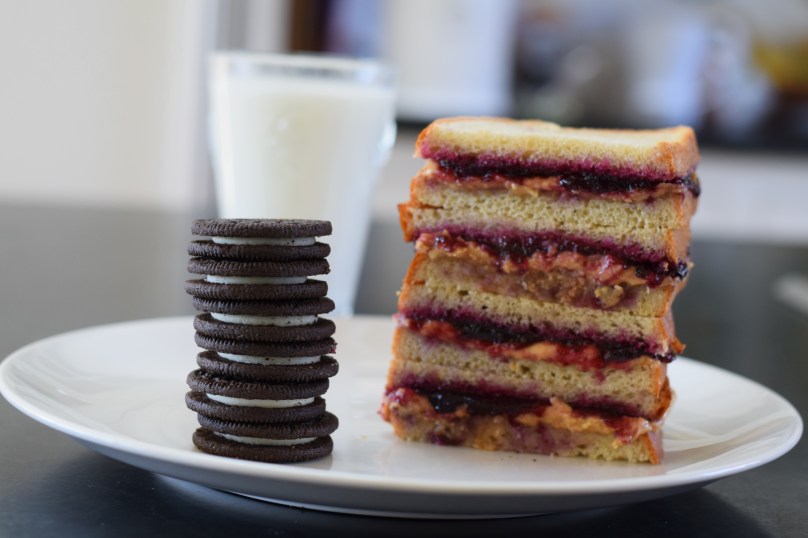
1929-1939: During The Great Depression, PB&J sandwiches were commonplace in school lunch boxes. Jelly was sweet and wet and was the perfect companion to help peanut butter not stick to the roof of the mouth. It also wouldn’t spoil unrefrigerated in a lunchbox, another bonus. More importantly,  the sandwiches were nutritious, and children liked them. With the automated production of peanut butter, jelly, and pre-sliced bread, the PB&J sandwich was on its way to becoming a very popular sandwich.
DSC_0889

1941-1945: During WW2, at least half of Welch’s production of grape juice and jelly were earmarked for the military and hospitals. Both peanut butter and jelly were part of the U.S. soldier’s meal rations. Soldiers came to rely on peanut butter and jelly sandwiches for meals in the field. Take a look at this video created by Steve1989, who reviews MRE’s and Rations on YouTube. This one on RCI (Ration, Combat, Individual) rations from the Korean War shows you what it was like to eat peanut butter and jelly while in the field.

Squirm alert: it is almost impossible to watch this video without wanting to yell at the kid and tell him not to eat that jelly!

Post War: Peanut butter and jelly sandwiches became even more popular as thousands of soldiers returned to civilian life and continued to want PB&J sandwiches.
DSC_0865

1962: I’ll close with this memorable Welch’s Grape Jelly ad featuring The Flintstones, a cartoon that was popular on Saturday mornings during the Sixties when I was growing up.

Afterschool snack for my six brothers in the Seventies. Nice memories!

DSC_0050

LET’S STAY CONNECTED!

Follow my photos of vegetables growing, backyard chickens hanging out, and dinner preparations on Instagram at JudysChickens.

Never miss a post: sign up to become a follower of the Blog.

© 2014-2017 Judy Wright. All rights reserved. Photos and text may only be used with written consent.


Family Dirt

One morning, many years ago, while my sons were still in grade school, our family was sitting around the breakfast table, and the conversation went something like this:

One son makes a comment about periods, of the female kind. His brother responds by saying, “You shouldn’t talk about periods when you don’t know what they are. Uh, what are they, Dad?”

My husband, who is historically quick with a good analogy, said, “You know how your mom gets her garden ready to plant every spring? She weeds the beds, turns the soil, and smooths out the dirt. She does all this to get the beds ready to plant seeds. A woman’s body is like a garden. Every month, it prepares a lining in the womb for a seed to get planted. Depending on whether or not the seed is fertilized, the womb either keeps the lining or lets it go. When it goes away, that’s when the woman gets her period.”

Wow. That was beautiful.

Two weeks later, I was driving the afternoon lacrosse carpool of 7th-graders when something was said about sex in the way-back of the Suburban. Sex? My ears perked up. That’s when I heard my son say,  “All I can say, is don’t ask my Dad about sex; I asked him about periods, and he started talking about gardening.”

I think about that sweet conversation with longing and a smile that runs deep when I approach my scruffy garden every spring after a long winter’s absence. What to do first? When you raise vegetables, the first chore is to start getting your garden ready so you can get your peas in the ground around the first of March. How do farmers pick March 1 as the planting date? One method is to count back six weeks from the last average frost date which for our region is April 15th. Or, we can go by nature’s signals: when daffodils are in full bloom, plant potatoes, and when the forsythia starts to bloom, plant peas.

I knew the clean-up job would be more fun with company … My husband is a problem solver extraordinaire. My kids will tell you they grew up in a household where their Dad’s motto was, “Be a problem solver, not a problem identifier.” I grew up in a household with many problem identifiers, so ours was a perfect union. If I am manipulative in any way, it’s in the way I’ve learned to present projects to my husband as problems to be solved. I know I’ve succeeded when I see him pull out one of his pre-cut sections of an index card from his wallet. These homemade notecards are where he writes his to-do list. Once he starts making a list on these cards, I know the project is as good as done.

Here’s his list (the words in parentheses are mine):
Ethanol-free gas from Billy’s Corner (for tiller and pressure washer)
New spading fork (to turn leaves in beds)
Grass seed and straw (bare spots in yard)
8-inch galvanized spike nails (to remediate chicken problem)

Here’s mine: pea seeds, plants for front flower pots

Here is a picture of my husband installing spike nails into the railing of the vegetable garden fence. This is his solution to finding a way to keep our chickens out of the garden. He is using strands of fishing line, strung between tall nails, to work as an added “invisible” fence. The idea is to keep the chickens from flying up onto the railing, using it as a landing platform, and then hopping down into the garden. In the chickens’ defense –and the chickens must be defended — it is not their fault they don’t know the difference between a vegetable garden and a compost pile. Unfortunately, it only takes five minutes for six chickens to trash a garden.
IMG_5599

Kitty was not happy with the chicken remediation project. She now has to slither along under the fishing line fence to get to where she is going, which let’s face it, is nowhere in particular. I consider that a very small price to pay to keep the chickens out of the garden. My friend, Kim Matthews, a massage therapist, says it probably feels good on her back, so no worries there.
IMG_5606 IMG_5611

Good Dirt

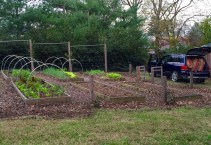
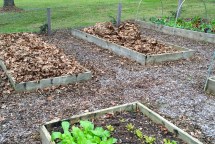
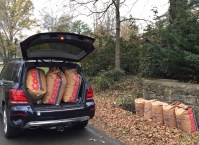
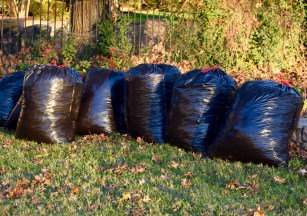
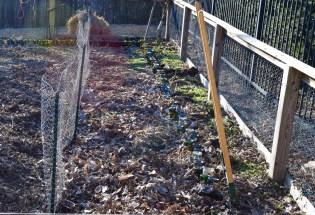
Much of what I did to get my soil ready “to plant the seed” occurred last fall when I mulched the beds with leaves. I typically pick up bags of leaves from the homes of friends. You can see from the middle photo that the back garden was still very productive on November 16th when I spread the leaf mulch. In the beds where greens were still growing, I tucked leaf mulch in between the plants and those crops lasted all the way to New Year’s Day when I harvested them for “prosperity”.
IMG_3971 IMG_3976 IMG_3977

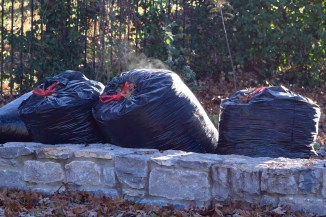
I got these bags of leaves from my next door neighbor. You can see steam coming off the bags just three weeks later indicating they already had started composting in the bag.
DSC_0314 DSC_0099

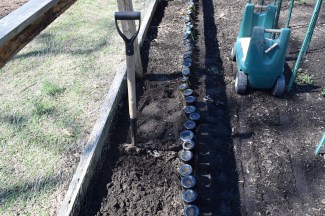
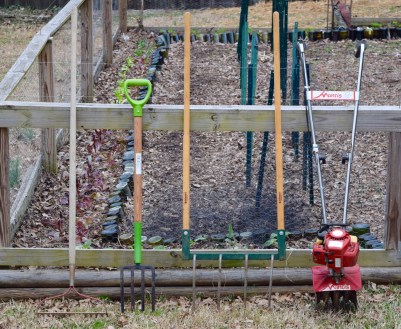
I worked the leaves into the beds using a broadfork and a spading fork.
DSC_0099 

I use these tools instead of a tiller on established beds because I’m trying not to disturb the wormhole tunnels and root tracks left by old, pulled plants. These tunnels are nature’s way of building pathways into the soil that new roots in the future will follow as they grow. Remember, the looser the soil, the more extensive the root formation, and the more productive the plants will be.

Tools for loosening, turning, and leveling dirt: (left to right) Bow Leveling Rake,  Spading Fork, Johnny’s Broadfork, Mantis Mini-Tiller and Cultivator
DSC_0408

I use our mini-tiller to mix up the compost pile which is filled with dirt, vegetable scraps, egg shells, coffee grinds, chicken manure, shredded paper, and leaves. The compost pile is one of the few places I still use a tiller and welcome the chickens and their chicken-scratching ways.
DSC_0273

In the Master Gardeners of Davidson County program, we learned that dirt is made up of the following components: 50% water and air, 48.5% mineral matter (sand, clay) 1% organic matter (plant residue) and .5% living organisms (worms, fungi). If you think of dirt in terms of its components, it helps you to figure out what you need to do to amend your soil. You need microbes and organic matter in your soil to break down organic matter, and the microbes need water and air to do their job of enriching the growing medium for your plants.

Necessary Minerals in Soil:
Nitrogen is good for vegetative growth; it’s what make leaves turn green.
Phosphorous helps create new root growth and blooms. Blooms lead to seeds.
Potassium is good for stem and stalk strength, vigor and disease resistance.
Calcium is good for root formation.
Magnesium helps with the uptake of other elements.
Sulfur helps with protein formation and dark green color of plants.

Soil pH. The pH stands for potential Hydrogen:
Soil pH refers to the amount of hydrogen ions or acidity in the soil. As acid levels (Hydrogen ions) increase, soil pH decreases.The pH scale ranges from 0-14. Seven is neutral, <7 is acidic, >7 is alkaline. The average pH for Davidson County soil is 6.2, so our soil is on the acidic side, which is great if you are growing vegetables which prefer an acidic soil of 6 to 6.5. To increase the soil ph, you add lime. To decrease soil ph, you add sulfur. Plants need the pH to be correct so osmosis can occur at the cellular level allowing nutrients to travel from water into the plant.

Old Dirt

When my husband and I first got married, we lived in a third-floor walk-up on the top of Beacon Hill in Boston. We grew herbs in window boxes and tomatoes in buckets on the roof of the bow window of the unit below ours.  I’m sure when famed architect, Gridley J.F. Bryant designed our building in 1846, he did not intend for future residents to do this. God love our neighbor and building manager, Curtis Phelps for not putting the nix on our newlywed exuberance for gardening.
KellyGardeningPinckneyBoston judy pinckney garden boston

When we bought our first home in Nashville, we built a garden, using a reclaimed fence from our neighbors, the Bartholomews, and bricks for a pathway from our neighbors, the Robinsons. The chicken manure for the garden came from our friends, the Hudson’s chicken farm.
firstvegtablegardensneed firstvegtablegardensneed

New Dirt

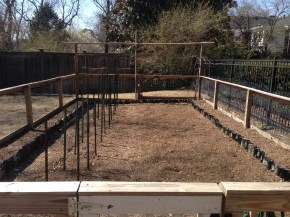
My garden beds are now ready to receive seeds and seedlings. The hardest work is done, and now it is time for the fun part: planting.
IMG_2105 DSC_0450
DSC_0404 DSC_0392

I think Gridley J.F. Bryant, having designed the overall grid-based street plan of Back Bay in Boston, would have at least approved of the orderliness of my vegetable gardens, if not the placement of tomato plants on his bow windows. As for my boys, now men, they’ve learned their Dad knows what he’s talking about and he’s their first text when they need advice. I, on the other hand, am the first person people call for family dirt.

Other Kitchen Garden Stories
Eulogy for a Chicken
Herb Porch Pots!
Spring Planting Guide for Your Kitchen Garden
Fall Planting Guide for Your Kitchen Garden
WWMD? A Bucket of Spring Veggies as a Centerpiece

LET’S STAY CONNECTED!

Follow my photos of vegetables growing, backyard chickens hanging out, and dinner preparations on Instagram at JudysChickens.

Never miss a post: sign up to become a follower of the Blog.

© 2014-2017 Judy Wright. All rights reserved. Photos and text may only be used with written consent.