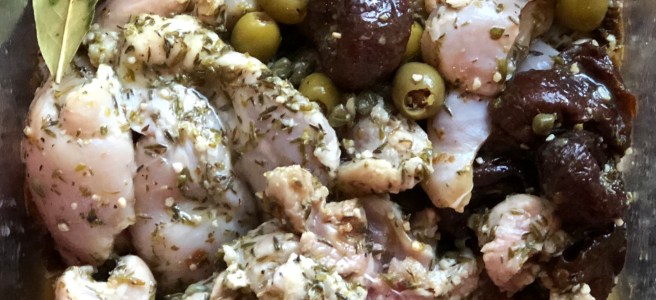
Simplified Chicken Marbella

For many a new bride in the Eighties, recipes from The Silver Palate Cookbook were among the most exotic we had ever prepared.

Chicken Marbella, the memorable entrée that called for chicken marinated for 24 hours with flavor-packed ingredients like oregano, bay leaves, capers, olives, and prunes, was the most exotic of all. It could feed a crowd, be cooked in advance, served hot, warm, or cold, and looked beautiful arranged on a platter. It was the perfect company dish.
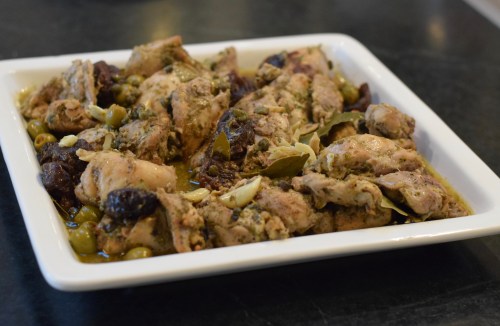
With all this high praise, it may seem blasphemous to write that I have tweaked this recipe. Times have changed in thirty-five years. People are keener about decreasing sugar intake. Thus I have omitted the cup of brown sugar. There are more options for buying specific cuts of chicken with bones in or out, skin on or off. I now use skinless chicken thighs instead of quartering a fryer. Nowadays, there is less time for food prep and shortcuts are championed, so I marinate the meat for four hours instead of twenty-four, and sometimes I don’t marinate it at all! This marinade is so savory, I cook the chicken in it using a Dutch oven instead of roasting the meat in a shallow baking pan.

Yes, I’ve messed with this recipe, but hopefully, I’ve simplified the process so people might start enjoying this delicious entrée more often instead of saving it for company.

Yield: 8-10 chicken thighs

The Marinade

In this recipe, the marinade is the star. In fact, once lined up for a photo, I had the urge to say, Ingredients, take a bow as if they were all part of an orchestra. I give thanks to cookbook authors, Julee Rosso and Shelia Lukins, who were revolutionary when it came to bringing uncommon flavors together.

Ingredients
I head of garlic, cloves smashed, peeled and then chopped
6-7 fragrant bay leaves (buy new ones if they don’t smell woodsy)
½ teaspoon black pepper
¼ cup dried oregano (¾ cup, if using fresh)
1 teaspoon sea salt
½ cup capers, drained (3½ ounces)
1½ cups dried prunes
½ cup green olives, drained (about 3½ ounces)
1 cup white wine
¼ cup extra virgin olive oil
¼ cup red wine vinegar
5 pounds chicken thighs, bone-in or boneless, skin and visible fat removed

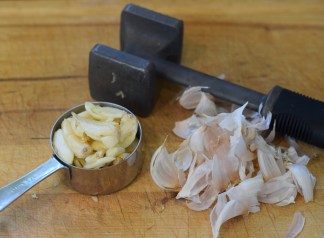
Cooking Tip: Prepping Garlic Cloves
An easy way to prep garlic cloves is to put them in a bag, smash them with a meat mallet, and remove the skins. Rough chop afterward.

 

Instructions
Add all of the ingredients into an oven-proof pot. I use a Dutch oven such as this one from Les Creuset.
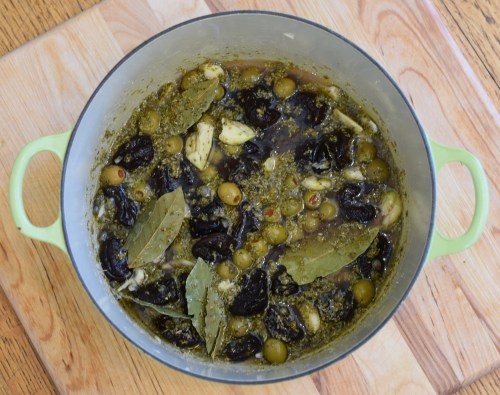
Add chicken, stir until chicken pieces are well-coated with marinade. Cover and put in the refrigerator for up to 30 hours tossing occasionally. About an hour before you plan to cook the chicken, remove from fridge and allow to come to room temperature.

Preheat oven to 350º.

Cook for 45 minutes for boneless chicken or an hour for bone-in. About halfway through the cooking time, open the oven and stir the chicken to evenly coat it with juices and marinade. Remove from oven and let rest until time to serve.
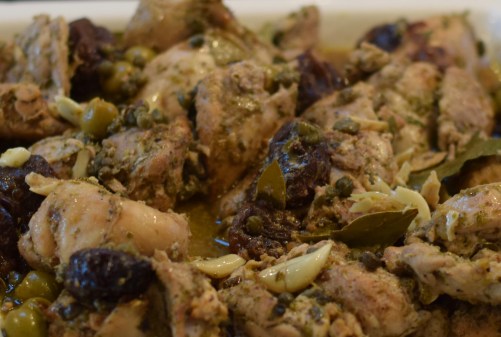
I was all set to post my recipe with the modifications when my husband said, “The only thing that could make this recipe better would be to use boneless, skinless thighs.” Arghh! Seasoned cooks know how much flavor bones bring to a broth. I was reticent but curious, so I made two versions for dinner one night, one with bones in and one with bones out. I invited family over for dinner and had them try both versions.
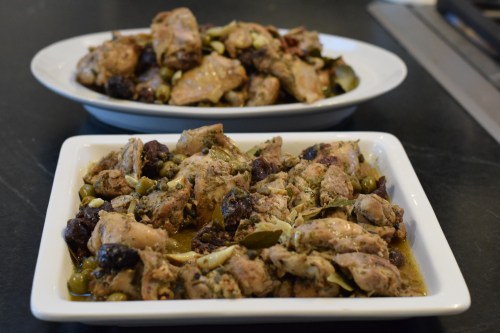
The verdict was tied until early the next morning when I received this vote, in a text, from my friend, Corabel Shofner, who was already back on tour for her fabulous YA (young adult) novel, Almost Paradise.

Bone-in won by one vote. Know that when serving this dish to a crowd, when people are not seated at a table, it’s easier to eat boneless chicken than bone-in.

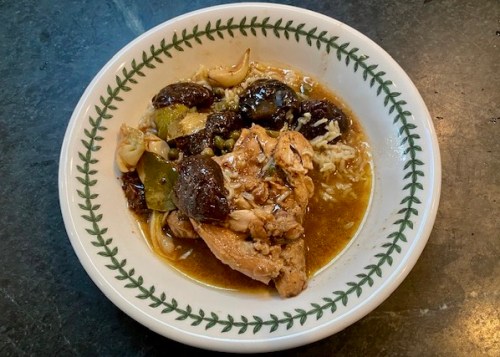
Dinner was served: Simplified Chicken Marbella over brown rice.
Other Fabulous Dinner Entrées
Yummy Shepherd’s Pie
Judy’s Mom’s Meatloaf
Easy Roasted Salmon with Olive Oil and Garlic Pepper
Brooks’s Pork Tenderloin with the Most Amazing Marinade
Pot Roast with Herbs and Root Vegetables
Rachelle’s Italian Sausage, Onions, and Peppers

Don’t miss a recipe! Become a subscriber and have every post delivered to your Inbox.

Follow Judy’s Chickens on Instagram and Pinterest @JudysChickens.

Remember to always check this website for updated versions of a recipe.  

© 2014-2020 Judy Wright. All rights reserved. Photos, videos, and text may only be reproduced with the written consent of Judy Wright.

Morning Rounds in the Garden, April

My favorite time of day is when dawn breaks. It doesn’t matter the season or the place, the beginning of a new day holds the promise of a cup of coffee, a new way of looking at the natural world depending on the morning light, and during the growing season, an opportunity to inspect my vegetable plants for new growth.

This morning, I thought I’d take you on a walkabout of the different garden beds in my backyard.

The Lower Garden

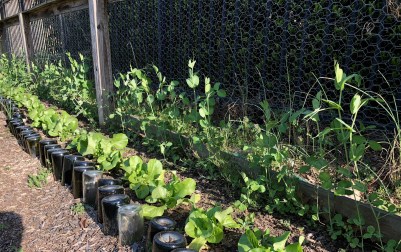
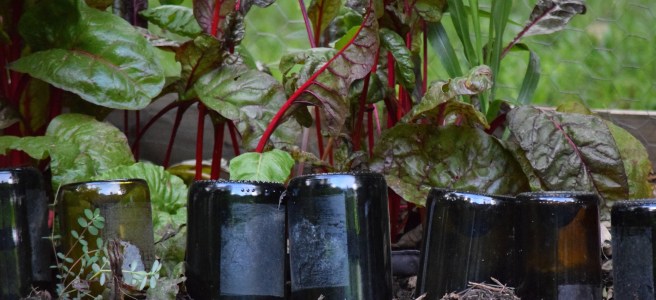
In the spring, planted within a wine bottle necklace (that creates a border between planting spaces and garden paths) are cold-hardy vegetables like peas, lettuces, spinach, radishes, chard, turnips, grapevines along the back fence.

There are six raised beds that are reserved for this Italian cook’s favorite vegetables: tomatoes, eggplants, peppers, and zucchini. These plants will go in the ground in mid-April or early May depending on when the ground warms up.

The raised beds were built by Nashville Foodscapes last spring. They have made a huge difference in the amount of time I spend on garden maintenance because 1) the soil in the beds no longer gets compacted from being walked on and thus there is now no reason to till, and 2) the thick woodchip pathways keep the weeds down to a minimum.

The Back Garden 

This garden has six raised beds in the interior. It is enclosed by a four-foot “rabbit” fence that is laced with blackberry branches on three sides and two espaliered pear trees on the tall side.

There are six raised beds. Four beds are planted with herbs and spring crops, and two are not yet planted. I have left them open to plant commercial crops such as cotton, tobacco, peanuts, sorghum, indigo, and rice. I plant these for the children who come by to visit the chickens.

Here are photos of what is growing in the four beds this morning.

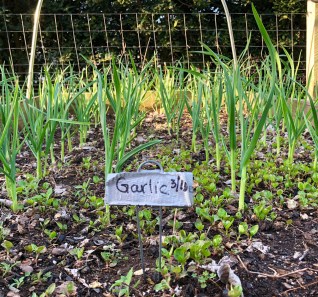
Herbs and Garlic
 

Spring Onions

Beets, Radishes, and Carrots
 

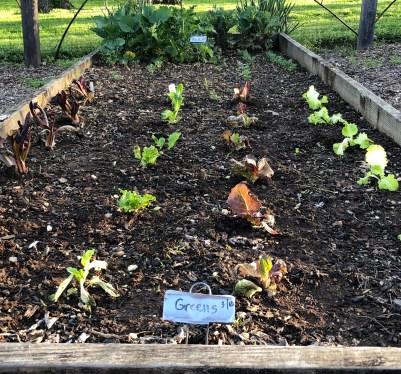
Salad Greens and Kale

Rain Garden
This is where water run-off from an underground 12-inch drainage pipe empties. I’ve planted it with blueberry bushes and native flowers to attract bees. You can see the crabapple trees in the background.

Berry Garden
This bed was created to help control water run-off. Growing in it are cherry bushes, currants, raspberries, and an apricot tree.

Fruit Trees
On the southern wall of our house, we have a fig tree. It is watered by the condensate that drips from an air-conditioner. Around the perimeter of the backyard, we have a muscadine vine, a plum tree, four apple trees, one mulberry tree, and two crabapple trees.

Three years ago the two crabapple trees had apple limbs grafted on to them by a technique known as bark-grafting. We know which limbs are the apple grafts because they haven’t leafed out yet. Apple trees are about a month behind crabapple trees.

Chicken Coop
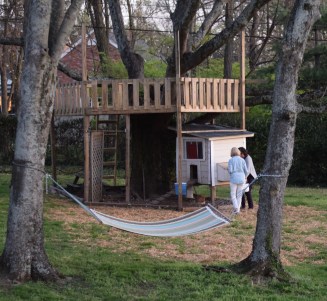
We’ve been keeping six chickens in our backyard coop for six years. We do it for the eggs and for the simple joy of watching the chickens strut around our fenced-in backyard.


Herb Porch Pots
For the last three years, I’ve been planting two planters on my front porch with herbs and edible flowers. I do it because they are beautiful to look at and because they are convenient to snip from when cooking. I plant them every February. When they start to look scraggly in late June, I transplant the plants to the herb garden.

Compost Corner
Every morning, I empty the compost bucket from the previous day’s kitchen scraps into the compost heap behind the white fence. There is a mulberry tree planted in the compost to hide the chickens from the hawks who circle overhead. The chickens spend a good deal of their day in the compost pile.

You can follow the progress of these gardens on Instagram @judyschickens.

Related Gardening Posts
Spring Planting Guide for Your Kitchen Garden
Family Dirt
Herb Porch Pots!
Eulogy for a Chicken
WWMD? A Bucket of Spring Veggies as a Centerpiece
How to Make Crab Apple Jelly (and grow the crab apples)
How to Make Grape Jelly (and grow the grapes)

Don’t miss a recipe! Become a subscriber and have every post delivered to your Inbox.

Follow Judy’s Chickens on Instagram and Pinterest @JudysChickens.

Remember to always check this website for updated versions of a recipe.  

© 2014-2018 Judy Wright. All rights reserved. Photos, videos, and text may only be reproduced with the written consent of Judy Wright.
Old-Timey Vanilla Bunny Cake

My mother made this bunny-shaped cake for us in the Sixties. I made it for my kids in the Nineties. Now, twenty-five years later, I am happily making it for my grandson. I love the architecture involved in creating the bunny shape out of two round cake pans as much as I love the simplicity in the flavor of a vanilla cake.

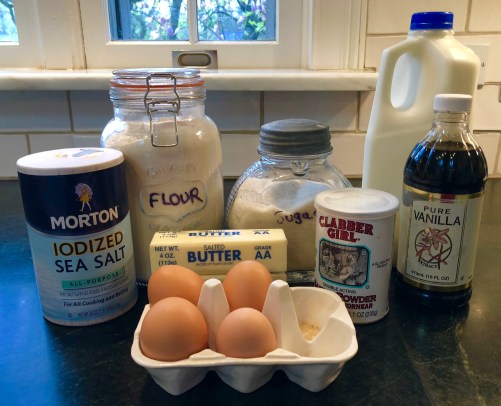
Cake Ingredients

2¼ cups all-purpose unbleached flour
1½ cups sugar
½ teaspoon salt
2 teaspoons baking powder
1 cup (2 sticks) butter, cut into half-inch slices, at room temperature
4 large eggs
½ cup milk (whole or 2%)
1 tablespoon vanilla extract

Instructions
Preheat oven to 350º.
Grease and flour two 8-inch round cake pans.

Place the flour, sugar, salt, and baking powder in a large bowl and mix on slow speed until well blended.

Add the slices of butter and blend on medium speed until the mixture resembles pea-sized crumbles.

In another bowl, mix together the eggs, milk, and vanilla with a fork until well blended.

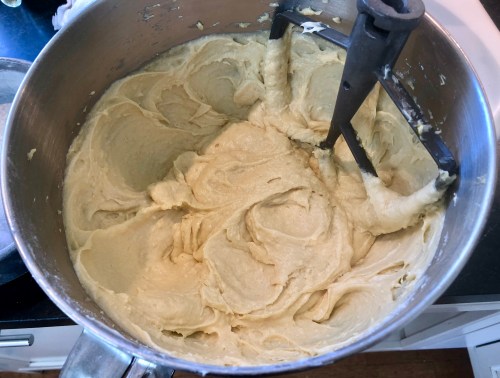
Pour the wet ingredients into the butter and flour mixture and beat on slow speed for one minute. Scrape down the sides of the bowl with a spatula. Beat the batter on medium speed for one minute until smooth and fluffy.

Pour batter into prepared cake pans. Bake for about 25 minutes on the middle oven rack. When done, the cakes should be golden in color and a knife poked into the center should come out clean.

Remove cake pans from the oven. Let cool on a wire rack for ten minutes. To easily release the cakes from their pans, use a knife to loosen the edges and then flip the pans onto a rack. The cakes must be completely cooled before frosting.

Cream Cheese Frosting Ingredients
DSC_0124

1  8-ounce bar cream cheese, softened
½ cup  (1 stick) butter, softened
1  teaspoon pure vanilla extract
3¾ cups (1 pound box) confectioners’ sugar
2-3 tablespoons whole milk

Instructions
Beat butter and cream cheese together in a large bowl on medium-high speed until smooth and creamy. Add powdered sugar and start beating on slow speed until the sugar is incorporated into the mixture to keep powdered sugar from spraying all over the room. Beat frosting until smooth and creamy.

frosting Red velvet cake

Add vanilla and beat for 15 seconds more. Add milk as needed to help fluff up the frosting.

frosting Red velvet cake
To Assemble Bunny Cake
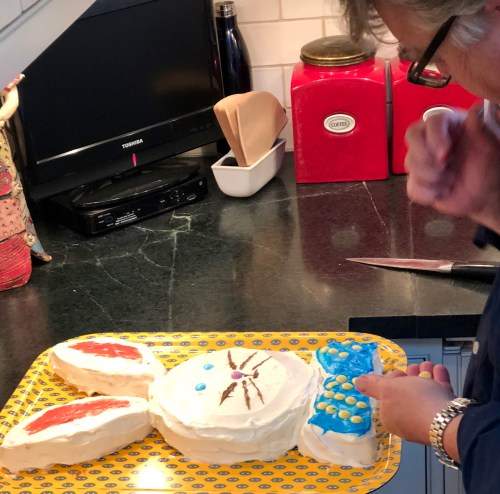
Cut one of the cake layers as shown.
Arrange cakes as shown below. Place parchment paper strips under the cake’s edges. Ice the cake and then remove the strips. Decorate with M&M’s.
My husband got into decorating the cake. I had to pull him off the job when he talked about applying eyebrows.

Meanwhile, a few miles away at my Goddaughter Leigh’s house, my dear friend Becky was busy making an Easter Bunny Cake for her three-week-old granddaughter. She sent me a photo.

The Barton/Meadors family made this beautiful bunny.

My friend Janet Davies sent a photo of her coconut-covered bunny cake. Here is her method of icing the cake: Cut each cake layer in half horizontally. Poke holes in the layers with a toothpick. Pour a mixture of 12 ounces frozen coconut, 1 pound powdered sugar, and 1 cup sour cream over the layers and allow to soak in.  Add flakey coconut to the top. The sour cream gives it a tangy touch.  Sometimes she takes off the crusty of the cake to make sure the runny icing gets inside the cake.

Here’s another cute one sent to me by mom’s cousin, Jean Maroney. Her daughter-in-law, Alena, made it.

My niece made this one.

Please share your creation on Instagram with the hashtag #judyschickensbunnycake

If you are celebrating Easter, Happy Easter!

Related Posts for Easter Day

Fun to do with Children:
To Dye For: Making Naturally Dyed Easter Eggs
How to Tell If an Egg Is Fresh or Hard-Boiled
Test Your Sense of Smell with Jellybeans

Brunch:
50 Ways to Make a Frittata
Quiche Lorraine with Bacon and Kale
Mom’s Monkey Bread, circa 1970
The Biscuit King

Desserts:
Italian Ricotta and Lemon Cookies
Italian Sesame Seed Cookies

If you enjoyed this post, please become a subscriber! Be sure to confirm the subscription on the follow-up letter sent to your email address.

Follow Judy’s Chickens on Instagram and Pinterest @JudysChickens.

© 2014-2019 Judy Wright. All rights reserved. Photos, videos, and text may only be reproduced with the written consent of Judy Wright.

Shopping for a Saree in South India

The day before my son’s Hindu wedding ceremony, his then fiancé’s aunt came up to me at the bridal luncheon and with a gentle and engaging voice said, “I am Uma. I will be your dresser tomorrow. May I come to your room at 2:00?”

Wow! Somebody was going to dress me? How nice.

Twenty-four hours later, Uma arrived and helped me put on my saree, a gift from the bride’s family. Soon after, I went outside and joined my son for the Barat. I was beaming; I felt like a princess. A saree will do that to a woman.

The Barat is the traditional Hindu and Sikh welcome procession of the groom’s family to the bride’s family, representative of a time when the groom’s village traveled to the bride’s for wedding festivities. In our case, the Barat took place in the streets of downtown Nashville. It wouldn’t have looked nearly as vibrant without the sparkle of the women’s sarees.

Shopping for a Saree

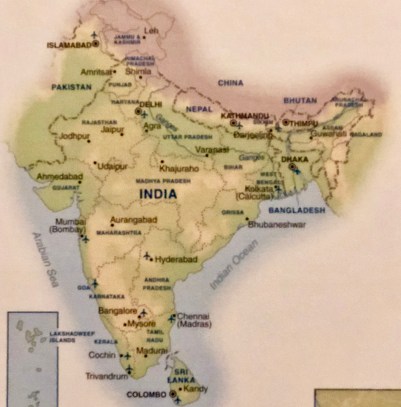
Last month, my husband and I traveled to India to tour the sites. Afterward, we flew to Hyderabad, the “City of Pearls” in Southern India, to see our daughter-in-law and her lovely extended family.

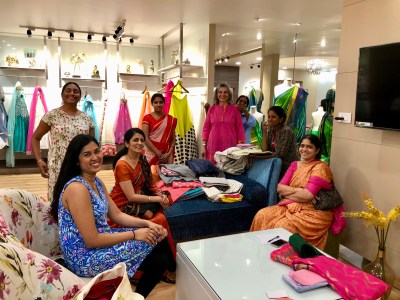
While there, we attended several celebrations. Parties sometimes mean opportunities for shopping. Although I didn’t think I needed anything when I arrived, after one-afternoon spent shopping for sarees, I was asking when we could go back to the shops! Part of the draw was all the colorful clothes made of fabrics that beckoned to be touched, but equally wonderful was simply being in the company of women who, along with giving me fashion advice, made me feel cherished. I don’t think I will ever forget this cheerful moment in Moksha Couture, a woman’s dress shop in Hyderabad.

What is a Saree?

A saree (or sari) is a traditional two-piece garment worn by women in India. It consists of one long decorative length of fabric in silk, cotton, or chiffon, and a coordinating blouse.

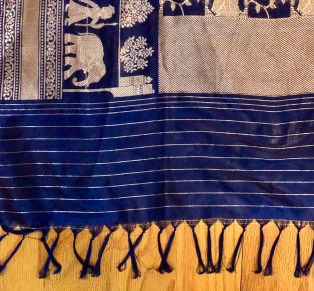
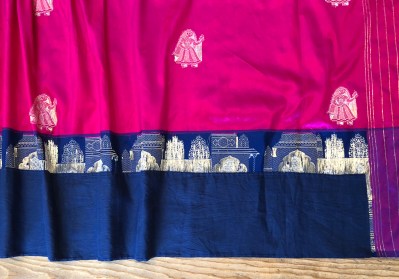
I laid my six-yard-long saree on the floor so you could see that one end of it is more decorative than the other. The decorative end is called the pallu and is the portion of the saree that will be draped over a woman’s shoulder where the design can be seen. The less decorated end is the part that wraps around a woman’s waist and covers her legs.

Notice the sensational pallus on the mannequins at Mandira chic saree shop in Hyderabad. What was once six flat yards of fabric has been transformed into a striking outfit when wrapped around the female shape. That is the beauty of the saree –it is versatile enough to suit any occasion and flaunt any figure.

Buying a Saree in South India

How a saree is draped varies geographically in India. In North India, for example, the pallu may be draped so you see more of it from the back side of a woman. In South India, the pallu is draped more commonly in the front, as seen in this post.

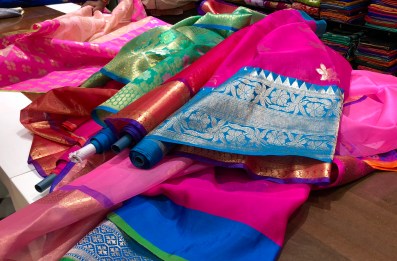
The first store we visited was Mandir. Their saree collection is pure eye candy. They have a saree for every occasion.

To a novice, a saree is a saree, but I quickly learned there are everyday sarees, party sarees, and wedding sarees. To my untrained eye, it seemed the party sarees had more silver or gold threads woven into them compared to the “everyday” sarees people wore in the home.

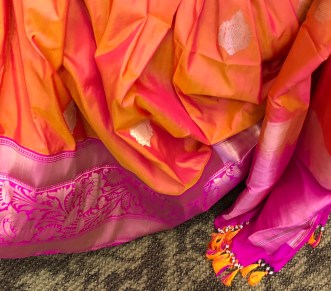
A wedding saree is full of sparkly gorgeousness.

Designing the Blouse

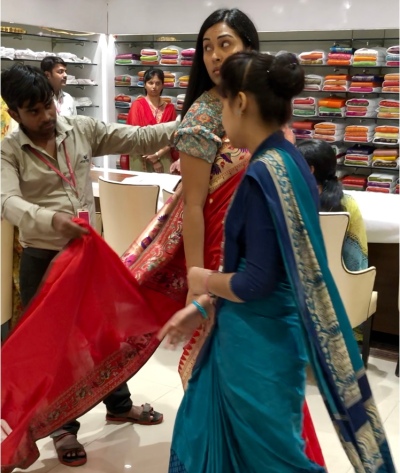
Woven into the pallu end of a saree is an extra yard of coordinating fabric that is left there to make the matching blouse. Note the solid red fabric the employee is holding.

The blouse is made by a dressmaker, so our next stop after purchasing our sarees was to go to Studio AJ.

Avani is the talented owner and designer at Studio AJ. She meets with her clients and discusses blouse design and how they would like the cut-off end of the pallu to be finished.

The cut edge needs to be finished to keep it from fraying. The threads are typically tied into knots, but can also be embellished with beads.


Additionally, a “fall” is often sewn onto the hem. A fall is a stiff strip of cotton fabric sewn onto a 2½-yard portion of the saree’s hem, on the wrong side, to give the pleats a better-looking drape.

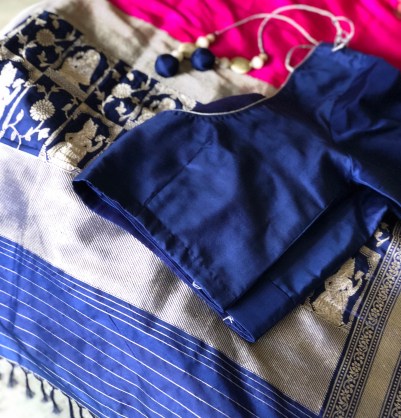
The Blouse. Our blouses buttoned in the front. The back side of the blouse is low-cut which looks very elegant. There are also ties on the back with pretty tassels that dangle as the woman walks. At Studio AJ the tassels are fabricated in the shop and can be quite decorative.

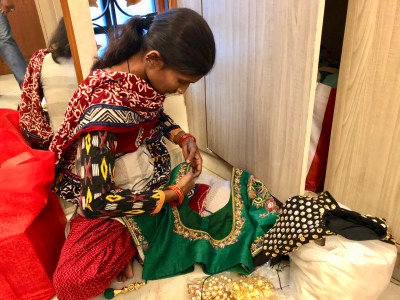
Blouses can be finished simply or elaborately as shown in the photo below where a seamstress is sewing on a golden decorative applique around the neckline.

Here is a photo two finished blouses. Notice the pretty tassels. They are made by covering styrofoam balls with matching fabric from the blouse.

When making blouses for weddings, the finishing requires a lot more handwork. In the photo below, the blouse fabric is stretched onto a frame to keep it taut while a finisher embellishes it with beads.

This blouse is being finished with pearls and beads in the Moghul style.

How to Put on a Saree

Step one is to put on a long petticoat that has a drawstring. The drawstring needs to be tied tightly as it is what holds up the “skirt” portion of the saree when it is wrapped around the waist. Sarees are usually 4 to 5 feet wide. The length of the “skirt” is adjusted by tucking the excess fabric into the petticoat’s waistband.

Here is a video of how a saree is wrapped and draped by a dresser at Mandir. The dresser arranged the center front pleats and pinched them together with a bulldog clip before she started dressing my beautiful daughter-in-law.

With each saree you try on in a store, the dresser puts it on for you. They usually take the extra fabric I mentioned (that is there for the blouse) and tuck it over your bare shoulder so you can see what the outfit will look like once the blouse is made.

Once you choose a saree and have the blouse, all that is left to figure out is what “ornaments” (aka, jewelry) you will wear with your saree. I am thankful to family members, Sadhana and Satish, for making sure I was well ornamented.

On the last night of our trip, we attended a party where the women all wore sarees. Even my husband got in on the shopping fun and wore the shirt he had made at The Gandhi Cottage Textile Factory while we were touring in Jaipur. Pictured with us are two of the many family members we came to know and love on our trip. If you are a follower of the blog, you may recognize Satish as the person who gave us a tour of his farm earlier in the day. As they say in America, “He sure cleans up well!”

This was the last photo we took in India before heading back home to America.

Related Posts:
Cooking 35,000 Meals a Day in a Sikh Kitchen in Delhi (India, Part 1)
Learning How to Block Print in a Factory in Jaipur (India, Part 2)
A Stepwell, Parcheesi, Brick-Making, and Chapati-Making (India, Part 3)
Room with a View: the Taj Mahal in Agra (India, Part 4)
A Cook’s Tour of a Farm in Southern India (India, Part 5)

If you enjoyed this post, please become a subscriber! Be sure to confirm the subscription on the follow-up letter sent to your email address.

Follow Judy’s Chickens on Instagram and Pinterest @JudysChickens.

© 2014-2018 Judy Wright. All rights reserved. Photos, videos, and text may only be reproduced with the written consent of Judy Wright.