A Biography Tour with My Mom in Rochester, NY: A Remembrance

A few weeks ago, I went home to Rhode Island for a quick overnight visit. My husband and I had a great meal with my brothers, their families, and my stepfather. We prepared the meal together. While I sat at the table, I thought, This is great, Mom may not be here, but the family still has it; we know how to get a meal on the table. Life goes on. Someone sets the table, someone clears it, my brothers crack jokes the way they always have, and the dog sniffs around under the table looking for handouts. Both Mom’s presence and absence were felt. Her legacy of bringing the family together around the dinner table remained.

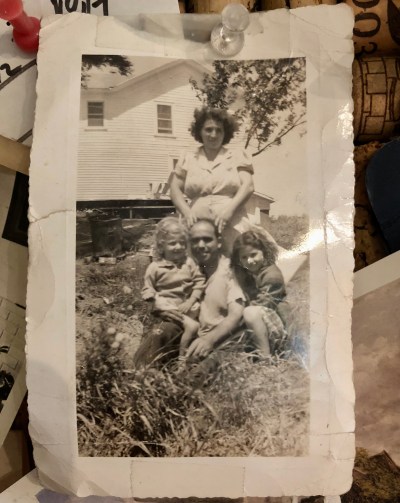
That brings me to this photo from our childhood when we lived in Bay View, in South Dartmouth, Massachusetts. My mother, a single, working woman, always got a hot meal on the table for dinner and looked good doing it.

The photo has lingered on my desktop for months for reasons unknown to me. Yesterday, it hit me. With the third anniversary of my mother’s death looming, this photo reminded me of my mother when she was Towanda-Mom. Thirty-two, divorced, beautiful, and working full-time while raising five children. She was full of spunk and life and had boundless love and compassion for others. She always tried to live her best life. She died three years ago yesterday. This photo reminded me of that inner strength and beauty and dogged insistence on sitting around the table for meals.

Mom and I and Our Excellent Adventure: a Remembrance 

In the summer of 2007, Mom and I received an invitation to a party for my Great-Aunt Mary’s 90th birthday in Rochester, New York. Rochester is where my Sicilian grandparents settled, met, married, and started their family amongst many other immigrant families from Valquarnera Caropepe, a mountaintop village in Sicily. This is a postcard my grandmother had of Valguarnera from the Fifties.

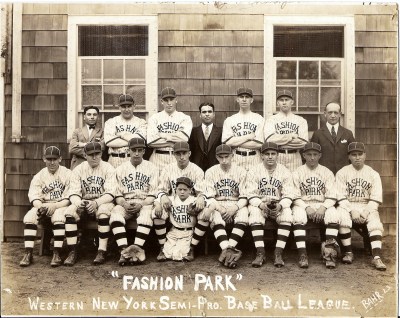
I had heard stories about Rochester throughout my childhood and into adulthood, but I had never visited the city. I have many recipes with Rochester relatives’ names on them like Margaret’s Italian Cookies, Aunt Mary’s Zucchini Casserole, and Aunt Rose’s Cookies. I can recall references to my mother’s former home addresses with comments that began with when we lived on Clifton Road, on Lake Avenue, or on Sodus Bay on Lake Ontario. I remembered stories my immigrant grandfather told us about the factories where he worked, notably Fashion Park and Bond Clothes, where he rose to be general manager of the plant and their baseball team. He loved baseball and was a scout for the Yankees. I wanted to see it all, these oft-described places and people whose names I knew by heart.
I called my mother and told her we should go to Rochester; I’d help her get there. I made the airline arrangements and reserved a car. Mom’s cousin, Mary Lou, invited us to stay with her. Everything fell into place. When we arrived, I told Mary Lou and her husband, Jimmy, I wanted to spend the next day bringing Mom to all of the special places of her childhood. My good friend, Corabel, refers to such tours as Biography Tours. Jimmy thankfully insisted on driving us. I tucked this photo of my mother and her family on Sodus Bay in my purse. Bringing Mom to her childhood beach house, a place full of happy memories, was something I had wanted to do for her for a very long time. This photo was my inspiration for the journey.
We were off on our tour the next morning. Our first stop was Mom’s grade school, Holy Cross. The school was closed, but the janitor let us in and opened up her fourth-grade classroom for her. She was thrilled.

We visited her church.

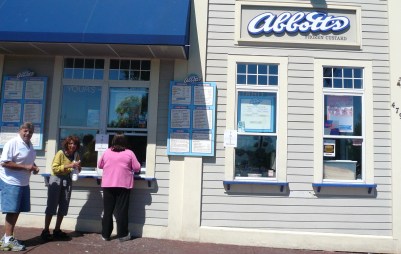
We went to her favorite frozen custard stand. I had never heard of frozen custard.
We went to Clifford Avenue home.

 

We went to the area of her Lake Avenue home, but that neighborhood had been redeveloped, and her house was gone. Jimmy brought us to see where Fashion Park and Bond Clothing once stood. Afterward, we drove to Lake Ontario. It took almost an hour to get there. Mom said we took the same route she always took as a child, past the homes where she and her sister would count WW2 military stars hanging in windows. She explained it was a game they played to pass the time. She quickly followed up by saying she didn’t understand the significance of the stars at the time.

When we got to Sodus Bay, Mom had no idea where to direct Jimmy to drive. Although I knew she didn’t have an address for the old house, I was hoping she would be able to guide us there once she recognized familiar landmarks, but such wasn’t the case. Personally, I hadn’t anticipated the town would be so big and the bay so vast. I became skeptical about being able to find the house. Talk about finding a needle in a haystack. We were toast.

We pulled into a marina and asked an attendant for help. Without any useful clues to offer, the conversation didn’t get very far. Suddenly shy, my mother told the attendant all she remembered was a long beach with a road between her house and the water. The attendant patiently brought up possible landmarks to help her remember the area. When he asked if there were bluffs nearby, Mom’s face lit up. She remembered the bluffs. The attendant asked if they were called Chimney Bluffs. “Yes,” Mom said, beaming.

The attendant gave us a map and circled the area where the bluffs were located. We drove to Chimney Bluffs, but it was a State Park, so there were no homes on the property. We drove to the beach, where we found a small parking lot by the water. We got out and looked around. There were no houses in sight. Nonetheless, Mom was happy to be back on Sodus Bay, and I took this photo of her.

The story doesn’t end there, though. We sat on the beach for a while, taking in the sea air and the moment. After a while, content with how far this goose chase had taken us, Mom was ready to head back to town, not wishing to inconvenience her cousin any longer. She didn’t think we would find the house in this area because the landmark she remembered, the road between the shoreline and the embankment, was nowhere to be found.

As I sat on the beach with my mother, I started to have a case of the heebie geebies. I felt we were close. I told my mother I was going for a walk down the beach. My mother took this photo of the beach as I walked away.

As I walked, I poked in and out of the trees, looking for a field with a white house on a slight hill. Nothing. Just a lot of empty fields. Suddenly, I felt an aura, whether it emanated from my grandmother or the house, I cannot say, but I sensed I was very close. Between the next opening in the trees, I saw this: a white house on a slight slope, just like the picture I had brought from home.

My heart started racing. I took a photo of the house and ran back to my mother. My mother was not convinced. I got everyone back in the car, and we drove down the country road to find the house. We saw a white house up on a hill with a long driveway.  We turned into the driveway. Still convinced we were in the wrong area, my mother warned us not to trespass, but I looked at Jimmy, and my eyes said keep driving. Here is a Google image of the area.

I got out of the car and knocked on the front door. A man came out to greet us. He seemed friendly enough, so I told him our saga from beginning to end. He grinned and said this house had to be the right one because it was over 100 years old and had been the only house on the coast for many years. He gave us a tour, and then Mom, Jimmy, and the owner visited on the sunporch while I walked around the property, taking pictures. It was all quite thrilling.

Old photos I found after the trip.

Here, my grandmother is pumping water by the front door while my mother and her sister sit on a bench. I saw remnants of the water pipe when I walked around the property.

Here is my mother in her two-piece bathing suit.

Grandma, my mother’s younger sister, Carol, and their dog, Queenie.

I love this shot of all the women on the beach. Not surprisingly, my grandmother is wearing an apron.

Mom was right-on about the road between the house and the beach. I found this photo after our visit.

Adorable Mom at her beach house, sixty years later.

The next day we went to the birthday party. I loved watching my mother greet one long-lost relative after another. Here she is with the birthday girl, Aunt Mary.

Here I am standing between my two beautiful and spunky great-aunts.

Like for my parents, grandparents, and great-grandparents before me, much of life still happens around the dinner table. The strong, faithful women in our family made sure the meals served to us were nutritious and delicious and remained a family event, one that always started with the Catholic prayer of gratitude: Bless us, oh Lord, and these, Thy gifts, which we are about to receive, through Thy bounty. Through Christ, our Lord, Amen. We at the children’s table could recite that prayer in under three seconds.

Related Posts:
A Birthday Tribute for My Mother: Knitting Neck Warmers with Mom’s Stash
Italian Sesame Seed Cookies
Aunt Bridget’s Chicken Soup with Tiny Meatballs
We, Will, Remember Them

Don’t miss a recipe! Become a subscriber and have every post delivered to your Inbox.

Follow Judy’s Chickens on Instagram and Pinterest @JudysChickens.

Remember to always check this website for updated versions of a recipe.  

© 2014-2020 Judy Wright. All rights reserved. Photos, videos, and text may only be reproduced with the written consent of Judy Wright.

How to Make Plant-Based Dyes

This is a story about how one thing led to another.

In April 2015, I wrote a post about using vegetables to make homemade dyes for Easter eggs. It seemed like everyone on Instagram was doing it and I wanted in on the action. You can read about it here. It was exciting to produce gorgeous colorful dyes from “scratch.”

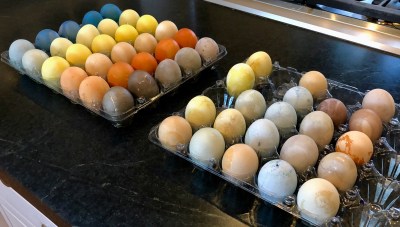
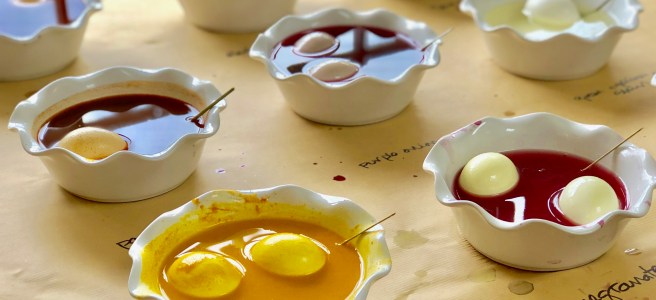
These are the colors I made by boiling vegetables in water.
Red/Purple cabbage produced the blue color. That was a nice surprise!
Yellow onion skins made the orange.
Red onion skins made the brownish-red color.
Red beets made the deep fuschia.

One analogous cooking tip I was able to learn from this egg-dyeing project was that yellow-skinned onions impart a nicer golden color to a pot of chicken stock than red onions.

Over the years, I invited my nieces over to dye eggs and we added ground turmeric to the mix. It produced yellow eggs.

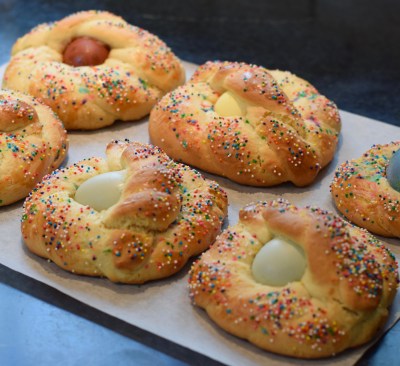
I used some of the eggs in these Italian Easter bread baskets, a recipe I need to post!

One year, I didn’t make vegetable dyes and instead used powdered indigo I had purchased for another project to over-dye already colored eggs. I loved the different shades of blue that resulted. The commercial dye was lightfast, too, meaning the colors didn’t fade the way many of the eggs did.

This past February, while touring a block-printing factory in Jaipur, India, I learned from a young man named Ali, that their factory printed with natural dyes made from plants like tomatoes, pomegranates, turmeric, sugar cane, and indigo.

My takeaway was that you could pretty much make fabric dyes from anything that ever stained your clothes, aprons, or dish towels while you cooked.

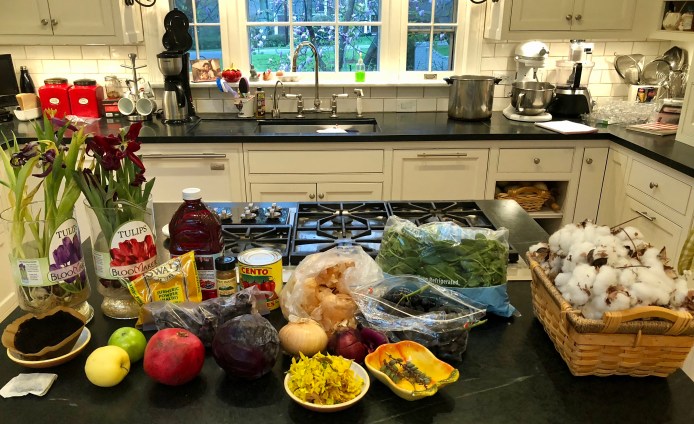
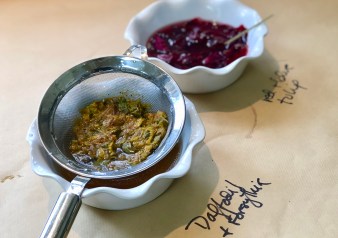
Two months later, Easter 2018, was the year I went a little cuckoo with the egg dyes. I poked through my kitchen spices, vegetable bins, backyard garden (found daffodils and forsythia), and the grocery store, looking for foods and flowers I could potentially use to make dyes. In the end, I chose pomegranates, dark grapes, blueberries, tomatoes, cranberry juice, red cabbage, spinach, turmeric, yellow and red onion skins, paprika, apple skins, used coffee grounds, daffodils, forsythia, and tulips.

I was all in.

Crazy as this all seems, I got into the zone on this project. I laid down a long sheet of brown paper and filled fifteen bowls with food and flower samples, some of which I had pre-cooked. I couldn’t cook them all because I didn’t have enough pots or time.

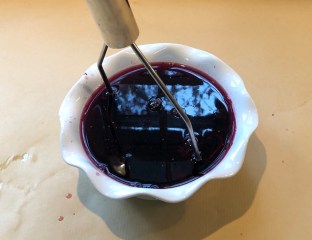
I filled each bowl with boiling water and let the materials meld for a few hours. Afterward, I mashed the plant materials in each bowl, heated them in the microwave, and strained out the pulp.
 

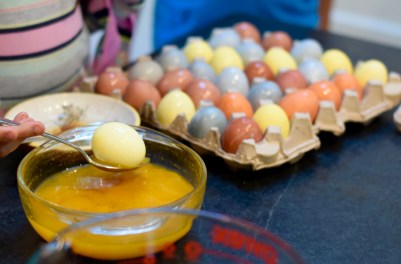
I added hot, medium-sized, hard-boiled, white eggs into the strained warm liquid and let them sit for a while longer.

The results were mixed. Some of the dyes produced rich dark colors, some were pale, some were lightfast, some were not. My favorite new colors were a lovely chartreuse from the pomegranate, a golden yellow-brown from the daffodils and forsythia, a pretty mocha-brown from the coffee grounds, and a light orange from the paprika.

While I used the dyes for eggs, in my head I was thinking about how they might dye fabric. I could see how some of the colors in the swatch below could be created from the colorful dyes I had made over the years.


Making Dye from Indigo Plants

In my garden, I am growing a patch of indigo and hoping that this will be the year I finally try my hand at making dye. There are many complicated steps involved, including the addition of chemicals in calculated amounts and resting periods, all of which have kept me from taking the time to focus and learn how to do it.

Today, I signed up for a class at Hill & Hollow Farm in Breeding, KY, to learn how; how to harvest indigo leaves and create dye. When I went to sign up for the class, I realized I had bought my first indigo plants from Hill and Hollow at their booth at the Nashville Farmers Market. I started with four plants and those plants have self-seeded to create the plot I have now. It was an omen. Stay tuned for that post.

Coincidently, in May, my artist friend, Tallu Quinn, showed me how to make patterned blue and white fabric squares using an ancient dyeing technique known as Shibori. That process will be described in another story, too. As a teaser, here is a photo of the still wet squares we dyed.

Working on this Shibori project with Tallu sealed the learning-how-to-make-indigo-dye deal for me. Once the fabric squares are sewn together for a quilt, a group wedding gift, I will write a post.

Like I wrote in the beginning, one thing led to another.

Related Posts
Learning How to Block Print in Jaipur (India, Part 2)
To Dye For: Making Naturally Dyed Easter Eggs
Morning Rounds in the Garden, July
How to Tell If an Egg Is Fresh or Hard-Boiled

Don’t miss a recipe! Become a subscriber and have every post delivered to your Inbox.

Follow Judy’s Chickens on Instagram and Pinterest @JudysChickens.

Remember to always check this website for updated versions of a recipe.  

© 2014-2018 Judy Wright. All rights reserved. Photos, videos, and text may only be reproduced with the written consent of Judy Wright.
Morning Rounds in the Garden, July

The July edition of Morning Rounds should begin with a feature photo of gorgeous heirloom tomatoes piled high on a platter, the raison d’être of the Italian summer garden. But, there are no tomatoes this year. They have all been devoured by four-legged creatures with long tails. Instead of peaceful, meditative walkabouts in my vegetable gardens each morning, I begin my day with a quick check of catch and release traps. It’s like setting out baited hooks at dusk when we jugfish for catfish and checking them with bated breath the next morning. Only we eat the catfish.

That’s an opossum’s tail!

In past years, this photo of a squirrel eating a green tomato on the railing of the front garden was an anomaly; now it’s the norm. I considered it quaint; now it makes me growl.

This is a telltale sign that a squirrel is eating your garden produce.

The rabbits have a different modus operandi. They eat the leaves and leave the stems. Currently, they are loving on my peanut plants.

On a much happier note, I do welcome this type of wildlife in my garden. It equals POLLINATION which equals fruits and vegetables in the garden.

I’m very thankful for the bees. If it weren’t for their hind legs collecting and depositing yellow pollen grains as they fly from flower to flower looking for nectar, we would not have zucchini, or Patty Pan squashes, or pumpkins, all gourds in the cucurbit family. Vegetables in the cucurbit family have distinct male and female flowers growing on the same plant. The flower on the right is the male and the one on the left is the female. The bees unwittingly connect them.

Beneath the female flower of this Patty Pan squash is an immature fruit. If pollinated, the fruit will grow to maturity. If not, it will wither and die. I call that failure to launch. Blessed be the pollinators, for they will have honey in heaven.

One morning I shot this short video after I saw a bumblebee fly into a pumpkin flower poking through the fence surrounding the compost pile. Wait for it. Oh, the things you can observe in the garden.


The Front Garden: The Italian Vegetable Garden

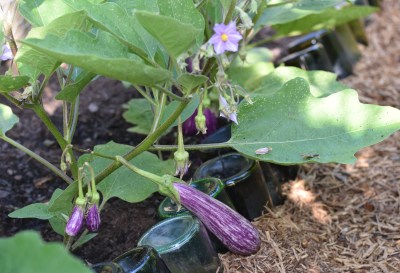
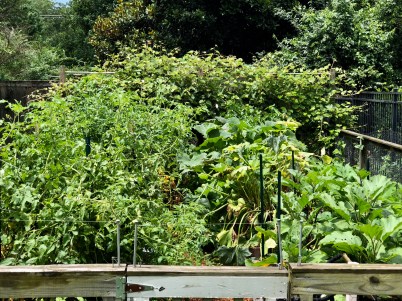
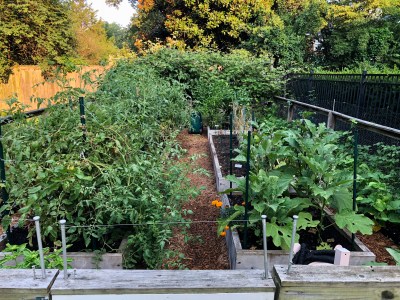
Moving onto other vegetables growing in the front garden, there are the swoon-worthy Tri-Color string beans and Fairy Tale eggplants,.

and the sweet peppers.

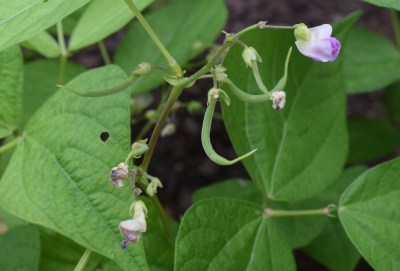
In the photos below, you’ll see buds, flowers, and small fruit growing on the single stems of eggplants, string beans, and sweet peppers. While bees visit these plants, their male and female reproduction parts are within the same flower and gravity and wind often does the job of spreading the pollen.


Other News

I harvested the soft-neck garlic bulbs at the end of June. The bulb heads are small because they had a short growing season. I planted them in the spring. If they are planted in the fall and allowed to winter over, they should grow much larger bulbs.

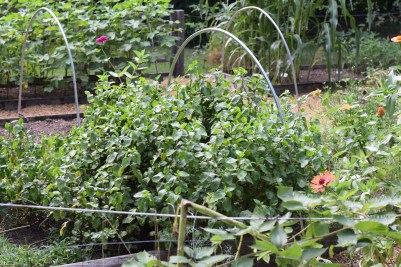
Sadly, by mid-July, my raised bed of squash and cucumbers plants became so unruly, due to overcrowding, that I pulled all the plants. Plants need air circulation. They need room to grow. My problem is I have a hard time thinning plants. Lesson learned. I felt so relieved when I finally pulled them. I knew from the beginning I should have thinned the seedlings.

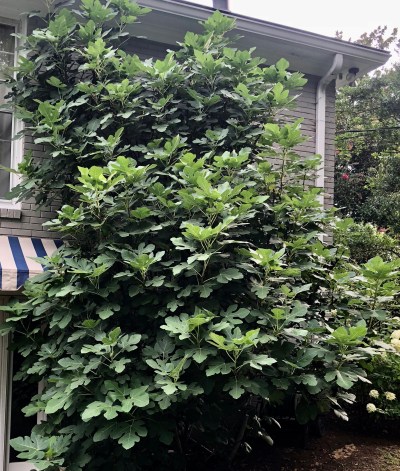
In other good news, the Brown Turkey fig tree is loaded with almost-ripe figs.

The fig tree is at at least twenty feet tall. I planted it in front of a southern-facing brick wall, and it has survived in this spot for over ten years. Every few years, I have to cut it back after we have a super cold winter. While I don’t have an irrigation system, the tree is watered by the steady drip of condensate from our air-conditioner. It remains lush all summer long.

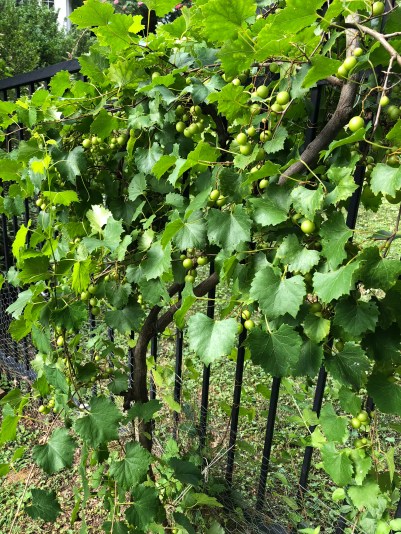
The Muscadine grapes are looking great. I gave them lots of room to grow along a fence.

The Back Garden: Commercial Crops and their Flowers

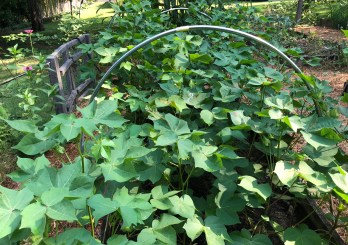
I am growing a variety of commercial crops for the sheer joy of seeing how they grow.

Cotton

Sugar Cane

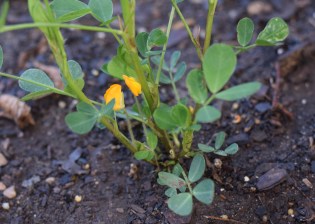
Peanuts

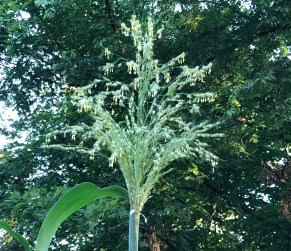
Corn

Tobacco (hasn’t flowered, yet)

Indigo (hasn’t flowered, yet)

Soybeans (missed a flowering photo)

Rice (this crop failed)

A morning haul of food. I look at this assortment of vegetables and wait for them to tell me what I should cook for dinner. I love the entire process of growing and cooking vegetables.

For ideas about how to prepare summer vegetables check out vegetable sides and pasta dishes on the blog Menu.

I’ll close with a video of my backyard composters eating their favorite food.


.

Related Stories
Morning Rounds in the Garden, June
Morning Rounds in the Garden, May
Morning Rounds in the Garden, April
Tomatoes: The Crown Jewels of the Summer Kitchen Garden
Fall Planting Guide for Your Kitchen Garden
Family Dirt

Don’t miss a recipe! Become a subscriber and have every post delivered to your Inbox.

Follow Judy’s Chickens on Instagram and Pinterest @JudysChickens.

Remember to always check this website for updated versions of a recipe.  

© 2014-2018 Judy Wright. All rights reserved. Photos, videos, and text may only be reproduced with the written consent of Judy Wright.

A Few Good Books

I am in a lively book club called The Book Hunters. We’ve been meeting the third Monday of every month since 1989. Most of us were new mothers when we started. Now, many of us are grandmothers. We used to meet in the morning and drink coffee. Now we gather in the evening and drink things other than coffee.

One of my favorite book club meetings happens in January when spouses or SO’s are invited to join us. We try to pick a book we think will generate a thoughtful and energetic discussion. Memorable books for this expanded gathering have been titles such as Endurance, Undaunted Courage, and The Road. Last year, we read The Sympathizer, a story about the Vietnam War as told by a Vietnamese counterspy. It was so informative, my husband and I went back and watched the Ken Burns Series, The Vietnam War to get more context. This year, we are reading A Murder in Music City.

Once a year,  the Book Hunters get together for a luncheon and instead of discussing one book we come prepared with suggestions for the next year’s list. Afterward, a group of us get together and attempt to whittle down the selection to eleven books. At that meeting, we assign books to each other to read so we can get more opinions about specific books. A month later, we get together again and hear each other’s thoughts on the assignments. We book-lovers long for superlatives like “I loved it” or “I couldn’t put it down” or ” I learned so much” or “It’s beautifully written.” If the readers have high praise for a book, it’s in.

Yesterday, we left that second meeting super excited about the reading list we had come up with. When my mother was alive, I would always send her a copy of the list after this meeting. These days I email it to my friend, Gayl, in Napier, NZ where she shares it with friends in her book club, Chooks & Books. Gayl also sends me book recs that the Chooks have enjoyed. One of them, On the Edge of the Orchard, was read by our book club last March. The discussion that ensued was one of the best. For me, that’s the beauty of reading, sharing, and discussing books together; you get a glimpse into the soul of others when you hear what moved them about a story.

Here’s our list.

September: Eleanor Oliphant is completely fine by Gail Honeyman (2017)

“Beautifully written and incredibly funny, Eleanor Oliphant Is Completely Fine is about the importance of friendship and human connection. I fell in love with Eleanor, an eccentric and regimented loner whose life beautifully unfolds after a chance encounter with a stranger; I think you will fall in love, too!” —Reese Witherspoon

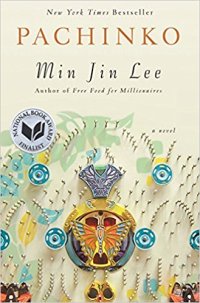
October: Pachinko by Min Jin Lee (2017)

“Beginning in 1910 during the time of Japanese colonialization and ending many decades later in 1989, Pachinko is the epic saga of a Korean family told over four generations. The family’s story starts with Hoonie, a young Korean man born with physical deformities, but whose destiny comes from his inner strength and kindness. His daughter, rather than bring shame on her family, leaves their homeland for Japan, where her children and grandchildren will be born and raised; yet prejudice against their Korean heritage will prevent them from ever feeling at home. In Pachinko, Min Jin Lee says much about success and suffering, prejudice, and tradition, but the novel never bogs down and only becomes richer, like a sauce left simmering hour after hour. Lee’s exceptional story of one family is the story of many of the world’s people. They ask only for the chance to belong somewhere—and to be judged by their hearts and actions rather than by ideas of blood traits and bad seeds.” –Seira Wilson, The Amazon Book Review

November: Circe by Madeline Miller (2018)

“A bold and subversive retelling of the goddess’s story that manages to be both epic and intimate in its scope, recasting the most infamous female figure from the Odyssey as a hero in her own right.”―The New York Times

“An epic spanning thousands of years that’s also a keep-you-up-all-night page-turner.” — Ann Patchett

December: Dollbaby by Laura Lane McNeal (2015)

“I started this on Sunday and finished it on Monday. It was just one of those books that is filled with secrets of the past that you just have to know about and characters that you love as soon as you meet them and then you love them more as the author lets you see who they are.” Angela M for Goodreads. 

“A big-hearted coming-of-age debut set in civil rights-era New Orleans—a novel of Southern eccentricity and secrets.” —Goodreads

January Couples Dinner: A Murder in Music City  by Michael Bishop (2017)

“Nashville 1964. Eighteen-year-old babysitter Paula Herring is murdered in her home. A few months later a judge’s son is convicted of the crime. Decades after the slaying, Michael Bishop, a private citizen, stumbles upon a secret file related to the case and with the help of some of the world’s top forensic experts–including forensic psychologist Richard Walter (aka “the living Sherlock Holmes”)–he uncovers the truth. What really happened is completely different from what the public was led to believe. In this true-crime page-turner, the author lays out compelling evidence that a circle of powerful citizens were key participants in the crime and the subsequent cover-up.” —Amazon

February: Same Kind of Different as Me by Ron Hall, Denver Moore, and Lynn Vincent (2008)

“A dangerous, homeless drifter who grew up picking cotton in virtual slavery. An upscale art dealer accustomed to the world of Armani and Chanel. A gutsy woman with a stubborn dream. A story so incredible no novelist would dare dream it. It begins outside a burning plantation hut in Louisiana . . . and an East Texas honky-tonk . . . and, without a doubt, in the heart of God. It unfolds in a Hollywood hacienda . . . an upscale New York gallery . . . a downtown dumpster . . . a Texas ranch. Gritty with pain and betrayal and brutality, this true story also shines with an unexpected, life-changing love.” –Amazon

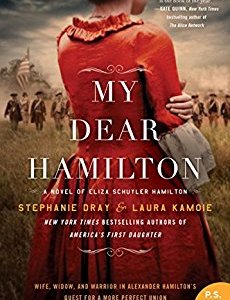
March: My Dear Hamilton by Stephanie Dray and Laura Kamoie (2018)

“A general’s daughter…Coming of age on the perilous frontier of revolutionary New York, Elizabeth Schuyler champions the fight for independence. And when she meets Alexander Hamilton, Washington’s penniless but passionate aide-de-camp, she’s captivated by the young officer’s charisma and brilliance. They fall in love, despite Hamilton’s bastard birth and the uncertainties of war.

A Founding Father’s wife…But the union they create–in their marriage and the new nation–is far from perfect. From glittering inaugural balls to bloody street riots, the Hamiltons are at the center of it all–including the political treachery of America’s first sex scandal, which forces Eliza to struggle through heartbreak and betrayal to find forgiveness.

The last surviving light of the Revolution…When a duel destroys Eliza’s hard-won peace, the grieving widow fights her husband’s enemies to preserve Alexander’s legacy. But long-buried secrets threaten everything Eliza believes about her marriage and her own legacy. Questioning her tireless devotion to the man and country that have broken her heart, she’s left with one last battle–to understand the flawed man she married and the imperfect union he could never have created without her…”  –Amazon

April: A Gesture Life by Chang-rae Lee (2000)

“A Gesture Life is the story of a proper man, an upstanding citizen who has come to epitomize the decorous values of his New York suburban town. Courteous, honest, hardworking, and impenetrable, Franklin Hata, a Japanese man of Korean birth, is careful never to overstep his boundaries. Yet as his story unfolds, precipitated by the small events surrounding him, we see his life begin to unravel. Gradually we learn the mystery that has shaped the core of his being: his terrible, forbidden love for a young Korean Comfort Woman when he served as a medic in the Japanese army during World War II.” —Penguin Random House

May:  Known as our “Free Read” luncheon where everyone gives suggestions for the next year’s book list.

June: Before We Were Yours by Lisa Wingate (2017)

“Based on one of America’s most notorious real-life scandals—in which Georgia Tann, director of a Memphis-based adoption organization, kidnapped and sold poor children to wealthy families all over the country—Lisa Wingate’s riveting, wrenching, and ultimately uplifting tale reminds us how, even though the paths we take can lead to many places, the heart never forgets where we belong.” —Penguin Random House

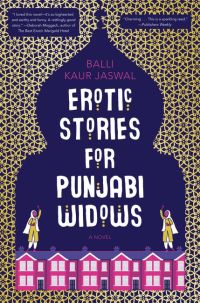
July: Erotic Stories for Punjabi Women by Balli Kaur Jaswal (2018)

“Nikki, a modern daughter of Indian immigrants, has spent most of her twenty-odd years distancing herself from the traditional Sikh community of her childhood, preferring a more independent (that is, Western) life. When her father’s death leaves the family financially strapped, Nikki impulsively takes a job teaching a “creative writing” course at the community center in the beating heart of London’s close-knit Punjabi community.  The proper Sikh widows who show up are expecting to learn English, not short-story writing. When one of the widows finds a book of erotica and shares it with the class, Nikki realizes that beneath their white dupattas, her students have a wealth of fantasies and memories that they’ve held in for far too long. Eager to liberate these modest women, she teaches them how to express their untold stories, unleashing the creativity of the most unexpected—and exciting—kind.  As the class grows, a group called the Brothers, who have appointed themselves Southall’s “moral police,” threaten to reveal the class’s scandalous stories and the mysterious secrets lurking beneath this seemingly sedate, tight-knit community.” —Harper Collins

August: Manhattan Beach by Jennifer Egan (2018)

“With Manhattan Beach, Jennifer Egan—who dazzled readers with her Pulitzer Prize-winning, A Visit from the Goon Squad—spins a classic historical novel. Classic in the sense that it’s virtually impossible to put down. Classic in its sepia-toned portrait of New York: set on the Brooklyn docks during World War II, when mobsters ruled, the war loomed, and a young girl dove her way into becoming the first female diver on the squad. Classic in its quintessentially satisfying characters: crooked gangsters, disappearing fathers, gritty sailors, and an intrepid young woman equally at home in a 200-pound diving suit and a green silk dress who unites them all. Classic in its revelation of the dangerous, altruistic and nefarious choices people make to support their family, their country and themselves. Manhattan Beach is classic in all of its American glory. “—Al Woodworth, Amazon

Since writing this post, friends havebeen sending the names of books they have read and loved. I’m starting a running list:

Educated, by Tara Westover. “I highly recommend it,” wrote three different people. I didn’t care for it.
Little Fires Everywhere, by Celeste NgQuick and thought-provoking. Story takes place in Shaker Heights, Ohio. I loved it.
The Alice Network, by Kate Quinn.
Beneath a Scarlet Sky, by Mark Sullivan. WW2 from the viewpoint of the Italians. I loved it.
4 3 2 1: A Novel, by Paul Auster.
The Overstory, by Richard Powers. Nine interlocking fables about trees & people. Reading it now..

Related Stories involving The Book Hunters:
WWMD? A Bucket of Spring Veggies as a Centerpiece
A Quick and Easy Baked Hummus and Feta Appetizer

Don’t miss a recipe or garden post! Become a follower and have every post delivered to your Inbox.

Follow Judy’s Chickens on Instagram and Pinterest @JudysChickens.

© 2014-2018 Judy Wright. All rights reserved. Photos, videos, and text may only be reproduced with the written consent of Judy Wright.