Room with a View: the Taj Mahal in Agra (India, Part 4)

Some of the memories of our trip to India will surely fade but not this one.

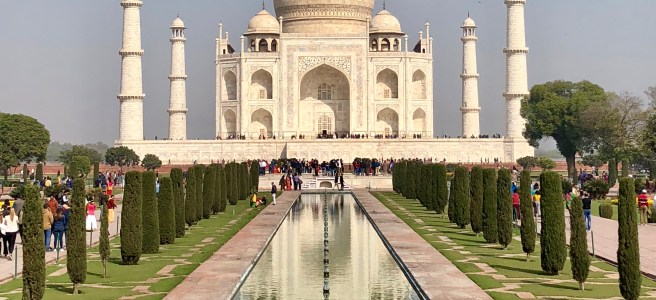
This view, seen through the red sandstone Great Gate of the Taj Mahal Complex, appeared surreal in the early morning haze enveloping Agra. It was the most stunningly beautiful sight I had ever seen. My husband and I crossed the threshold of the Gate, and suddenly we had an unobstructed view of the Taj Mahal — and the gardens that led to it. We were smitten — with the view and each other.

Thirty-five years together will get you a look like that now and then. Out of nowhere, I started humming the dramatic love theme from The Godfather. This wasn’t the first time I’d been moved to hum, but it was the first time I had to ask my husband what I was humming! I surely had to push deep into my brain synapses to come up with that song from 1972, but it did express the beauty, love, and drama I was feeling.

The Taj Mahal is a mausoleum built by the Mughal emperor, Shah Jahan for his third and favorite wife Mumtaz Mahal who died during the birth of their fourteenth child in 1631. Construction began in 1632, and the entire complex was completed in 1653. Following the Shah’s death in 1666, he was buried beside his wife.

As we moved closer, the view became more splendid and ethereal. Our guide pointed out the Qur’anic verses that the calligrapher had inscribed around the arch of the mausoleum by inlaying jasper, a type of quartz, into panels made of marble. An optical trick was employed by the calligrapher to make the letters look equal in size as they are read from the bottom up and from right to left. He subtly enlarged the letters as they got closer to the top of the arch.

I love how the architects found a way to ensure that perpetual floral arrangements lined the entranceway to the inner sanctum of the Shah’s wife’s final resting place. No photos were allowed inside, but the mosaics made with semi-precious stones (coral, onyx, carnelian, amethyst, and lapis lazuli) and low relief marble panels of stems of flowers continued throughout the interior of the building.

The Taj Mahal backs up to the Yamuna River.

The mausoleum is flanked by identical red sandstone buildings for architectural balance. One building is a mosque, and the other was described as a guesthouse. Four ornamental minarets surround the Taj Mahal.
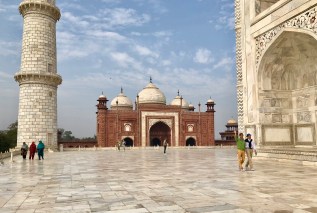
 

A view of the Great Gate from the terrace of the Taj Mahal, a distance of 1000 feet. The gardens exemplified paradise.
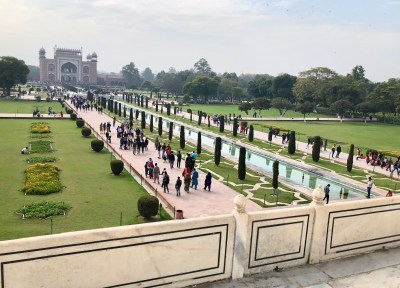
A Map of the Taj Mahal Complex

We left the Taj Mahal and took a horse and buggy ride to the Agra Fort, the walled, imperial city of the Mughal Emperors. The Fort was built by Akbar, the first Mughal emperor, between 1565 and 1573.

Akbar’s grandson, Shah Jahan, added the white marble Diwan-i-Khas or Hall of Private Audience in 1635. It was used as a place to welcome kings and nobles and conduct important affairs of the state. The mosaics are similar to those found in the interior space of the Taj Mahal.

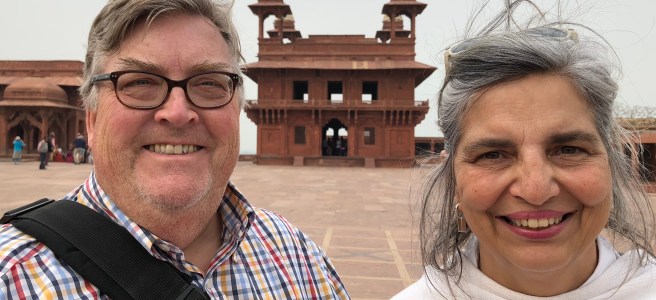
Shah Jahan was later sentenced to lifelong house arrest by his son and imprisoned in a room with a view of the Taj Mahal, as seen in the photo below. (Our guide was obsessed with taking pictures of us.) On the right of us is another view of the Diwan-i-Khas. I read that the structure is only covered in white marble. Underneath is red sandstone.
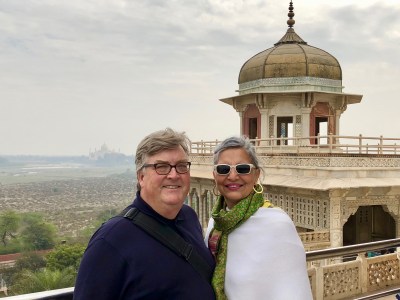
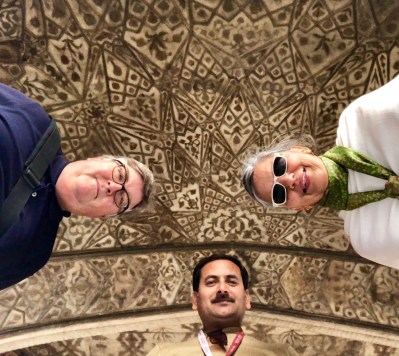
I was obsessed with the photo technique I learned the day before for taking photos of mosaic ceilings. I taught it to our guide!
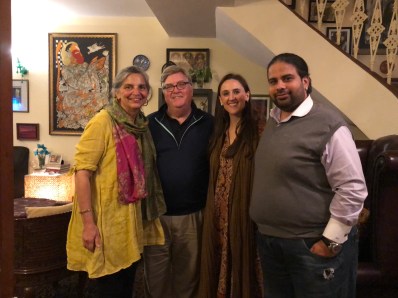
As soon as we finished our tour of the Agra Fort, our driver, Ravi, bee-lined it back to Delhi so we could enjoy dinner at the home of a Nashville friend now living in Dehli, Reed, and her sweet husband, Arjun. We were served the most colorful and flavorful of meals, the perfect ending to an equally colorful and sensual tour of the Golden Triangle.
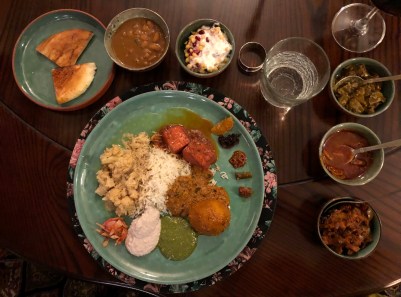
I asked Reed to name the foods served to us for this Kashmiri feast: “On your plate, you have lal tomater paneer, gobi (cauliflower) yakhni, dum aloo (potato), rice, two chutneys- walnut radish & mint. There’s raita up at the top, that boondi anar (pomegranate) raita, red kidney bean (rajma), and all the other tidbits are achaars (pickled fruits or vegetables), and there’s pickled onion.”

Reed and Arjun, both work with Wildlife SOS, an organization that rescues, rehabilitates and re-releases (where appropriate), injured and exploited animals from all over India. Once relieved of their labors, some of the rescued animals live out their lives with Wildlife SOS. Reed told me their organization has spent time educating elephant and camel ride operators throughout India on the most humane ways to treat and care for their animals. Donations are always welcome for the care of these animals.

It was a true joy to sit and visit with Reed and Arjun in their Dehli living room after so many nights of living in hotel rooms — a beautiful way to end this leg of our trip.
Next up is our tour of Hyderabad in Southern India where we shopped for saris, visited a family farm, and took a bus tour of the city. For now, I’ve got to get my spring vegetable garden planted!

Related Posts:
Cooking 35,000 Meals a Day in a Sikh Kitchen in Delhi (India, Part 1)
Learning How to Block Print in a Factory in Jaipur (India, Part 2)
A Stepwell, Parcheesi, Brick-Making, and Chapati-Making (India, Part 3)
A Cook’s Tour of a Farm in Southern India (India, Part 5)
Shopping for a Saree in South India (India, Part 6)

If you enjoyed this post, please become a subscriber! Be sure to confirm the subscription on the follow-up letter sent to your email address.

Follow Judy’s Chickens on Instagram and Pinterest @JudysChickens.

© 2014-2018 Judy Wright. All rights reserved. Photos, videos, and text may only be reproduced with the written consent of Judy Wright.

A Stepwell, Parcheesi, Brick-Making, and Chapati-Making (India, Part 3)

This driving leg of the Golden Triangle was my favorite.

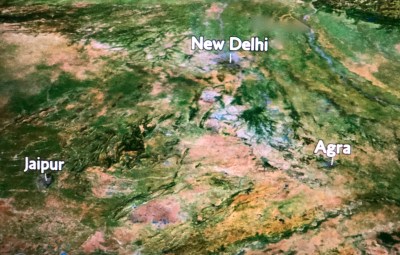
The morning started with the well-documented tour of a block-printing factory early in the morning and ended with our 6:00 PM arrival at a hotel “with a view of the Taj Mahal.” Read along to hear about the amazing slices of life we saw on our journey: chapati-making, brick-making, cow dung chip-making, a photo-making tip, and more. A maker’s dream!

How to Print Fabric

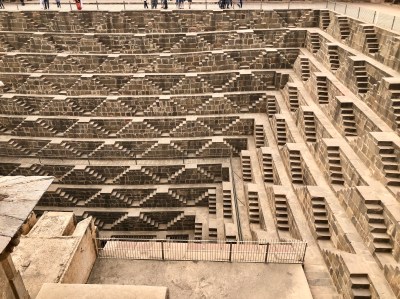
Monument Stop: The Chand Bauri Stepwell in Abhaneri  (Our Favorite!)

This was the coolest monument we saw in India. The 3500 narrow steps that surround this perfectly symmetrical, geometrically splendid well (or baori) were built between 800 CE and 900 CE as a way to conserve and store monsoon rains for year-round use. In India, there are four seasons: winter (December to February), summer (March to May), the rainy or monsoon season (June to September), and a post-monsoon season (October to November). The well is 13 stories and 100 feet deep.

There were green parrots to be seen all over India. I was glad they made a quick appearance in this video.

The Harshat Mata Temple is adjacent to the stepwell. It was built between the 7th and 8th centuries to honor Harshat Mata, the Goddess of Joy and Happiness.

Temple ruins surround the building.

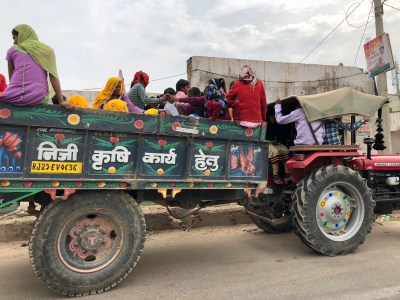
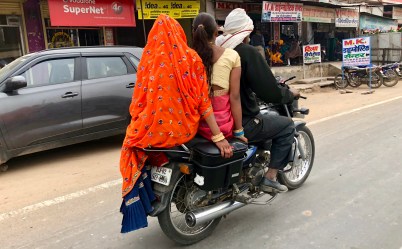
How to Transport  a Lot of Sari-Wearing Women to a Wedding in the Country

We saw women riding side-saddle on motorcycles throughout India.

The motorcycles had footrests located on the left side to accommodate women riding side-saddle. By the way, helmets are not required, nor are people in the backseat of cars required to wear seatbelts, and infants and children do not use car seats.

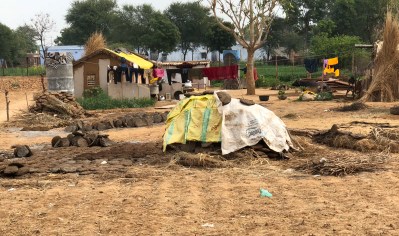
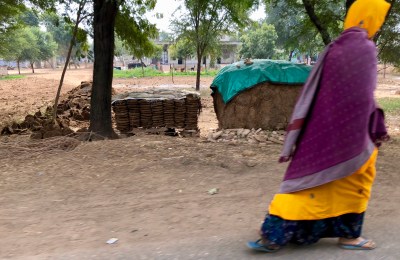
How to Dry and Store Cow Dung for Fuel on a Farm

Here is a field of cow chips drying in the sun. They are used by rural farmers as a source of fuel.

Ravi, who lives on a farm, told us they use dried cow dung to heat water and to cook grains to feed their buffaloes.

I said to Ravi, “You cook the buffaloes’ food?!”

Ravi, replied, “If you want buffalo to give you good milk and butter, you feed them good food.”

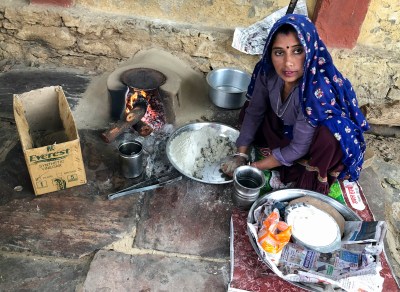
How to Make Chapati Outdoors in a Parking Lot 

We stopped to eat a delicious lunch complete with garlic naan, our favorite bread in India. We did not get the “Dehli-Belly” that travelers to India often talk about because Ravi chose restaurants that had a good reputation for cleanliness in the kitchen. Additionally, he kept the car stocked with bottled water.

After lunch, Ravi brought us behind the restaurant to introduce us to a woman who was making chapatis. Chapati is an unleavened flatbread made of either whole wheat flour and water, or ground millet and water. Ravi told us if you were going to do hard work on a farm for the day, you would eat millet chapati because of the complex carbohydrates and nutrients it provides. Otherwise, at mealtime, most eat whole wheat chapati. The woman below is making the grayish tinted millet chapati. She mixes the millet and water just before kneading and flattens the dough into a disk using her hands instead of a rolling pin.

When making whole wheat chapati, the dough needs to be prepared thirty minutes ahead of time and allowed to rest before rolling. Notice the color of the dough is lighter. The cook is pulling a ball of dough out from a mound of resting dough under the towel. This is just like what we saw in Dehli when we watched the Sikhs make chapati.

Here is a video of this lovely woman demonstrating how to roll and cook whole wheat chapati.

How to Make Bricks in a Field

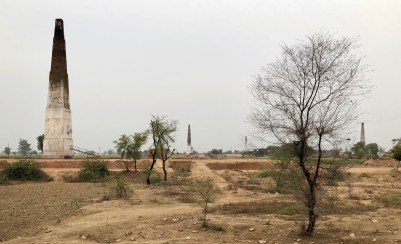
We passed brick-firing chimney stacks frequently as we traveled the farm roads. When we saw laborers in the process of mixing clay and water to make bricks, we asked Ravi to pull over.

We marveled at how this woman consistently mixed uniformly-sized clumps of mud.

The brick-maker used this mold to form each brick.

He lined them up to dry.

Once dried, a team comes along to stack them for further drying. I’m not sure how long they dry before they are fired, but Ravi, who used to make bricks, told us they start the process early in the morning to give the sun time to dry them. He said, if it starts to rain while they are making them, the bricks turn to mud.

Here is a video of the brick-making process.

While I was taking pictures, this man walked over, said nothing, and posed for me.

Monument Stop: Fatehpur Sikri and the Parchisi Court

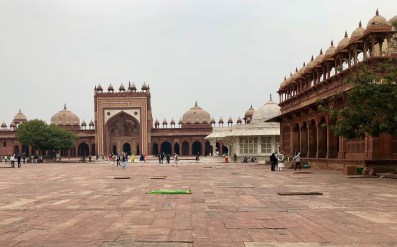
Fatehpur Sikri is a town outside of Agra. For fourteen years Fatehpuri Sikri served as the capital of the Mughal Empire. It was founded by Emperor Akbar in 1571.

The Parchisi Court

We learned from our guide that the extravagant Mughal Emperor Akbar built this Parchisi Court in 1572 to play a game that was somewhat similar to chess only the game pieces were women slaves (concubines) dressed in colorful outfits. The players moved according to dice tossed on the table. The American board game, Parcheesi, is an adaptation of this Indian game.

Here, our guide explains:

How to Shoot a Cool Photograph under a Beautiful Dome

While at Fatehpur Sikri, our guide introduced us to a fun way to photograph the interior of domes. Simply lay your phone on the ground, screen side facing up. Flip the camera lens as you would for a selfie, position yourself looking down at the camera, and either use the timer to snap the photo or your finger. We loved this photo technique and used it throughout our trip.
 

We had fun showing other tourists how to do it, as well.

A Room with a View: The Jewel of the Golden Triangle

We went to bed with visions of the Taj Mahal dancing in our heads.

What a fantastic day!

Related Posts:
Cooking 35,000 Meals a Day in a Sikh Kitchen in Delhi (India, Part 1)
Learning How to Block Print in a Factory in Jaipur (India, Part 2)
Room with a View: the Taj Mahal in Agra (India, Part 4)
A Cook’s Tour of a Farm in Southern India (India, Part 5)
Shopping for a Saree in South India (India, Part 6)

If you enjoyed this post, please become a subscriber! Be sure to confirm the subscription on the follow-up letter sent to your email address.

Follow Judy’s Chickens on Instagram and Pinterest @JudysChickens.

© 2014-2018 Judy Wright. All rights reserved. Photos, videos, and text may only be reproduced with the written consent of Judy Wright.