@judyschickens Homemade Healthy Super-Delicious Granola, Revised

When I started making granola, our family couldn’t get enough of it. Yes, it was nutritionally dense and packed with protein, vitamins, minerals, fiber, and antioxidants, but it was also sweet and salty, making it addictive and high in calories.

Granola

I recently read Michael Moss’s bestseller, Salt Sugar Fat: How the Food Giants Hooked Us. He wrote, “To make a new soda guaranteed to create a craving requires the high math of regression analysis and intricate charts to plot what industry insiders call the “bliss point,” or the precise amount of sugar, fat or salt that will send consumers over the moon.” With the concept of the bliss point in mind, I began tailoring my recipe to reign in the salt and sugar content and decrease the calories. I made several batches to reach a healthier and tolerable bliss point.

[Now, in 2023, I have completely eliminated the brown sugar. I’ve also eliminated the ground flax and chia seeds.]

Here is a list of the dry ingredients and their corresponding nutritional attributes (starting with the bowl of coconut at the top of the photo):

DSC_0486
Coconut: fiber, iron, zinc
Pecans: antioxidants, vitamin E, protein
Craisins: antioxidants, fiber
Ground Flax Seed: omega 3’s, fiber, protein & lignans
Raw Pumpkin (pepitas) Seeds: magnesium, zinc, omega 3’s
Wheat Germ: vitamin E & folic acid
Raw Sunflower Seeds: vitamin E & magnesium
Almonds: protein, fiber, vitamin E, minerals
Old-Fashioned Rolled Oats: lowers LDL cholesterol, fiber
Chia seeds: high in fiber and protein

Ingredients:
granola
8 cups old-fashioned rolled oats
2 cups wheat germ (half a jar)
1 cup raw or roasted, unsalted sunflower seeds
1 cup raw, unsalted pepita seeds (green pumpkin seeds)
2 cups roughly chopped pecans or walnuts
1 cup sliced almonds
1 cup unsweetened, shredded coconut
1 tablespoon ground cinnamon
2 teaspoons sea salt
⅔ cup extra-virgin olive oil
⅔ cup sorghum syrup (or honey)
2 teaspoons vanilla extract
1 cup hot water
2 cups dried cranberries

Yield: 4.5 pounds

Preheat oven to 250º

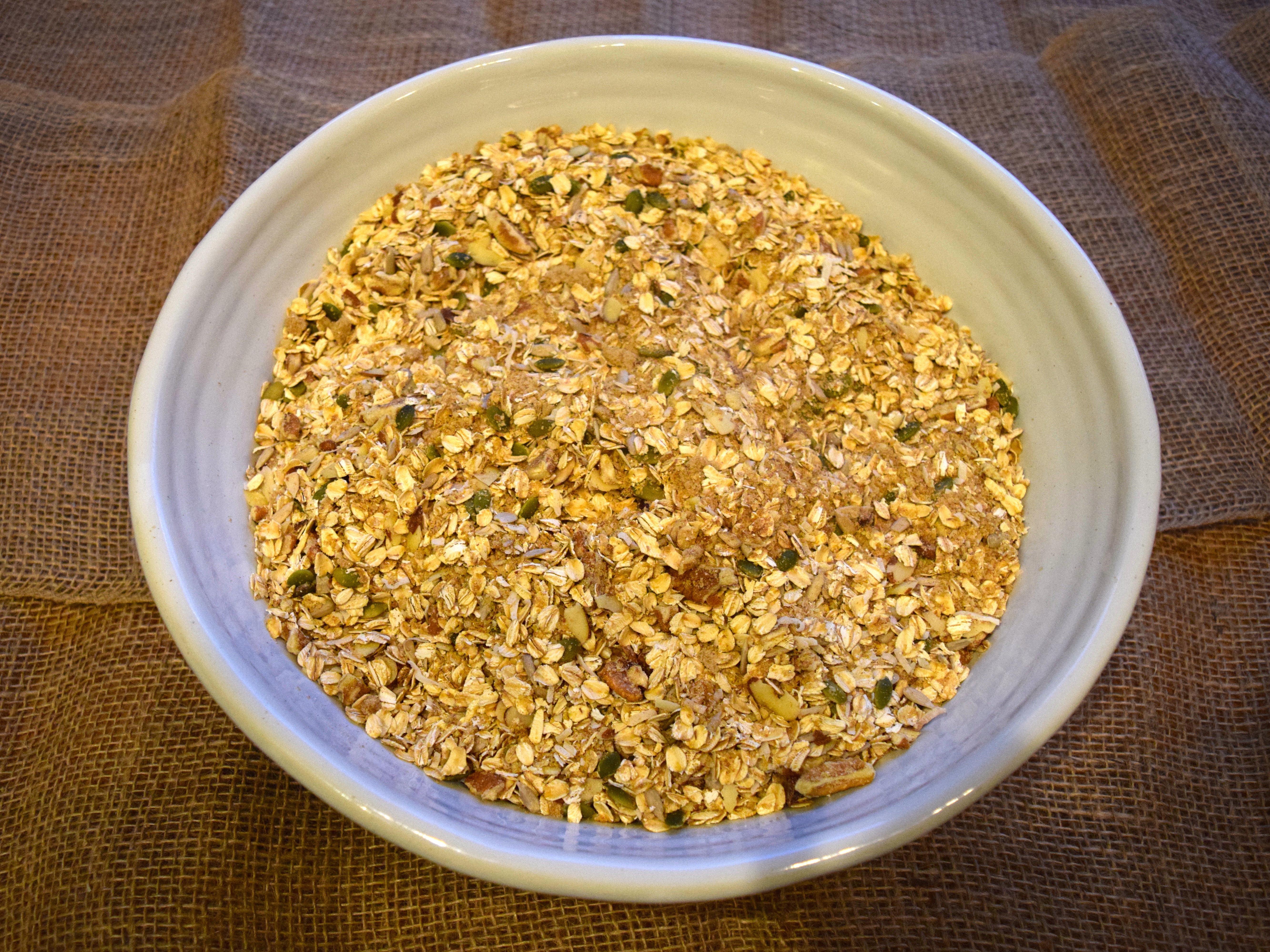
Mix the oats, wheat germ, pepita and sunflower seeds, nuts, coconut, cinnamon, dried cranberries, and salt in a large bowl.

Granola

Into a 4-cup liquid measure, add olive oil, sorghum, hot water and vanilla. Whisk until well blended.

granola

Add liquid ingredients to dry and stir immediately until all ingredients are uniformly coated.

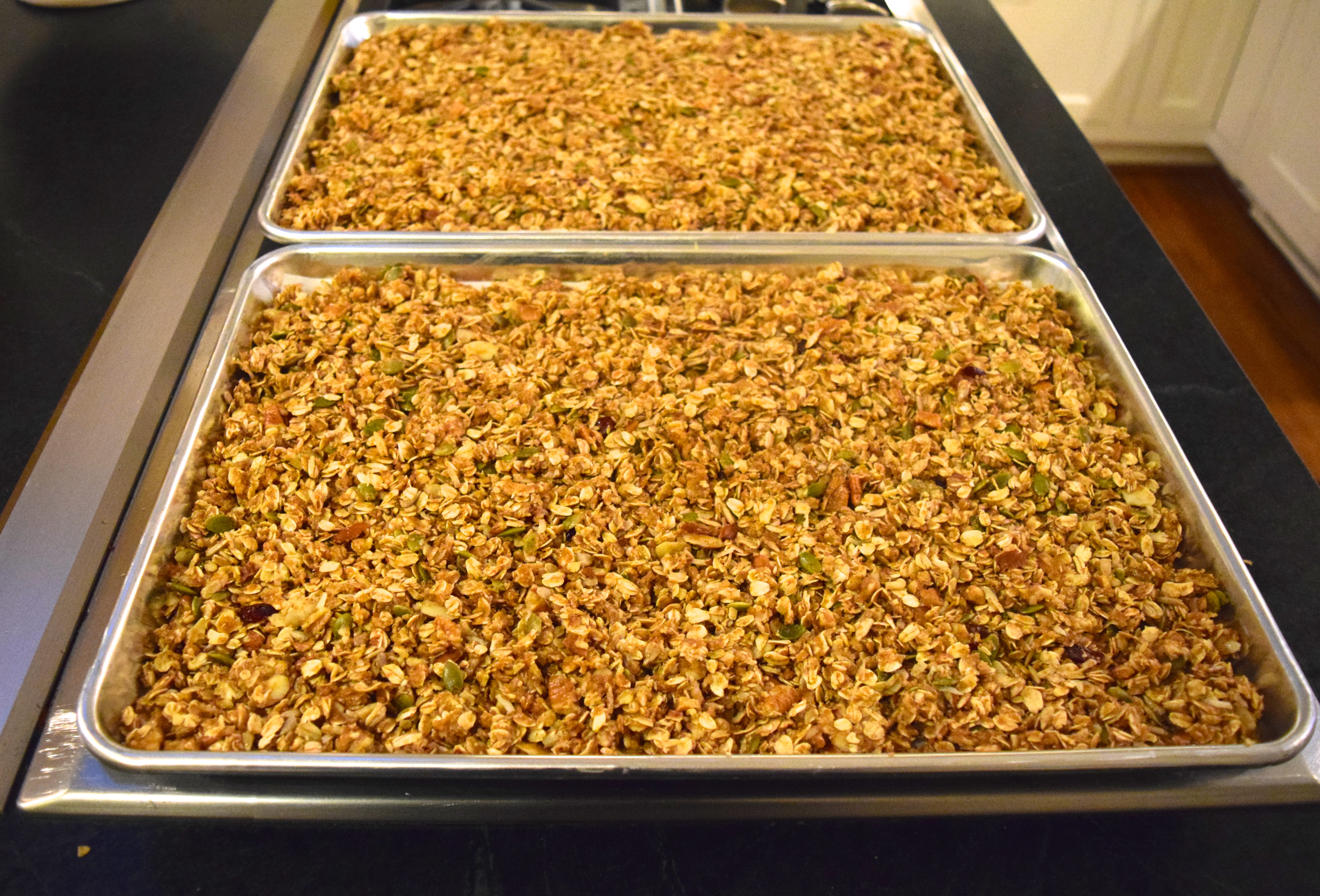
Pour mixture into two  13″ by 18″ rimmed baking pans.

.Granola

Bake for one hour, stirring every 20 minutes. The granola will become crunchy as it cools. Store in an airtight container when cooled.

A tasty and nutritious breakfast:

I enjoy having a half cup of granola with simple-to-make homemade plain yogurt or kefir for breakfast. Kefir is a slightly sour probiotic drink that has the consistency of liquid yogurt. If you add berries to the top, it’s like eating a sundae for breakfast!

DSC_0945

Related Breakfast Posts
Fruit and Nut Bread
The Biscuit King
The Navel Mary Way: How to Peel an Orange

Sign up for the latest recipes and follow me on Instagram and Pinterest @judyschickens. Always check the website for the most current version of a recipe.

© 2014-2023 Judy Wright. All rights reserved. Photos and text may only be used with written consent.

Kelly’s Duck Stew

I was sitting in church, studying the congregation, and wondering, WHO has too many ducks in their freezer? Duck season was over, and we had no ducks. I was craving my husband’s duck stew. I knew there were people in Nashville who had too many ducks in their freezer. I’ve been there.

Duck Stew

As the service ended, my friend Greer came up to me and said, “By any chance, could The Nashville Food Project use a freezer-full of ducks?” I laughed out loud and told Greer about my daydreaming moment in church. I told her TNFP would love to have them, and by the way, could she spare eight breasts for us?  The next morning, Greer donated the frozen duck breasts to the ever-resourceful, Anne Sale, TNFP’s Meals Coordinator. It was a win-win-win-win-win situation: Greer got her freezer space back, her husband, David, a volunteer at TNFP, felt good about donating his ducks to a worthy cause, Anne got a free source of protein for TNFP’s meal planning, many Nashvillians were nourished by the donated meat, and my family and I got to enjoy a bowl of my husband’s duck stew. Blessings all around.

Yield: 5 quarts

Ingredients:
Duck stew roux
8 duck breasts (2 pounds- they each weigh about 4 ounces), cut into 1″ chunks
1 cup all-purpose flour
1 teaspoon salt
1 teaspoon pepper
1 stick butter (½ cup)
6 celery stalks, sliced (about 3 cups)
2 large onions, coarsely chopped (about 5 cups)
10 carrots, sliced (about 3½ cups)
1 cup apples, minced, or use applesauce
10 cups chicken broth
2 cups red wine
2 pounds white potatoes chopped into 1-inch chunks (about 8 cups)
2 teaspoons each salt and pepper, or to taste

Prep the duck meat and veggies:
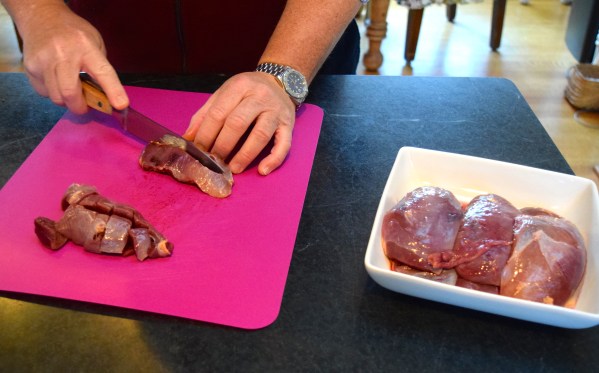
Chop the breasts into bite-sized pieces. Duck stew roux

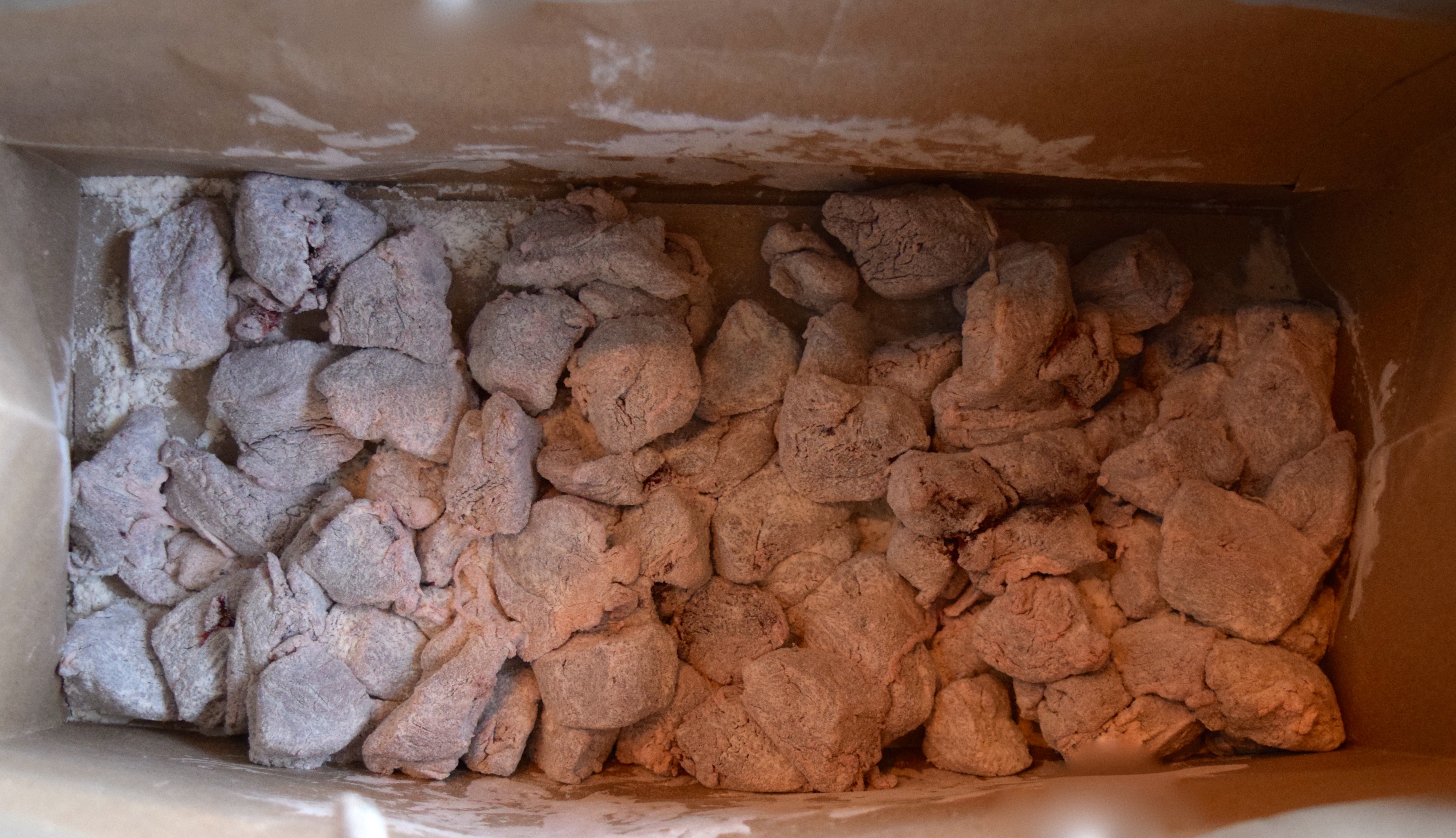
Put the flour, salt, and pepper into a paper bag, add duck pieces and shake to evenly coat each piece of meat. Discard excess flour. Set aside the coated meat.
Duck stew roux

Here my husband is teaching my son how to make duck stew.

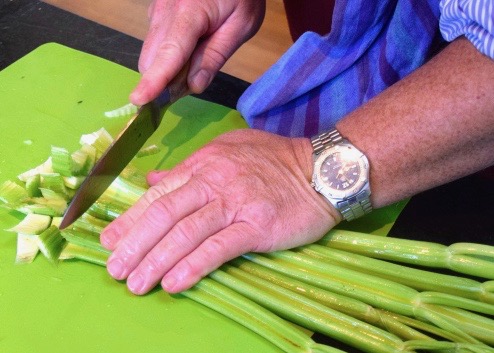
Wash and scrub the veggies. There is no need to peel them. Coarsely chop the onions, slice the celery and carrots thickly, and mince the peeled apple. Set veggies aside.

Prepare the stew:
Melt butter in a sauté pan or in the bottom of a 6-quart Dutch oven.

Duck stew roux

Add floured and seasoned meat to pan and brown on all sides.

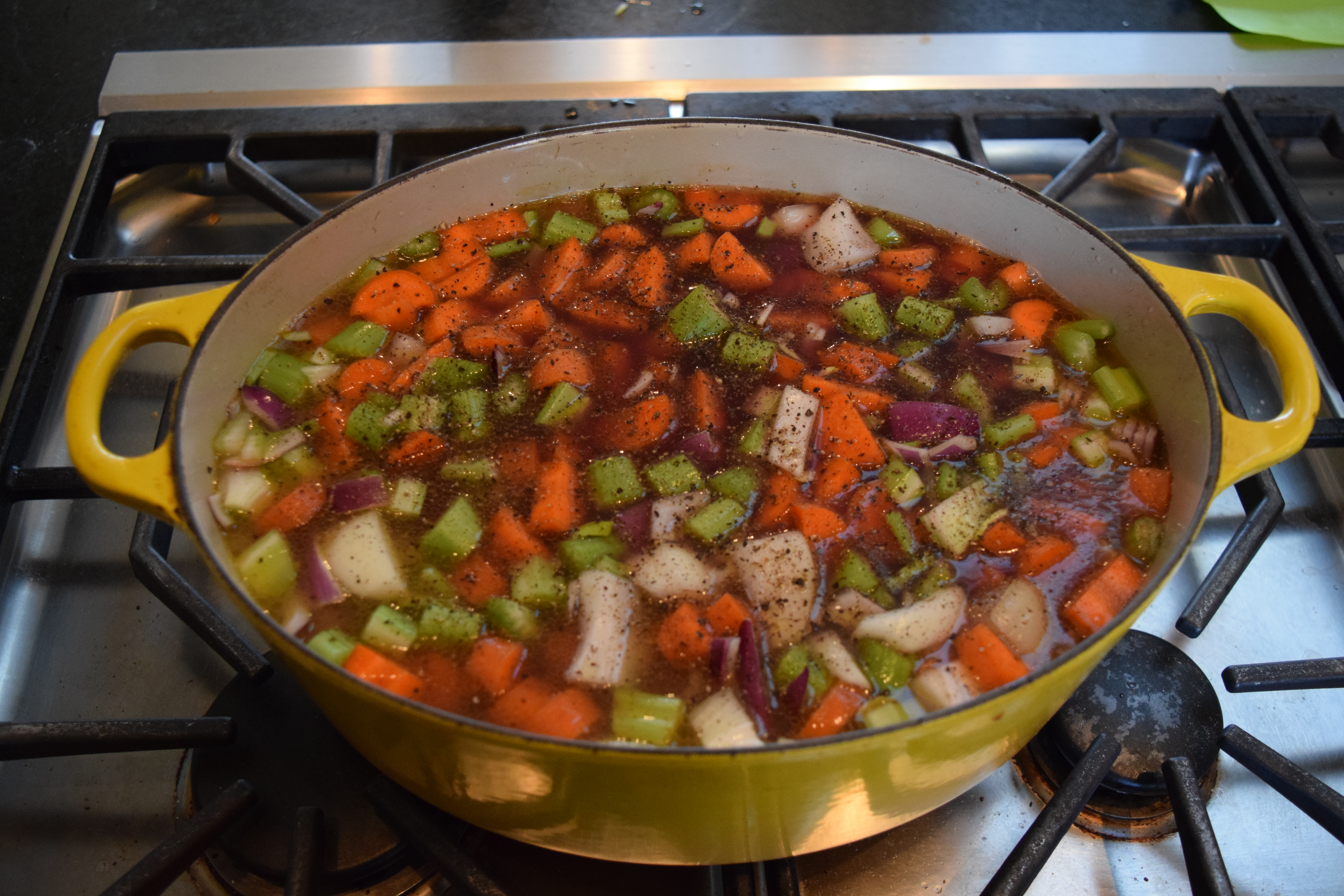
Add meat and juice to a stockpot or Dutch oven. Deglaze the sauté pan with ¼.cup red wine and add to pot. Add onions, celery, carrots, and apple. DSC_0627

Add broth. Add salt as needed, lots of cracked pepper, and red wine.
DSC_0635

Cover and simmer on the stove for about 2 hours, then add potatoes and cook for an additional hour. We used sweet potatoes this time, but found the stew to be too sweet and now only use white potatoes.

Duck stew roux

My husband serves the stew over a wedge of homemade cornbread placed in the bottom of each person’s bowl. We add a garnish of sliced green onions and parsley on top. Sometimes we add crumbled cornbread, as well. Delicious!

Related Posts:
Chicken Stock from Rotisserie Chicken Bones
Bruce’s Turkey and Sausage Gumbo
Aunt Bridget’s Chicken Soup with Little Meatballs
Mrs. Lombard’s Portuguese Kale Soup
Pasta e Fagioli

Don’t miss a recipe! Become a subscriber and have every post delivered to your Inbox.

Follow Judy’s Chickens on Instagram and Pinterest @JudysChickens.

Remember to always check this website for updated versions of a recipe.  

© 2014-2025 Judy Wright. All rights reserved. Photos, videos, and text may only be reproduced with the written consent of Judy Wright.

Bruce’s Turkey and Sausage Gumbo

I raised my hand and said to the chef, “I’m just not getting this. What is a roux? What does it DO?” I was sitting in a class at The New Orleans School of Cooking while my husband attended a meeting. The chef was big and hilarious, so when he suddenly got serious and answered, “A roux is the difference between bread and toast,” I felt like Confucius had just spoken. I smiled. I nodded. I had not a clue what he was talking about. But some mystical voodoo thing was happening in his kitchen, and I didn’t get it.  I sat in my seat and continued to take notes, but I knew a roux was not in my future, so neither would gumbo or étouffée ever be either.
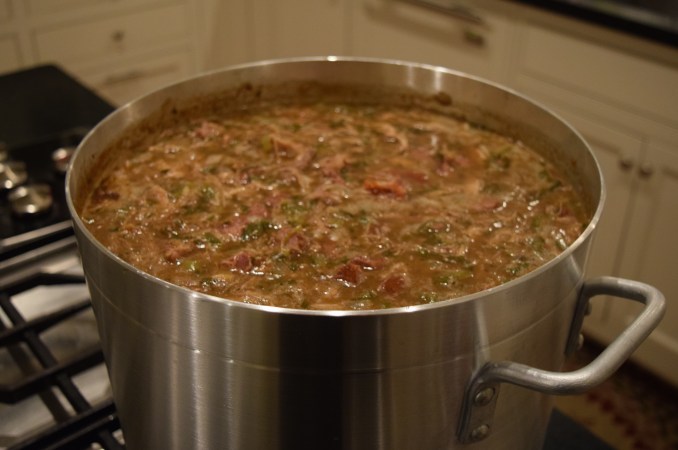
Fifteen years later, I found myself cooking regularly with Bruce Dobie and Ann Shayne in The Nashville Food Project kitchen, where we were volunteer chefs. Bruce is from Lafayette, Louisiana, also known as South Louisiana. Every fall, Bruce started talking about the gumbo he would make with the turkey carcass as it got closer to Thanksgiving. When Bruce was growing up, it was a South Louisiana tradition to have turkey dinner on Thursday and gumbo several days later. Bruce said his brother would say to the turkey at the end of the Thanksgiving meal, “Bye. See you Saturday.” Fridays were reserved for making stock and pulling meat from the bones.

Ann and I asked Bruce if he would show us how to make gumbo. He was happy to oblige. We were told to save our T-day turkey carcasses in the freezer until we could figure out a time to cook. He would start by teaching us how to make a roux.

Bruce arrived in my kitchen one Sunday afternoon with three boxes of groceries and cooking utensils. Ann and I were instructed to make turkey stock and pick out meat from the strained stock. Noted. We arrived with our part of the gumbo. Bruce is an enthusiastic guy by nature, and his enthusiasm is contagious; thus, he was pumped and we were pumped. He started waxing eloquently about the mystery that was about to unfold. I thought he was discussing the mystery of making a roux, but he said the roux was just the “foundation of something miraculous.” Bruce’s miracle had to do with what happened in the stockpot once we put all the ingredients together and let them simmer for the day. He repeatedly used three M words: miraculous, magical, and mysterious. Ann and I were in for a good ride.

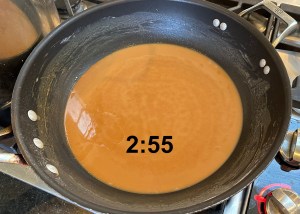
Just so we are all on the same page, a roux (pronounced “roo”) is a thickening agent for soups and sauces. It is made by cooking equal parts of flour and fat in a thick-bottomed pan until the flour is brown and toasted. A properly cooked roux is silky-smooth and adds an intense nutty flavor while doing its core job of thickening soups, sauces, and gravy. The longer you cook it, the darker it becomes and the more intense the flavor; you might cook it until light in color for gravy, darker for an étouffée, or to chocolate brown for gumbo. Bruce is a newspaperman, so he would say, “Cook until it’s the color of Ronald Reagan’s brown suit.”

You don’t want to burn it, so you must constantly watch it and whisk it. I remember our instructor in New Orleans telling us that when his mother was making her roux, that was the time children would get into mischief by doing things like jumping on beds. They knew their mother would never leave the roux.

Yield: Four gallons. Divide the ingredient list in half for the amount you would prepare if using one large turkey carcass.

Ingredients:
2 turkey carcasses should yield 8 quarts of gelatinous broth and about 2 pounds of turkey meat.

8 quarts turkey stock
2 large onions, chopped
2 sweet bell peppers, chopped
6 stalks celery, chopped
1 head of garlic, minced
¼ cup olive oil
40 okra pods, sliced
2 bunches of parsley, chopped
2 bunches of green onion tops, sliced
2 15-ounce cans of whole tomatoes, diced, save juices
2 pounds Veron Andouille Sausage
1 pound Conecuh Original Smoked Sausage “Spicy & Hot”
1 pound Conecuh Hickory Smoked Sausage
5 pounds turkey breast, cooked and cut into bite-sized pieces
2 pounds turkey meat pulled from the carcasses (1 pound per carcass)
1⅓ cups all-purpose flour, sifted to get rid of lumps
1⅓ cups canola oil
50 drops Tabasco Sauce
2 tablespoons Louisiana Hot Sauce
2  teaspoons red pepper powder (cayenne)
1 teaspoon crushed red pepper
1 tablespoon gumbo file (a sassafras thickener)
2 tablespoons ground black pepper
Salt to taste, to be added after it has cooked. I added 1½ tablespoons

Prep the Stock:
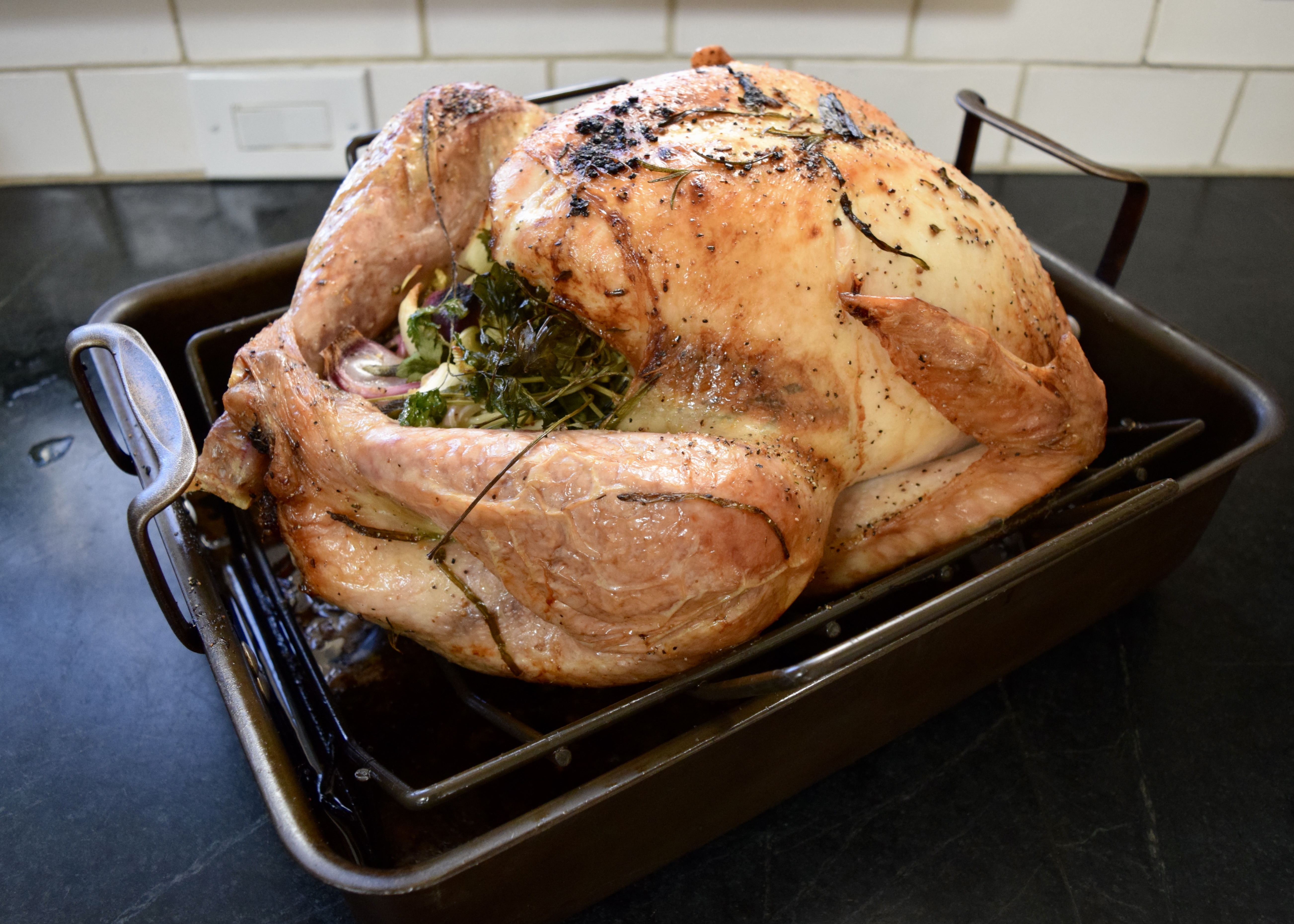
It all starts with a roasted turkey. Throwing an uncooked turkey in boiling water will not yield the same richly-flavored results. Roasting the turkey first will. It is okay to freeze the carcass until you are ready to use it.
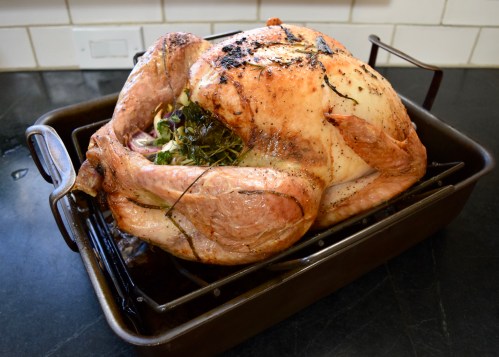
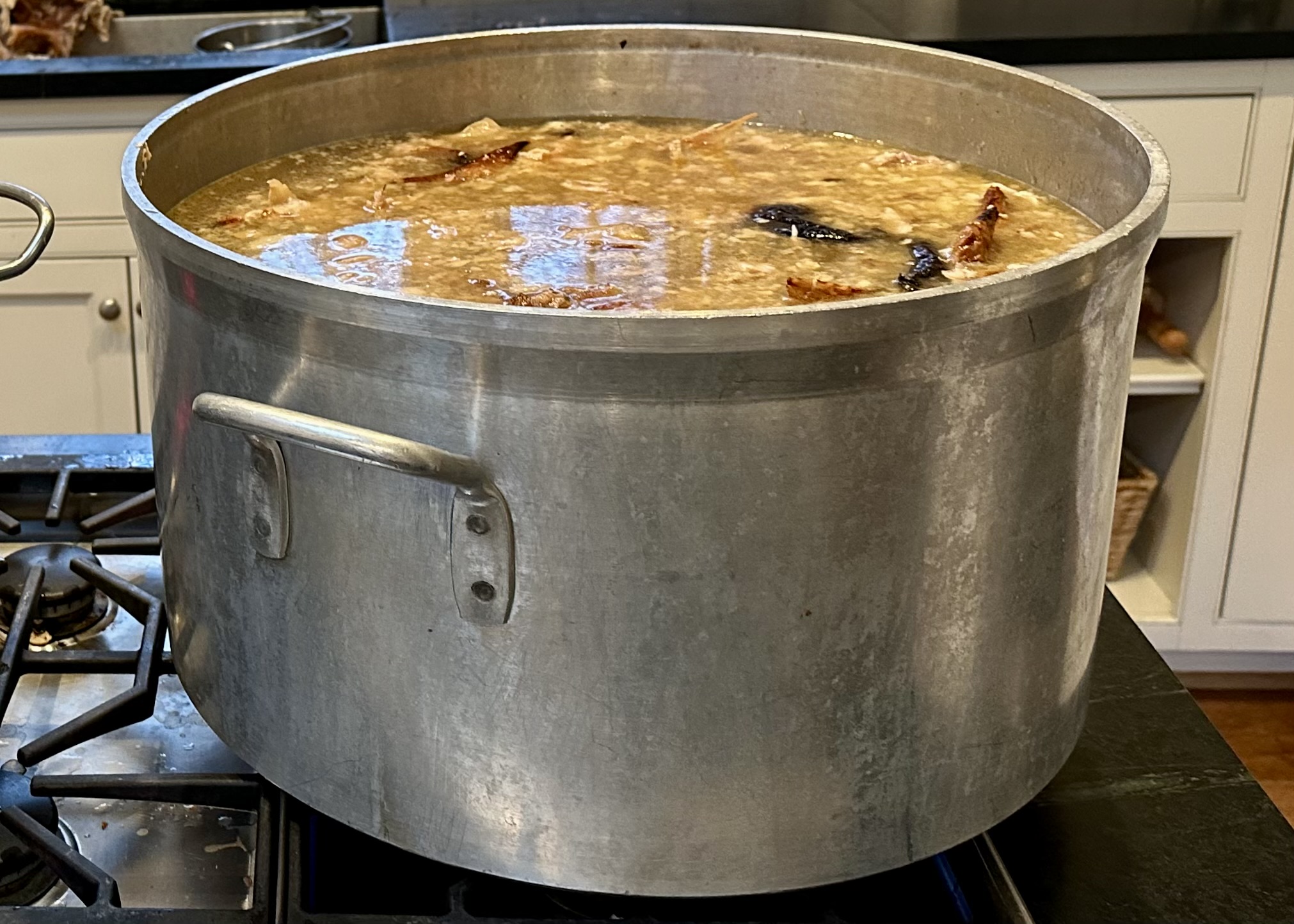
Simmer the turkey carcasses, complete with skin, innards, and any leftover meat, in a large stockpot of water for a minimum of five hours. There is no need to add any seasonings as the turkeys were well-seasoned when roasted.

Strain stock. Set bones and meat aside and refrigerate liquid until fat rises and hardens. Remove fat. The stock should have the consistency of Jell-O.

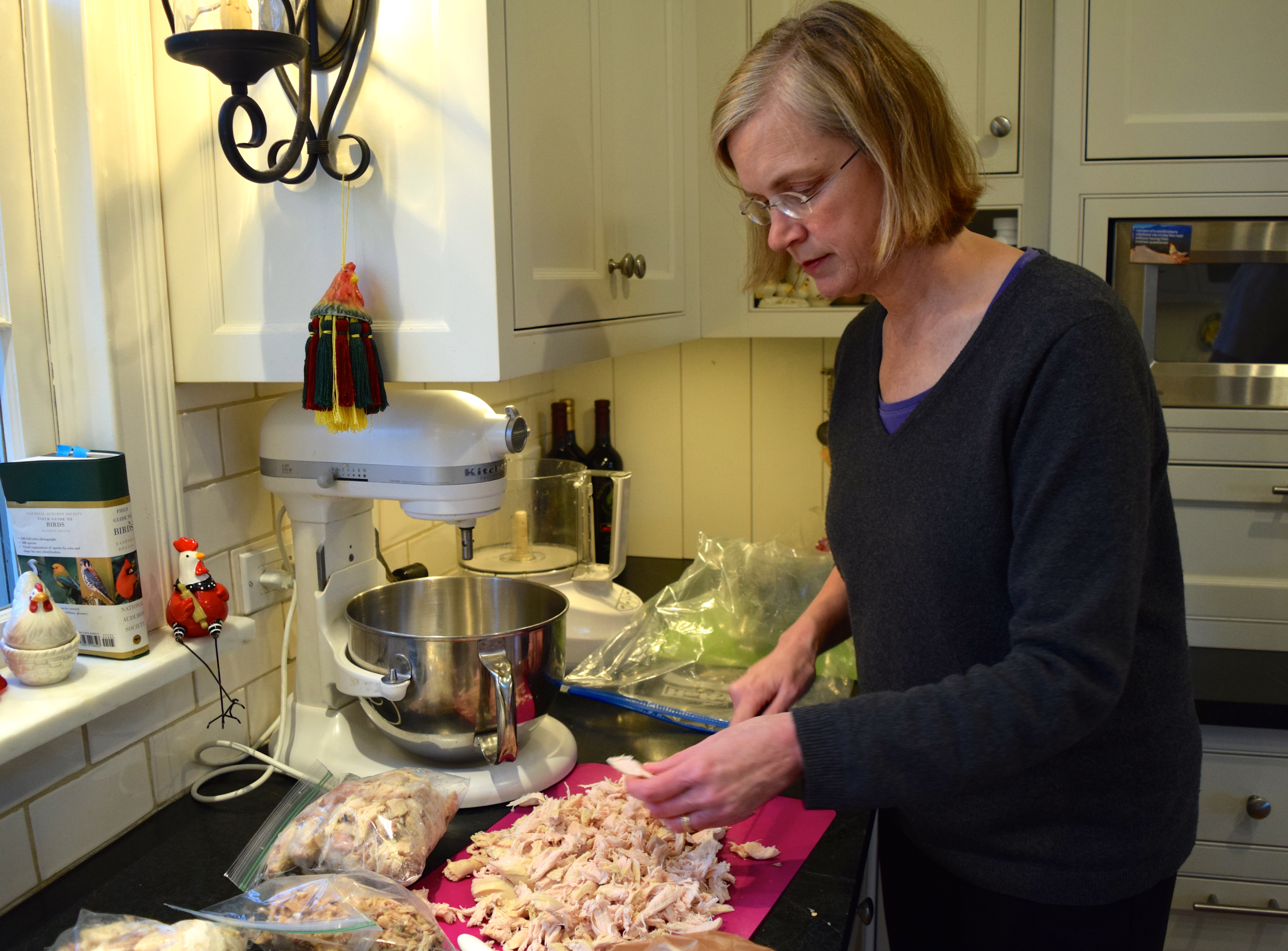
Spread meat and bones on a baking sheet and allow to cool. Once cool, pull meat off, including little pieces. Discard bones and skin. Below is a picture of Ann’s two pots of broth with the hardened yellow fat on top.
IMG_7719

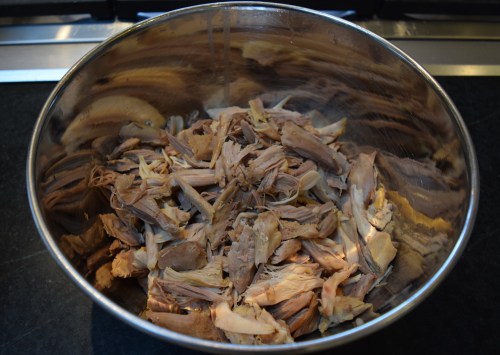
This photo is of the meat we picked, about one pound per carcass.
gumbo Gumbo

Game Day:
We’ve got all our ingredients out and are discussing our game plan.
gumbo Gumbo

 Prep the Vegetables and Meat:
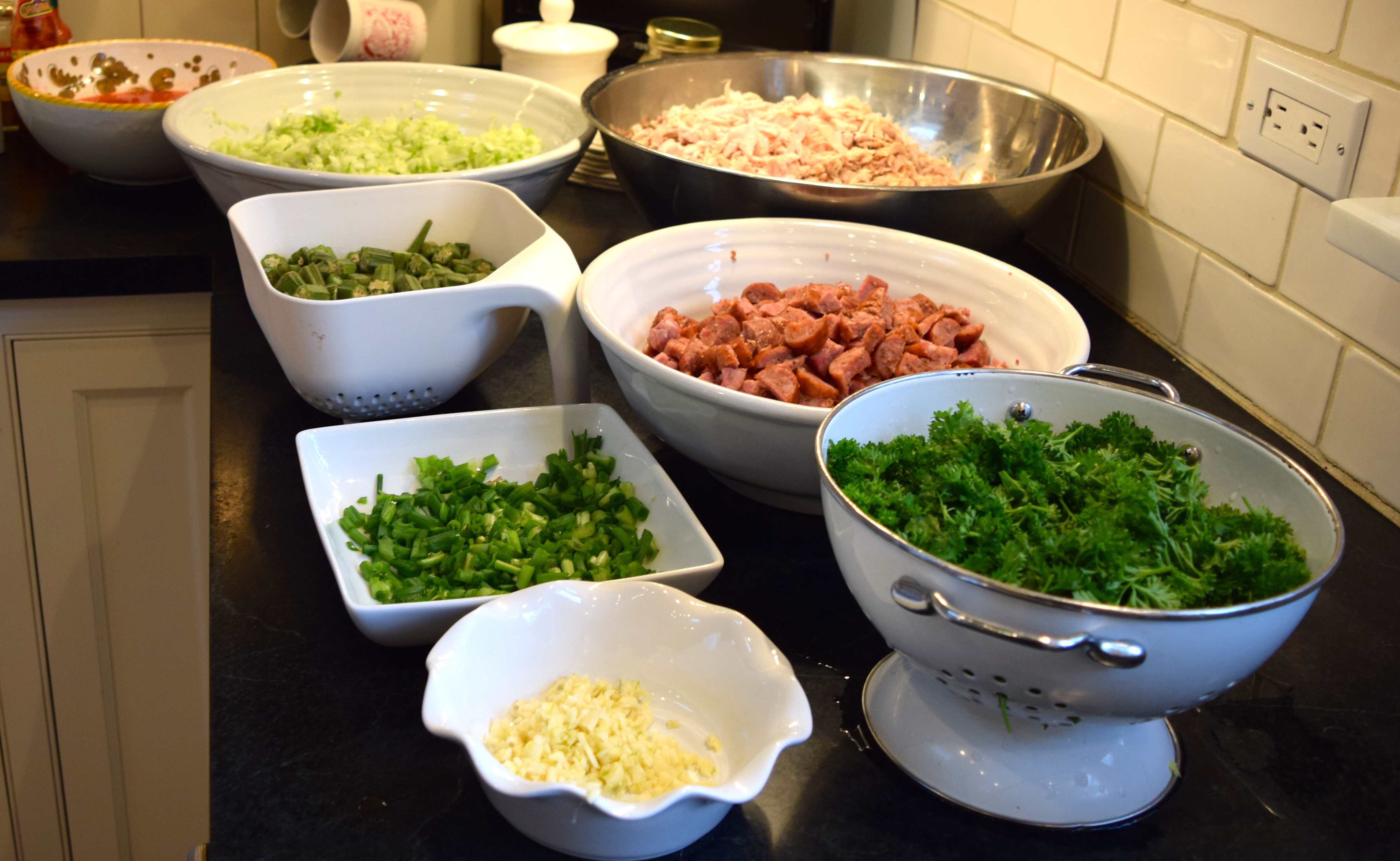
Our mise en place: Turkey, sausage, parsley, garlic, green onion tops, okra, bowl of the trinity (onion, sweet bell pepper, celery), and, turning the corner, chopped tomatoes.
gumbo Gumbo

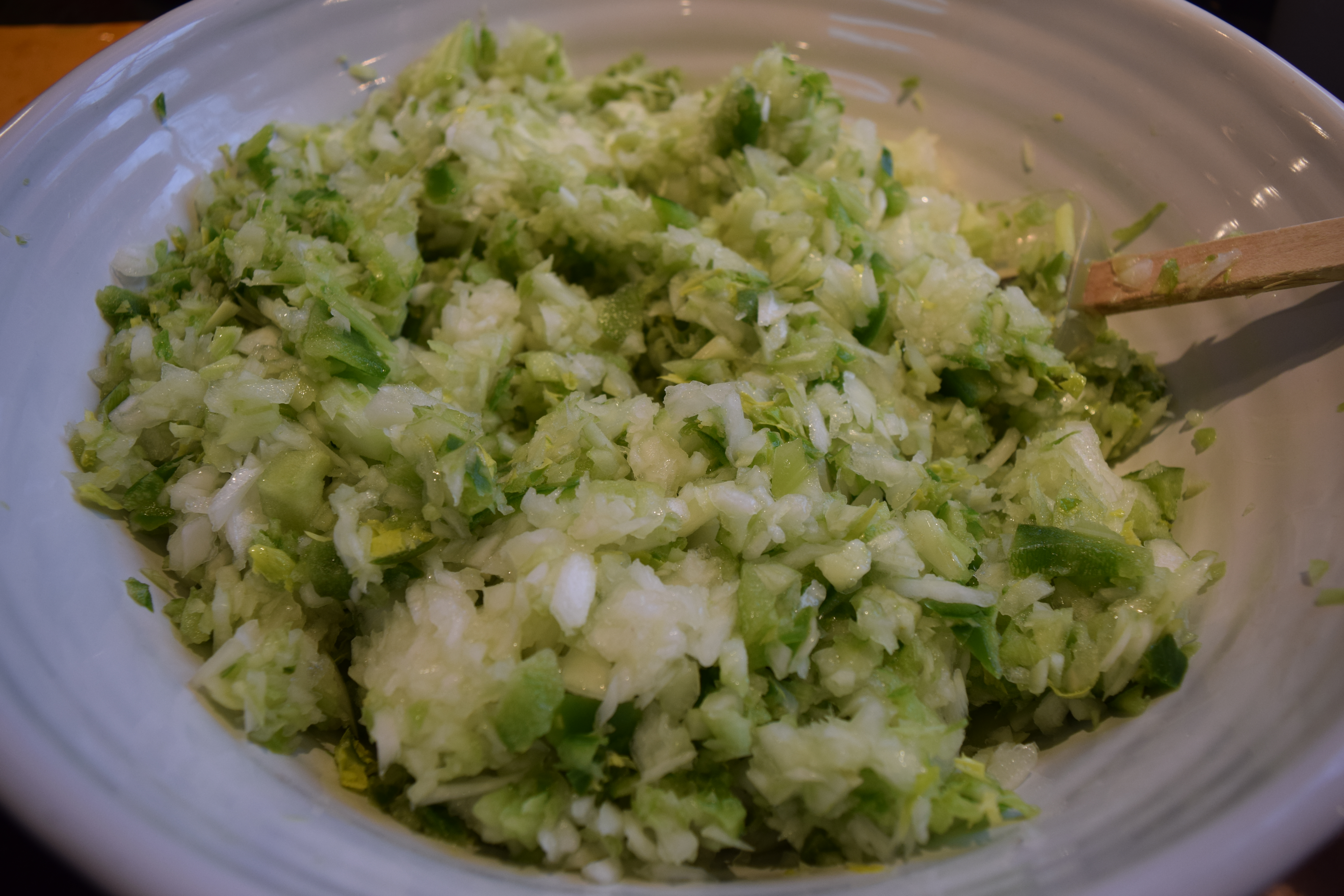
Chop the onions, celery, and green peppers. This is known as the trinity. Add minced garlic, and you have added “the pope.” Add the pope.
DSC_0196

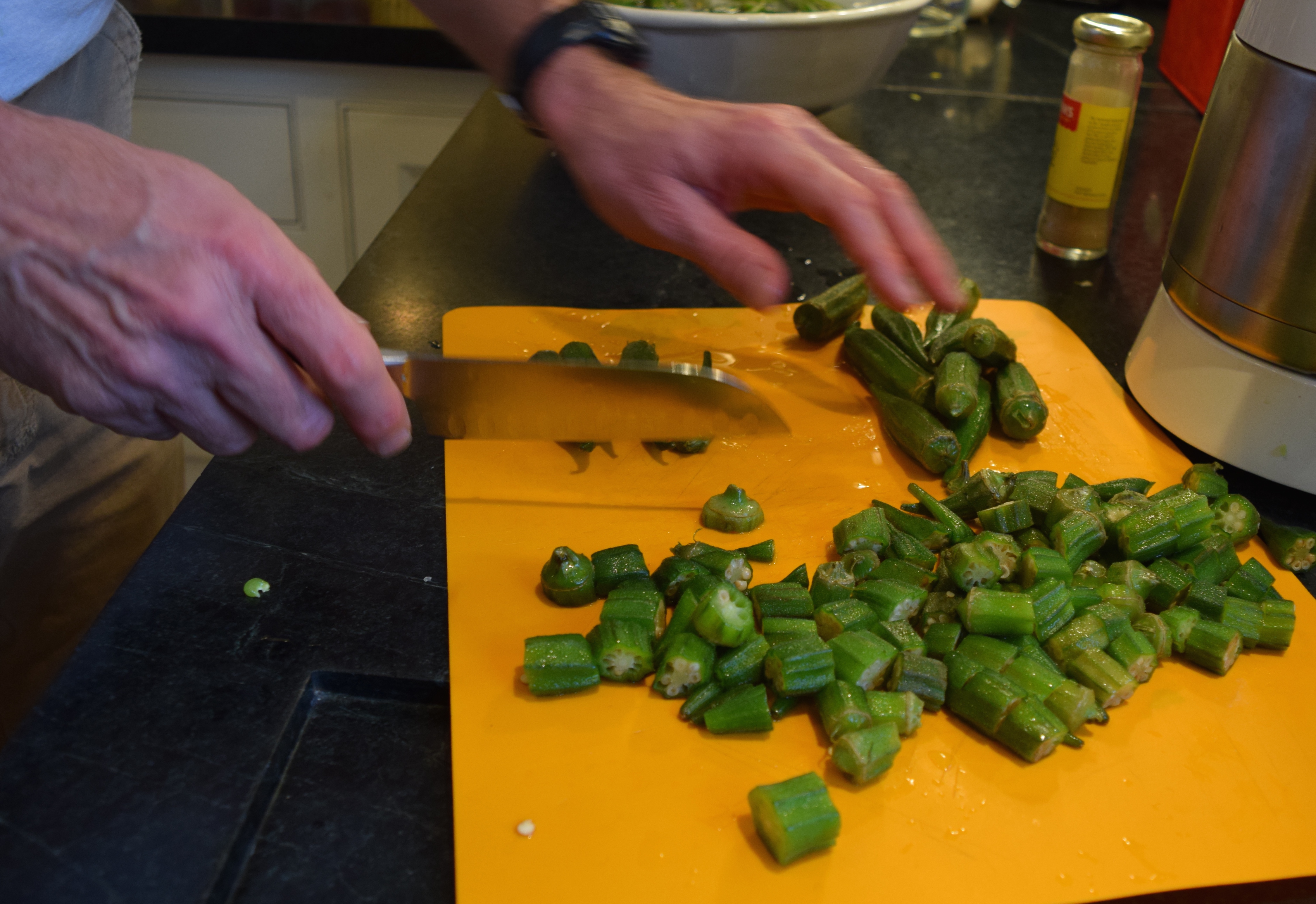
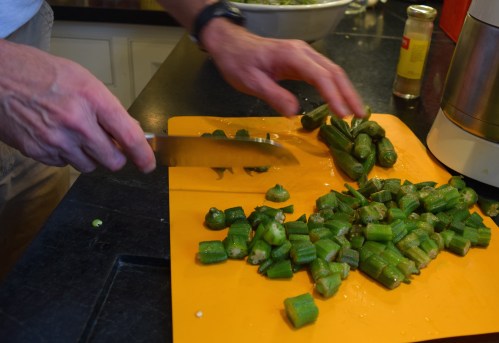
Slice the okra, including the short stem. Bring a pot of water to a boil and blanch okra for 5 minutes. Drain. This helps keep okra from becoming too gooey in the gumbo. Set aside.
gumbo Gumbo

Pierce sausage in multiple spots with a fork and place in a shallow pan with boiling water for 5 minutes to release fat. Alternatively, Bruce grills the pierced sausage. Cut into bite-sized slices. Set aside.

Chop turkey into bite-sized pieces. Set aside.
gumbo Gumbo

Chop parsley, green onion tops, and tomatoes. Set aside.
gumbo Gumbo

Make the Soup:
Into a 20-quart stockpot, add olive oil and the chopped onions, celery, sweet peppers, and garlic mixture. Sauté on low heat for 15″ until vegetables are softened. Add the turkey stock, chicken, sausage, okra, parsley, green onion tops, and tomatoes. Turn the heat to medium and let it cook while making the roux.
DSC_0280

Making the Roux

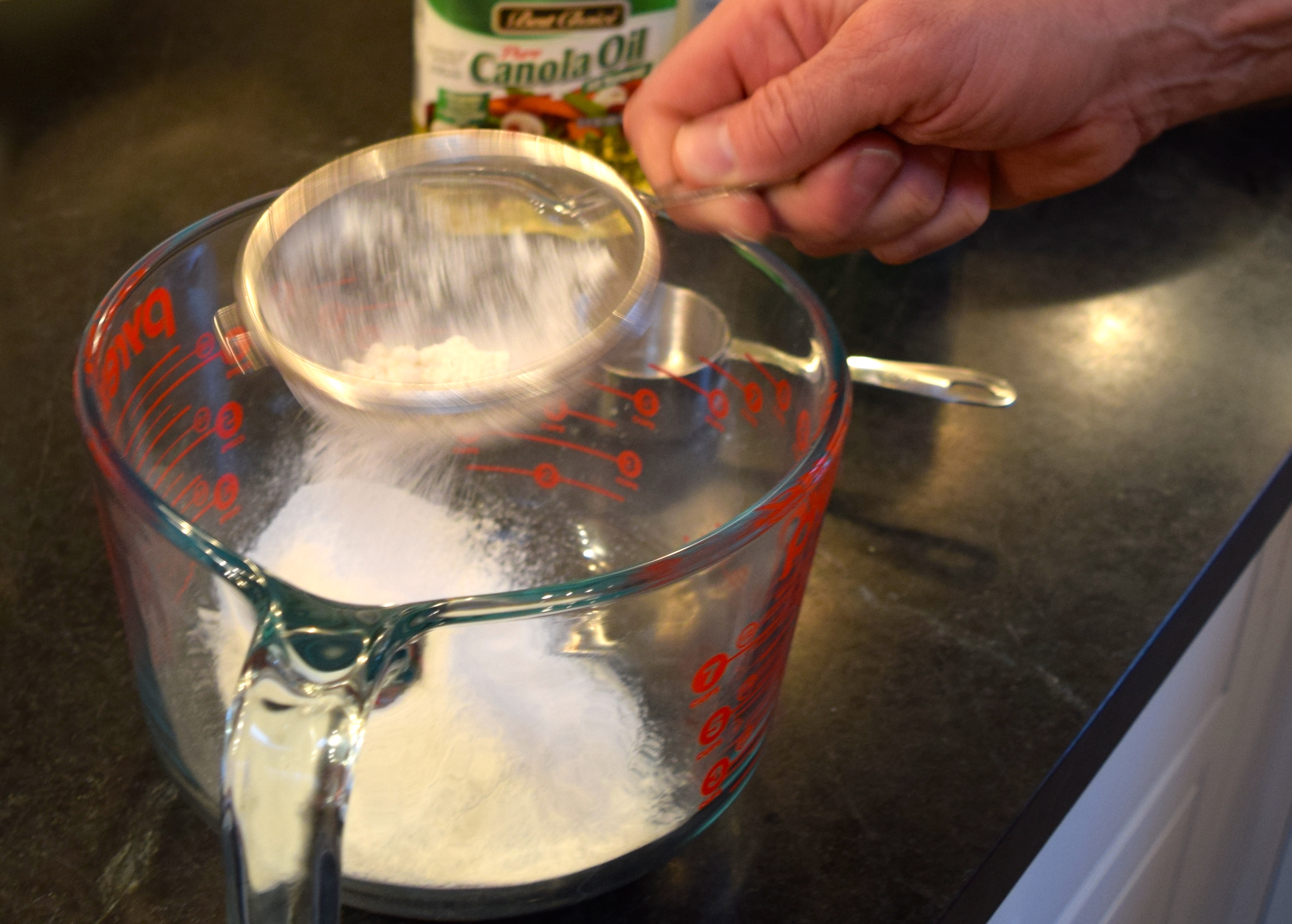
A roux is made with flour and a fat (cooking oil or butter). Use equal parts of fat to flour. There can’t be any lumps, so run the flour through a sieve.

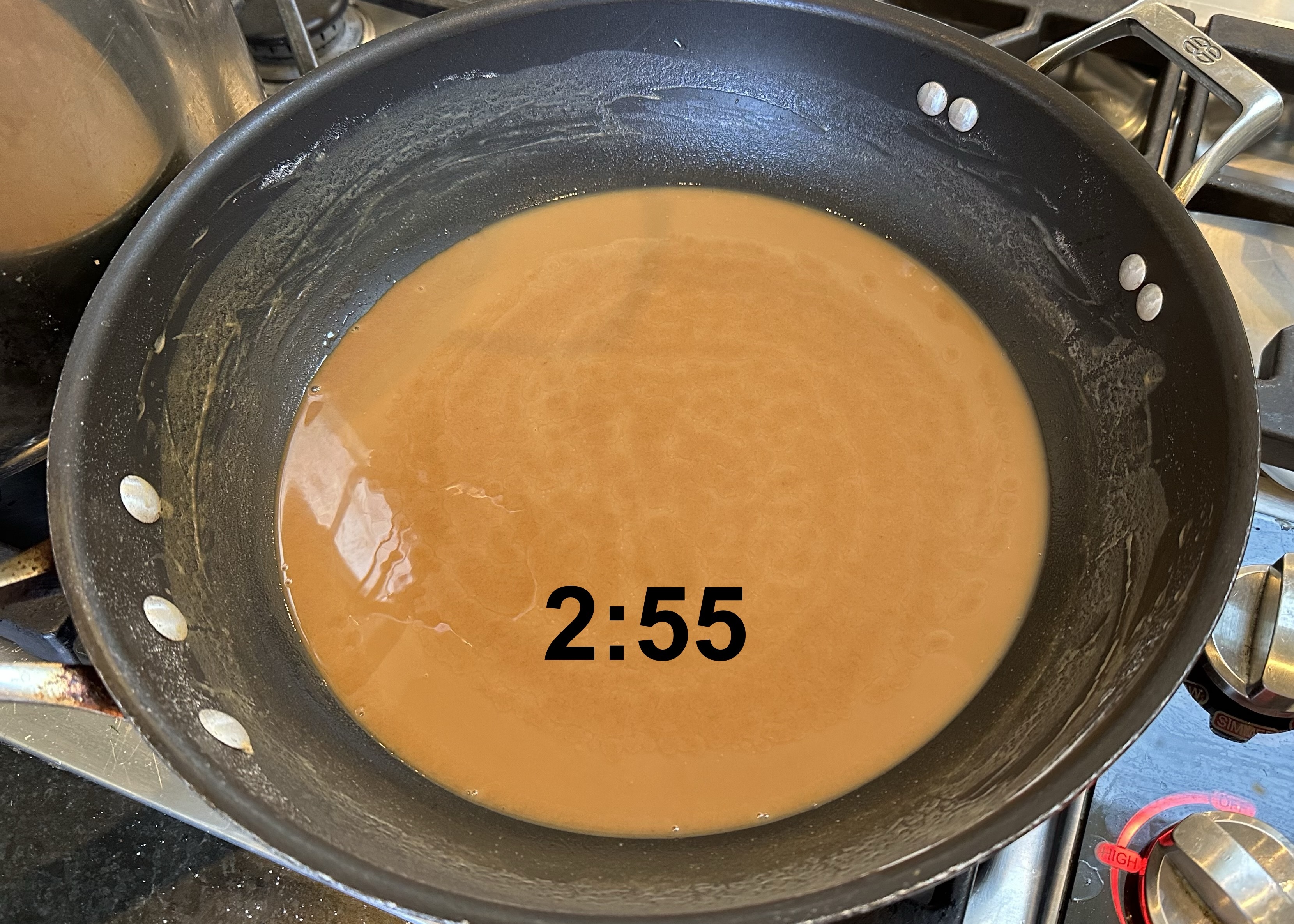
gumbo GumboYou cannot rush making a roux; it will take at least 30 minutes on medium-low heat. You cannot leave it; you will need to whisk it for the whole time it cooks. Finally, it is ready when as Bruce says, “It becomes the color of Ronald Reagan’s brown suit,” a nice chocolatey brown.

***Be careful; the mixture is boiling and can cause severe bubbling-type burns on your skin should it spill on you. I never cook it when children are in the vicinity.

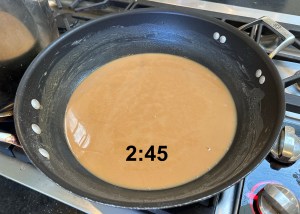
 

Pour the roux into the gumbo pot. It will sizzle when it touches the soup.

The Seasonings:
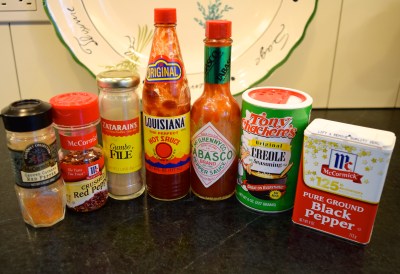
Cajun seasonings, take a bow! We used every heat spice except Tony’s Chachere’s Creole Seasoning. I’m not sure how that got in the photo.
gumbo Gumbo

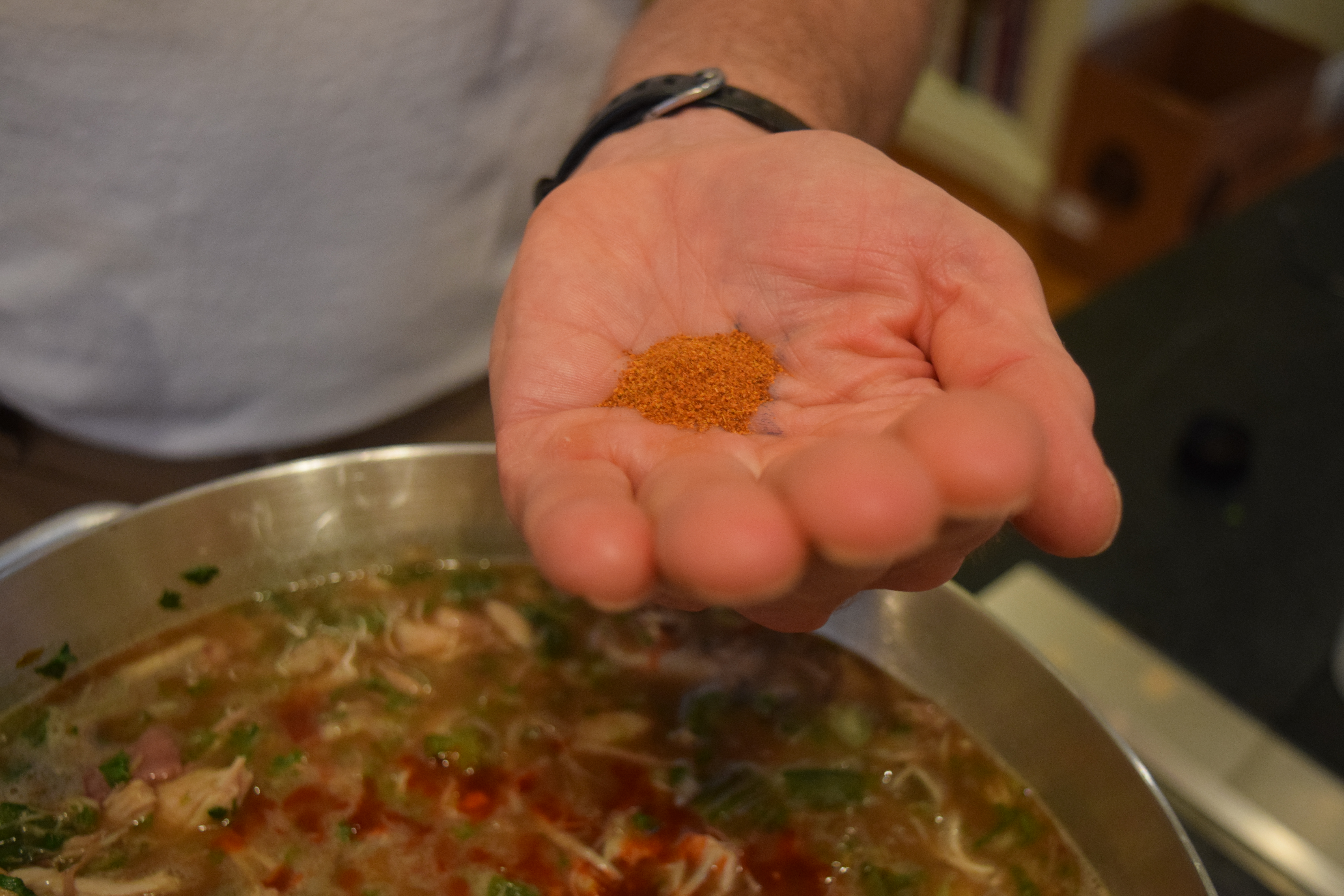
Realizing that adding spices to a dish when unfamiliar with them is daunting, I will show you how much of each seasoning Bruce said.
50 drops of Tabasco sauce and 2 tablespoons of Louisiana Hot Sauce.
DSC_0321

1 teaspoon each of cayenne red pepper and crushed red pepper flakes, and 2 tablespoons ground black pepper!
DSC_0326

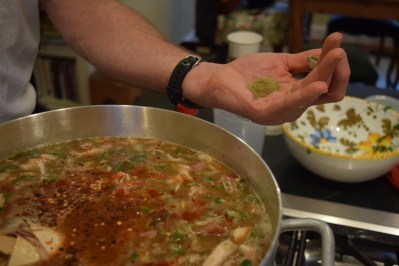
1 tablespoon of gumbo file (ground sassafras used as a thickener)
DSC_0330

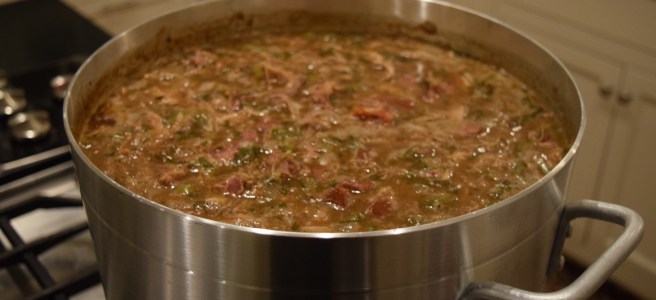
Stir it all together, simmer until bedtime, and wait for the magic to happen.
gumbo Gumbo

Here’s Ann cheering the magic on.
gumbo Gumbo

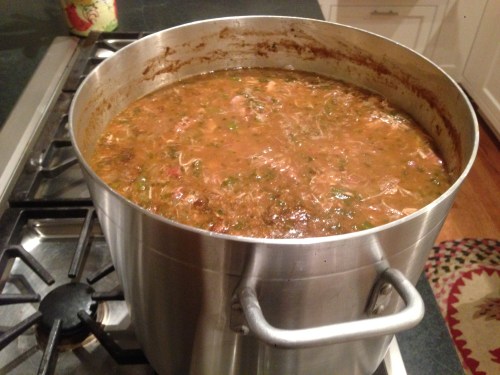
About 5 hours later. After giving all the flavors time to meld, add salt to taste.
IMG_6788

I turned the stove off, put the lid on, and put the gumbo to bed. First thing in the morning, I put the gumbo into containers and stored some in the refrigerator and some in the freezer.
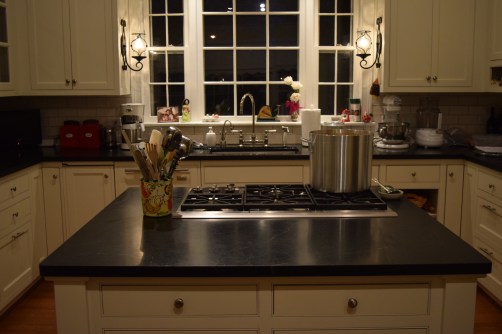
DSC_0353

To Serve:
-Serve over rice (not too much– should still be soupy).
-Add fresh chopped green onion or parsley on top.
-Bruce likes to heat it up and add shrimp just before serving.
-Have these three seasonings available for people to season their gumbo per their personal taste: Tabasco (for heat), Louisiana Hot Sauce (for flavor), and red pepper (more heat).
-Gumbo freezes well.

Thanks, Bruce and Ann! It was epic!

P.S. “And I helped!”

IMG_6787


Related Posts:
Mom’s Easy Pumpkin Pie
Karen’s Foolproof Make-Ahead Gravy
Grandma’s Cranberry Chutney
Holiday Inn: Feeding a Houseful
Chicken Stock from Rotisserie Chicken Bones
Winter Snow Day Fun: Soup, Knitting, and Coloring

LET’S STAY CONNECTED!

© 2014-2023 Judy Wright. All rights reserved. Photos, videos, and text may not be reproduced without the written consent of Judy Wright.

Follow Judy’s Chickens on Instagram and Pinterest @JudysChickens.

If you enjoyed this post, consider becoming a follower. Press “confirm” on the follow-up letter sent to your email address.
Raising Sorghum Cane to Make Sorghum Syrup

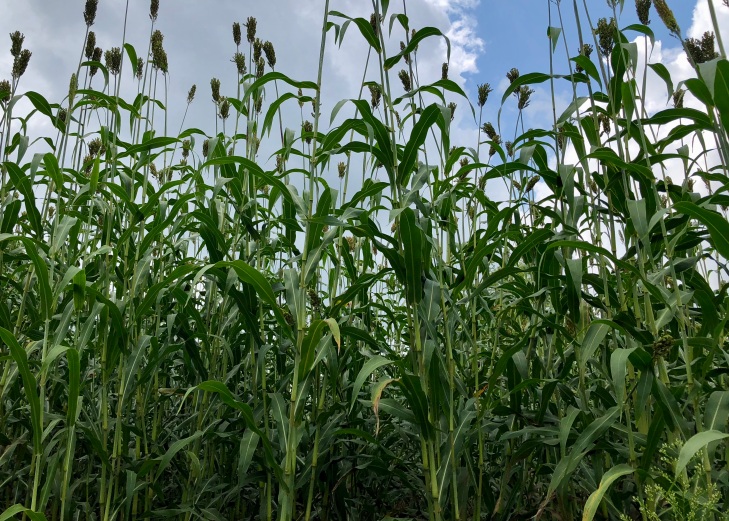
Last September, my husband and I were invited to watch a Mennonite family make sorghum syrup from stalks of sorghum we saw growing in a field all summer in Kentucky. The seeds were planted in April and the stalks were harvested from late August through September. While there are many varieties of sorghum grown, some for syrup, some for silage (animal feed), and still others for grain to be milled for flour, this family was growing their sorghum for syrup and silage.

The fields were gorgeous with their tall stalks, topped by a sea of golden bushy seed tassels. Up close, one can quickly see why sorghum is in the same grass family as corn, oats, and wheat; they all grow in the same way with long stems, broad leaves, and seed tassels full of kernels of millable grain.

Sorghum - Version 2

Sorghum cane usually grows from six to ten feet tall. It is exceptionally heat-tolerant, which may explain why it is often the last grass still green and standing in fields in the Southeast in September.

To harvest the cane, farmers strip off the leaves and remove the seed tassels. Next, the stalks are cut down as close to the ground as possible because that’s where most of the juice is found. The stalks are stacked on carts, and the carts are pulled by horses to the grinding shed.

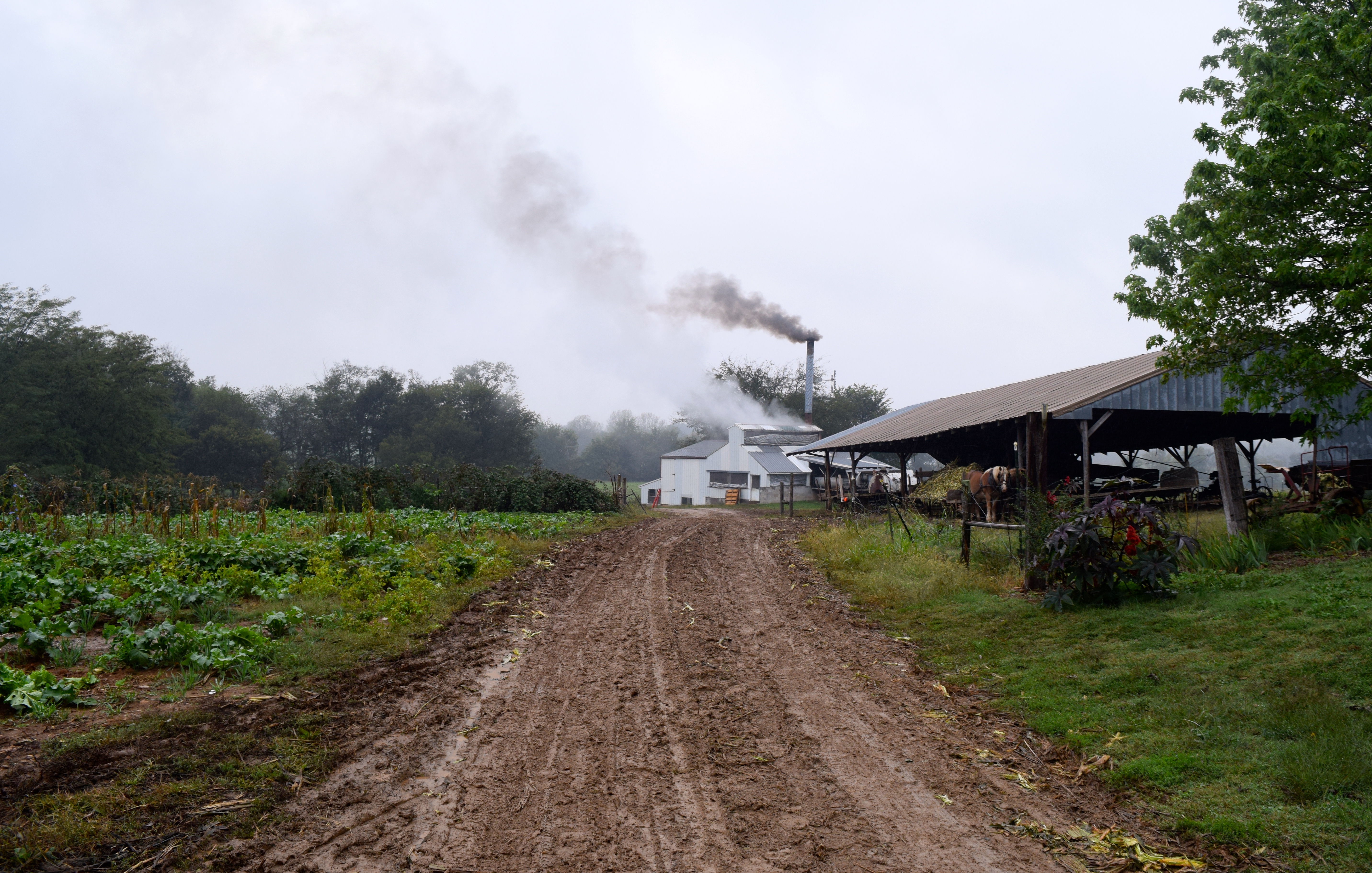
We had been to this farm many times to buy eggs and vegetables but had never been down this dirt road to the sorghum processing shed. Our farmer friend told us to head for the tall smokestack, and there we would find the men boiling down the syrup.

.DSC_0206

We passed an open shed on the right where the stalk grinder is located. Here, the sorghum stalks are fed into a set of rollers that press out the neon-colored juice.

Sorghum

If you have ever been to a historical demonstration of a sorghum pressing, you may have seen this same process, only back in the day, a mule was used to provide energy to pull the crank that rotated the rollers in the press. As the mule walked in a circle, sorghum juice poured from the press into a collection barrel. I found this image in a publication called Bittersweet.

1i3p24a

In Nashville, you can see a live demonstration of this process at the Music and Molasses Arts and Crafts Festival held annually in October at the Tennessee Agricultural Museum.

 events3

At the Mennonite farm, a diesel-powered conveyor belt moves the waste from the pressed stalks to a cart.

where the sweet-tasting scraps are enjoyed by the workhorses, who transport it to the compost heap.

..

There is beauty in the simplicity of this process.

Further down the road, we came to the cooking shed where the thin neon-green sorghum juice is cooked down to a thick syrup.

The pre-cooked juice is stored in the white tank located on the shelf on the left. The gray tank, on the right, is the boiler where steam is created to generate heat to cook down the syrup in the cooking pans located inside the white door.

Sorghum

On the backside of the building, you can see the wood-burning furnace that heats the water in the boiler to create steam. The younger generation of boys is tasked with keeping the fires stoked while the older men, in the building on the right, boil down the juice.

Sorghum

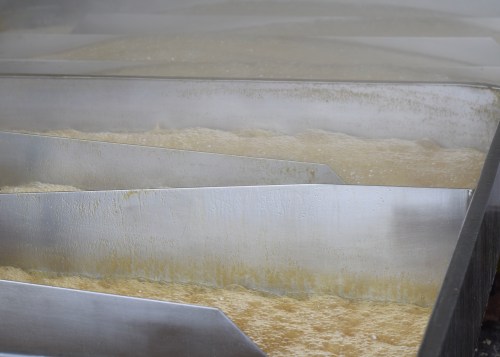
The steam, much hotter than boiling water, travels through pipes to the cooking room where it runs under a 75-foot maze of metal cooking trays. Ten gallons of juice will render one gallon of syrup. The steam in the room is created by the nine gallons of water boiled out of the juice. The steam is so thick you can barely see across the room.

Sorghum

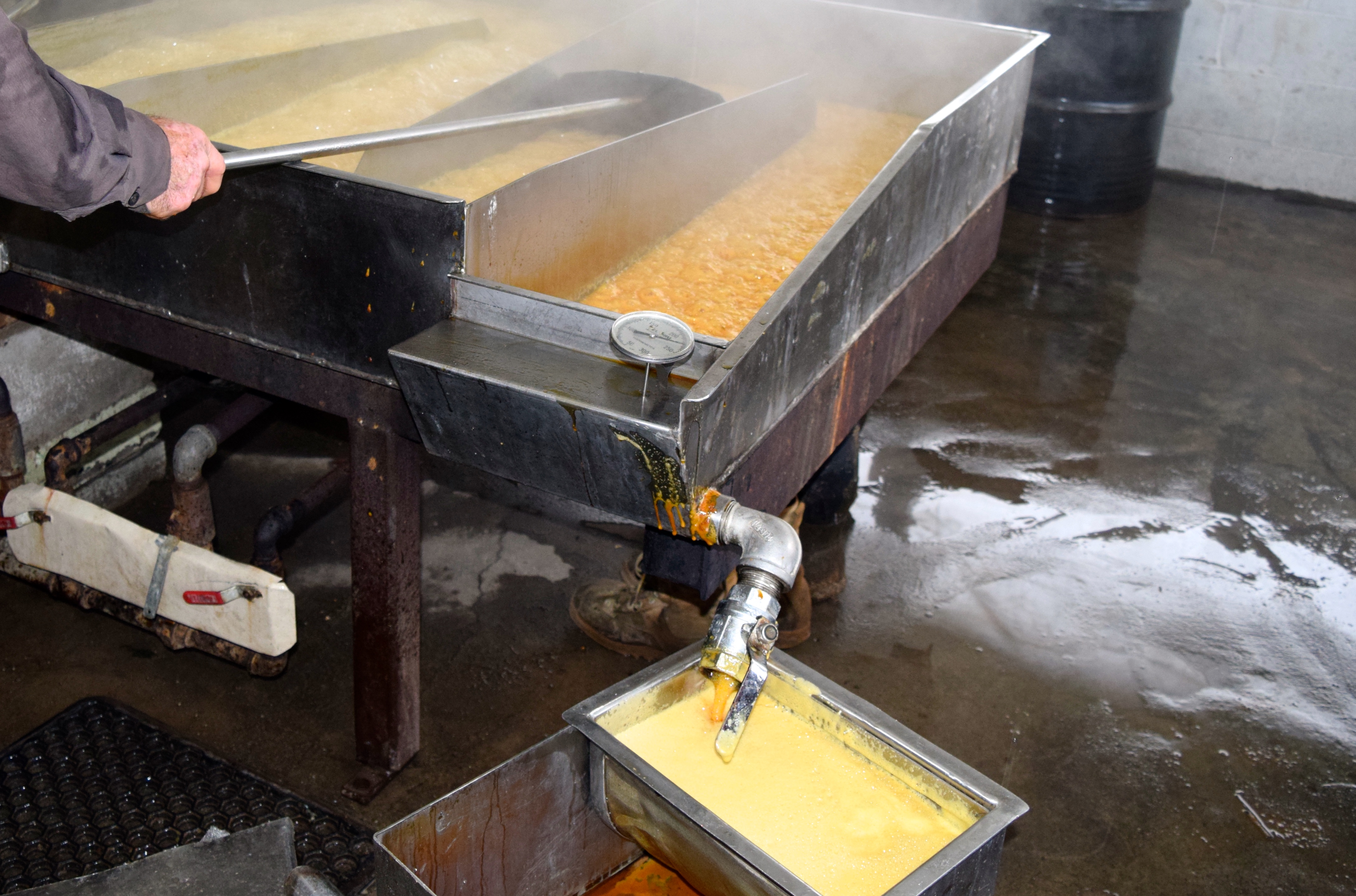
The sorghum syrup starts out as a thin neon-green liquid loaded with not so tasty chlorophyll. The farmer uses a hoe-like tool to skim off the chlorophyll and other impurities on the liquid’s surface, as it boils up from the juice.

By the time the syrup reaches the end of the maze, it is ready to be filtered and jarred. Here the farmer scrapes the last bit of sweet foam off the syrup so there won’t be white foam streaks in the jar.

An old farmer I met in Nashville told me when he was growing up, there was a commercial sorghum mill in Crossville, and on the day they were cooking the syrup, all the mothers in town would send their kids to the mill with steel cups to scavenge the foam and bring it home. The mothers would use this gleaned sweetener to make cakes and biscuits. He said the foamy syrup was tasty and free!

Sorghum

The syrup drips through the filter into a barrel and from there is poured into jars of all sizes. It is sold in stores around the county.
Sorghum

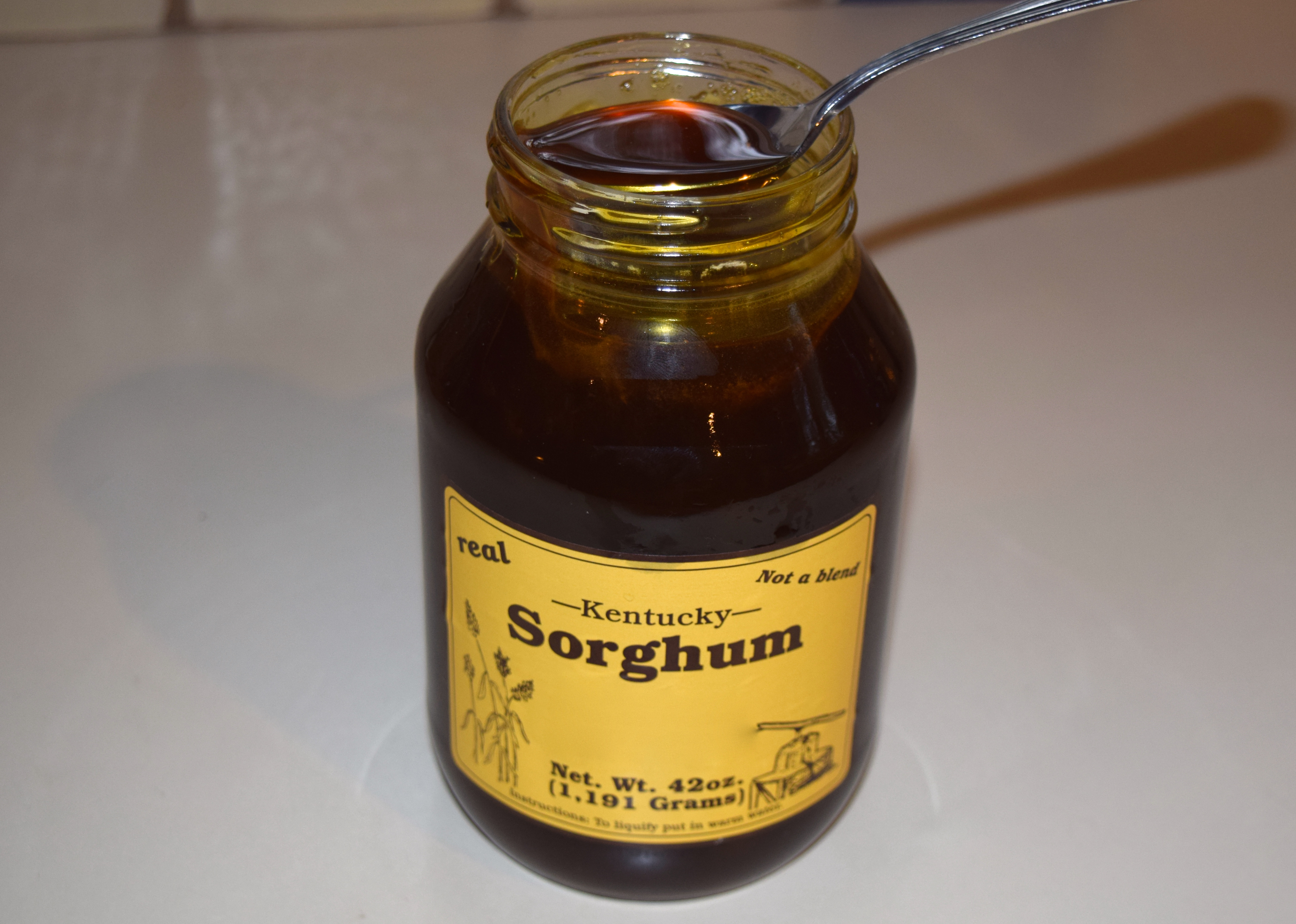
Sorghum is enjoying quite a renaissance lately. I see it frequently listed as an ingredient on many restaurant menus. You can use it in almost any recipe that calls for honey, molasses, corn syrup, or pure maple syrup. That includes both sweet and savory dishes. It is high in iron, potassium, and calcium and is 100% natural with no chemical additives.

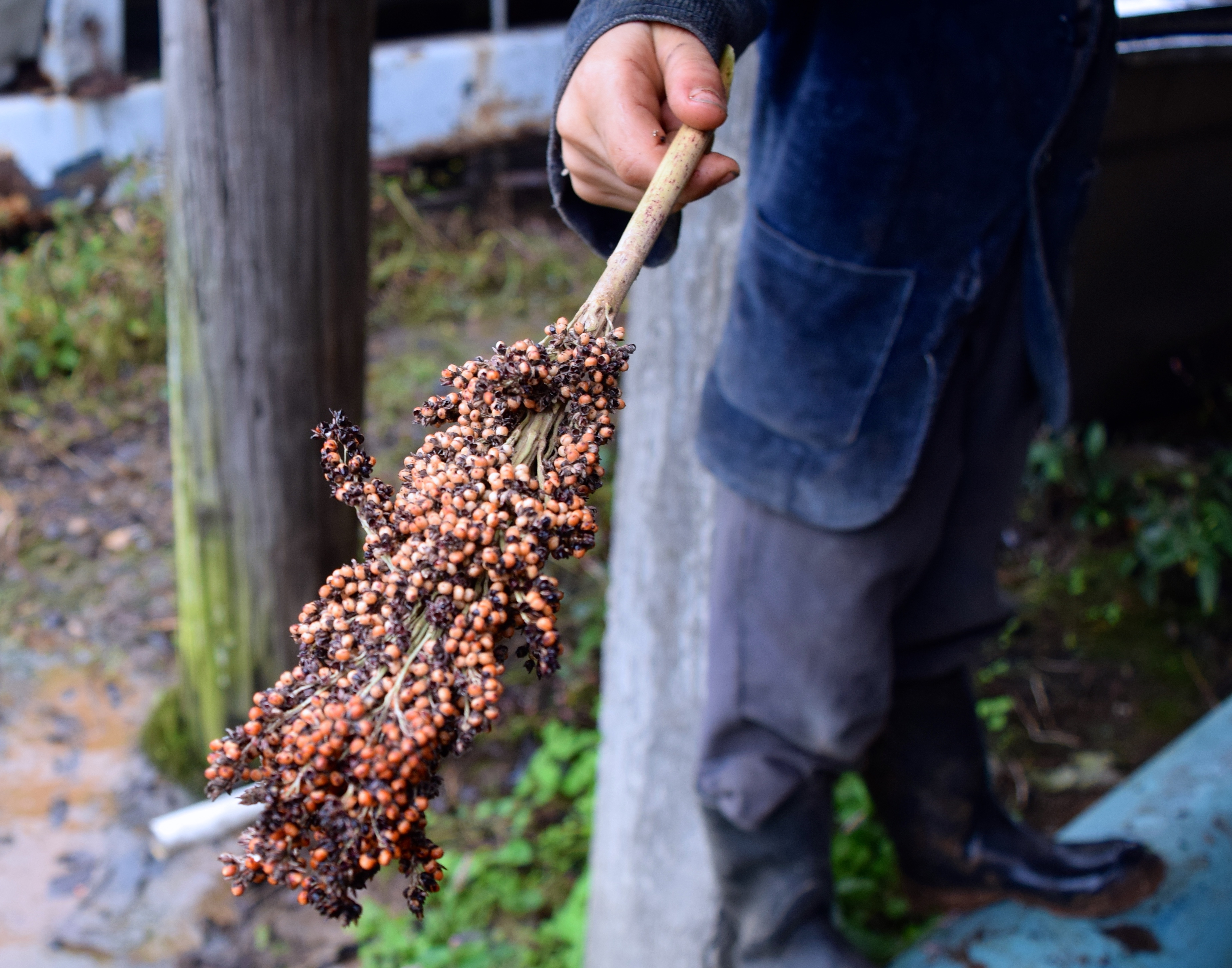
As we were getting ready to leave the farm, a young boy offered me a sorghum seed tassel. He had been picking off the kernels and eating them while we toured. I asked his dad if the seeds were good to eat. He told me, “Don’t eat them, PLANT them,” and he gave me a seed tassel. He instructed me to plant one red seed every six inches in the spring.

Sorghum

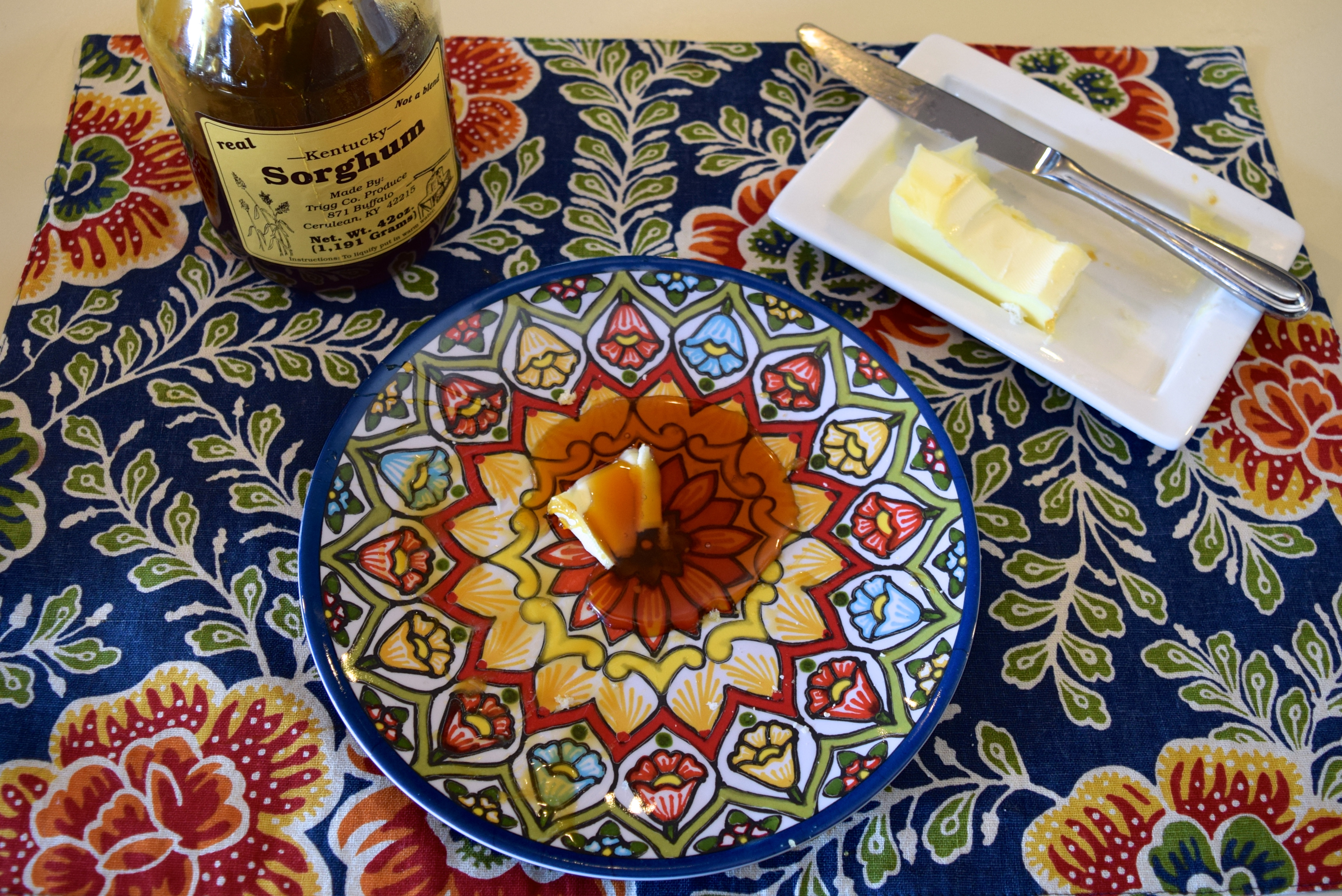
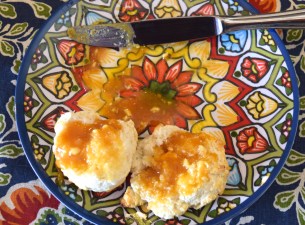
Our favorite way to enjoy sorghum is mixed with butter and spread on a biscuit! Check out my biscuit recipe here.

DSC_0280  DSC_0271

Related Posts on Commercial Farming:

If you enjoyed this post, please share and become a follower. When signing up to become a subscriber, be sure to confirm on the follow-up letter that will be sent to your email.

Follow Judy’s Chickens on Instagram and Pinterest @JudysChickens.

Always check my blog for the latest version of a recipe.

© 2014-2020 Judy Wright. All rights reserved. Photos, videos, and text may only be reproduced with the written consent of Judy Wright.