@judyschickens Everyday Salad Dressing

When your son calls and asks, “How do you make salad dressing, Mom?” first, you melt, and then you get busy blogging. After all, wasn’t that the reason you started blogging, so your kids could have easy access to THE recipes with a few good Big Fat Italian stories thrown in for good measure?

IMG_3524

Salad dressing is a staple you might want to consider making from scratch. It’s easy to make and nice to have readily available, there are no preservatives or sugar in it, it doubles as a last-minute chicken, pork tenderloin, or steak marinade, and as long as you keep olive oil, red wine vinegar, garlic pepper, and salt in the cupboard you’ll never run out. Once you start making your own, it will become second nature to keep the vinaigrette bottle full.

Yield:  One cup (easily doubled or quadrupled)

Ingredients:
⅓ cup red wine vinegar (not red wine balsamic*)
⅔ cup extra virgin, first cold pressed, olive oil
1 teaspoon sea salt
½ teaspoon McCormick California Style Garlic Pepper

DSC_0056

*I do not make this make-ahead vinaigrette with balsamic red wine vinegar. For some reason, the mixture turns syrupy when I do. I know not why. It doesn’t happen when I use white wine balsamic vinegar.

Directions:
Mix all ingredients together and shake. Store at room temperature. When measuring,  I eyeball the vinegar and oil — one-third vinegar to two-thirds oil — and use a measuring spoon for the salt and garlic pepper. I’ve been making this salad dressing for 20 years. I had no idea my kids had noticed.

The key ingredient is McCormick’s California Style Garlic Pepper with Red Bell and Black Pepper. I prefer garlic pepper to garlic salt because I have more control over the amount of salt since I can see the pepper to garlic ratio. You can’t say that about garlic salt. I also use garlic pepper in marinades, rubs, and as a prime seasoning ingredient for roasted vegetables. It’s how I push the easy button when making dinner day in and day out. True confession: I travel with it on vacations when I know I will be cooking.

Here’s my favorite winter salad, Grapefruit and Greens Salad:

DSC_0343

And, my favorite spring salad, the Lily Pulitzer Salad.

And, my favorite potluck summer salad, affectionally known as Meera’s Trader Joe Salad

During the summer, I use the marinade to make Lemony Grilled Chicken Breasts every time we have a crowd to feed for dinner.

DSC_1077.jpg

A few other salads dressed with this vinaigrette:

Roasted Beet Salad with Vinaigrette

Blanched String Beans with Vinaigrette

Marlin’s Black-Eyed Pea Salad

BlackEyedPeas

P.S. I have searched for years for a better drip-free salad dressing bottle than my 15-year-old Tupperware jar (on the left, in the first photo). I finally found one I like. It’s made by OXO.

LET’S STAY CONNECTED!

Follow my photos of vegetables growing, backyard chickens hanging out, and dinner preparations on Instagram at JudysChickens.

Never miss a post: sign up to become a follower of Judy’s Chickens.

© 2014-2019 Judy Wright. All rights reserved. Photos and text may only be used with written consent.

Homemade Grape Jelly

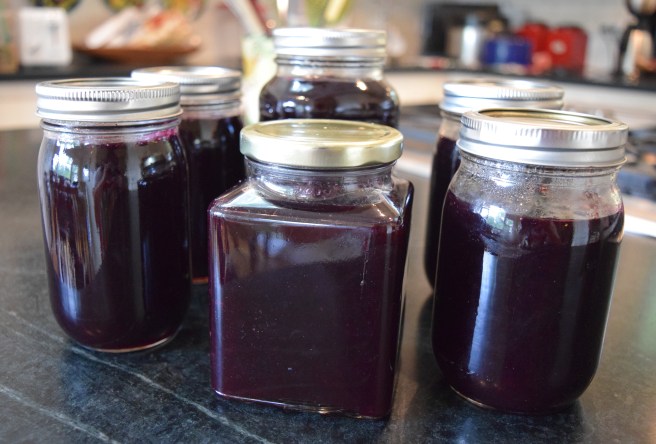
I can’t believe I made GRAPE JELLY, that ubiquitous purple gooey staple of my youth.
DSC_0313

For Baby Boomers like me, long before we had five varieties of preserves in the refrigerator, we had one — Welch’s Grape Jelly. In the 1960s and 70s, my mother always had a two-pound jar of it in the cupboard and a five-pound tub of peanut butter. Every day, my brothers would come home from school, make two peanut butter and jelly sandwiches, add a stack of Oreos, place it all on a plate, and down it with a glass of milk — all as an afterschool snack. To this day, I can still visualize the sleeve of sliced bread collapsing as its contents were depleted within an hour of the boys coming home from school.

That memory got me wondering about PB&J sandwiches. You can read, A Brief History of the Peanut Butter and Jelly Sandwich HERE

Growing Grapes at Home

DSC_0002

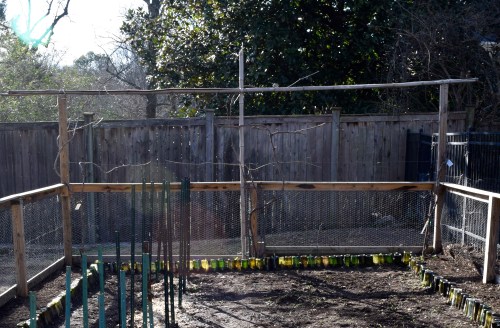
Over the last 20 years, my husband has tried to grow grapes with only fair results. We often had a lot of foliage with very little fruit. About five years ago, he decided to get serious and built a trellis for the vines on the western end of our vegetable garden. We planted muscadine grapes, which we knew grew well in our area, and one lone purple grape, Champanel, similar to the Concord grape. This year, grape production from that one Champanel vine exploded.

March 15: Grapevines appear dormant.
vegetable gardening

April 12: First nodes, then buds appear on the vines as the outer leaf unfurls.

grape

April 30: Each green ball is a flower bud. The buds bloom into tiny white flowers that last one or two days before falling off and leaving the beginnings of individual grapes.

DSC_0770

grape

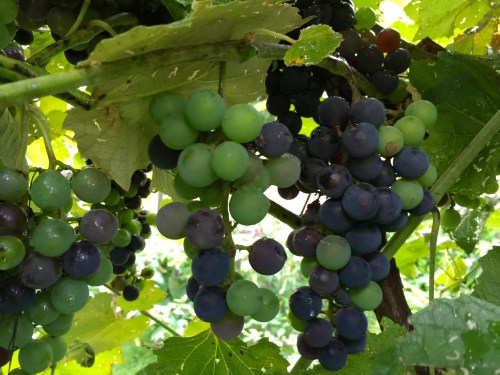
July 23: Almost ready to pick. I covered them with netting to keep the birds out.
IMG_1551

August 6: Harvest Day! Notice Marion, the Plymouth Bard Rock hen, eyeing the bowl of grapes on the ground. Chickens. Love. Grapes.

IMG_1664

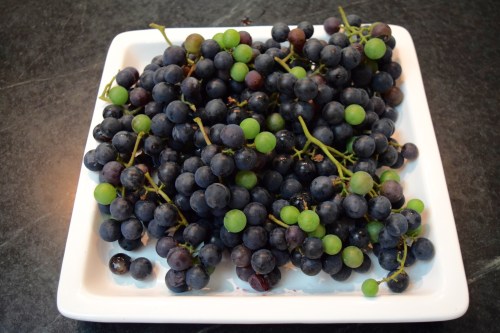
We harvested eight pounds of grapes from that one plant. After washing and patting them dry, removing the stems, rotted fruit, and unripened grapes, we were left with about six pounds of edible grapes.

DSC_0198

Making Grape Jelly

All sweet jams and jellies are made essentially the same way. First, you simmer fruit to soften it and get it to release a naturally occurring gum-like “setting” agent known as pectin. Next, turn up the heat, add sugar, and bring the fruit juice to a rolling boil which evaporates some of the water, leaving a gelatinous substance we know as jelly.

Note: only use grapes that are sweet enough to eat! The only “fail” I have had with this recipe was to use grapes that looked ripe but hadn’t ripened to the point of tasting sweet off the vine. I was trying to beat the birds and harvested too early. I thought adding sugar would sweeten them, but the jelly tasted tart.

About Pectin

Different fruits have different amounts of pectin; crab apples have lots of pectin; grapes have very little. Thus, to get low-pectin varieties of fruit to set, you need to add pectin from another source. Otherwise, you end up overcooking the fruit’s good juices to get it to firm up. Additional pectin helps speed up the setting process.

The pluses of using pectin: Pectin helps jelly achieve a “set” quickly, resulting in a shorter cooking time, translating into a more intensely flavored jelly. Pectin helps the fruit’s color stay vibrant. Finally, using pectin results in a higher jelly yield because you boil it for a shorter time, allowing less evaporation of the fruit’s juices.

DSC_0335

Feel free to follow the directions on the pectin box, which calls for 3.5 pounds of cleaned grapes and 7 cups of sugar. You can buy grapes at the supermarket, too, by the way! Look for the darkest grapes you can find for the most intense flavor. You could also use 100% pure grape juice, but I have never tried that. I adjusted the recipe to fit the amount of grapes I harvested. I honestly had no idea if the proportion of grapes to sugar and pectin would work to achieve a set. I was thrilled when it did, and I have provided you with the exact amounts of ingredients I used for this batch.

My ingredients for 13 cups of jelly:

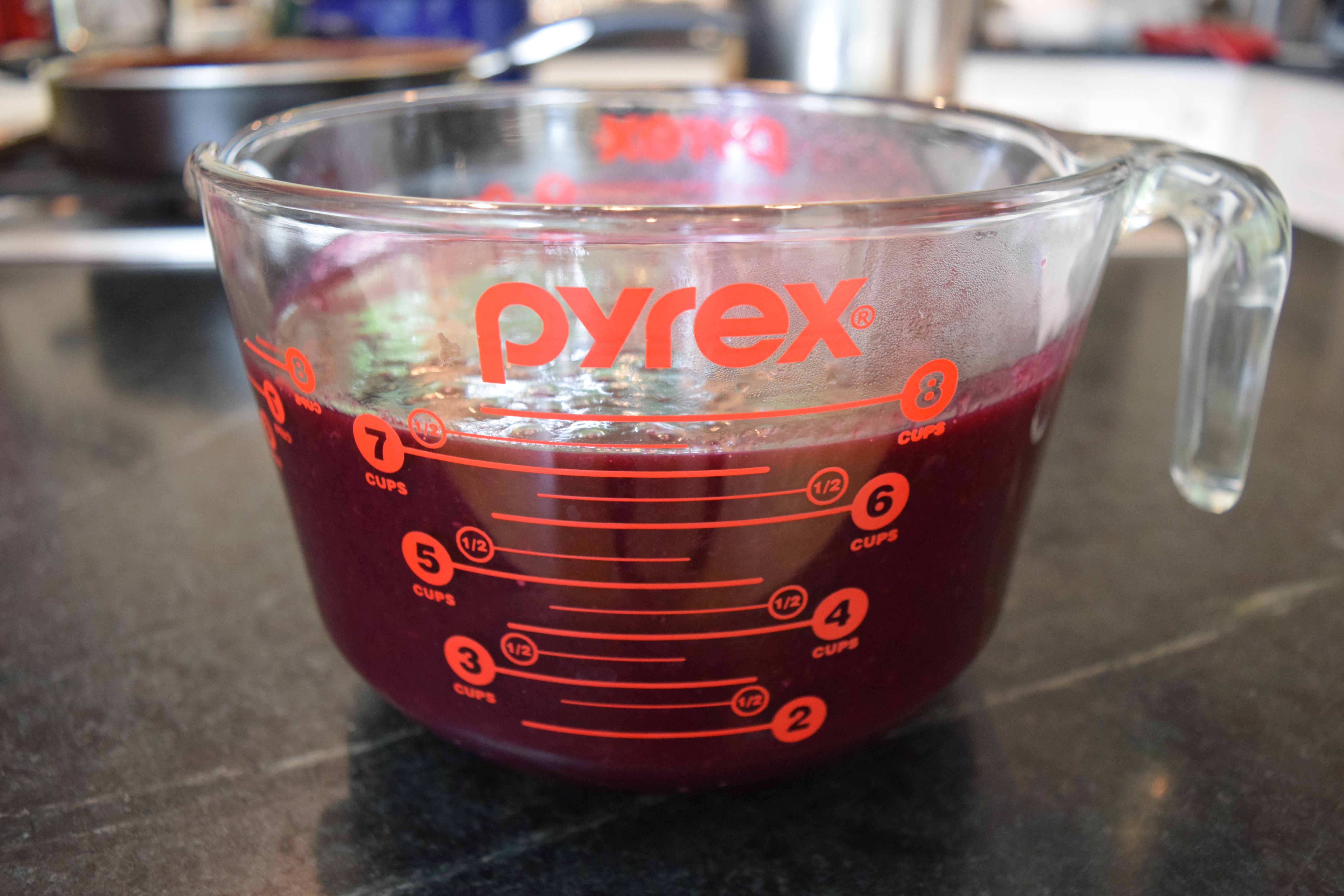
6.25 pounds of cleaned grapes which produced 7 cups of grape juice
9 cups sugar
1 box of pectin (1.75 ounce package)
1/2 teaspoon butter (to stop jelly from foaming while cooking.)

Instructions:

Before you start cooking, clean 16-ounce jelly jars in the dishwasher and have them ready to fill as soon as the jelly is finished cooking. You will also need new clean lids to heat-process the jars.

Pour grapes into a large pot. Do not add water.

DSC_0282

Using a potato masher, squish the grapes in the pot.

DSC_0284

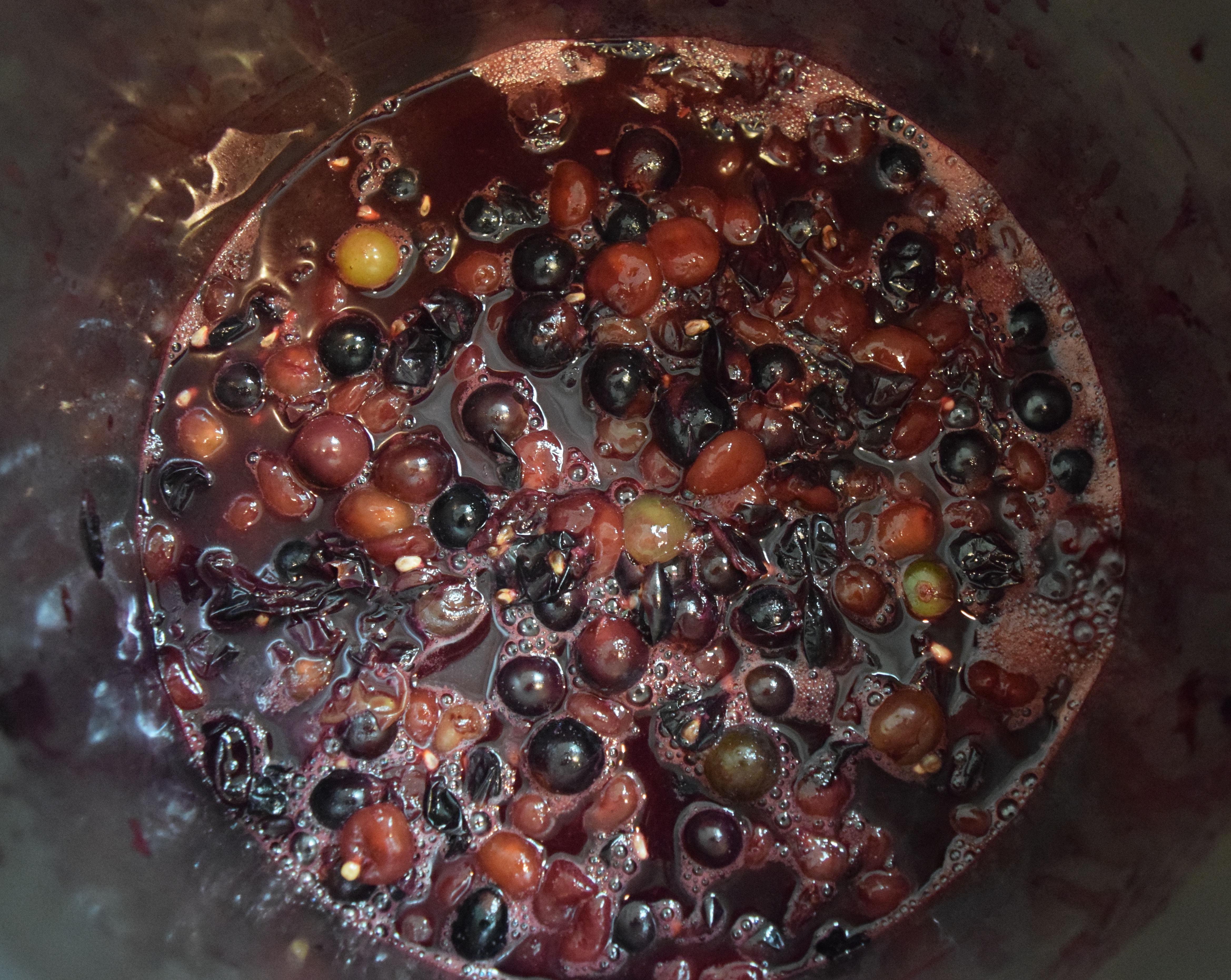
Turn the heat on high. Grapes will release more juice as they are heated. Bring grapes to a gentle boil. Continue to simmer on low heat for 10 minutes.

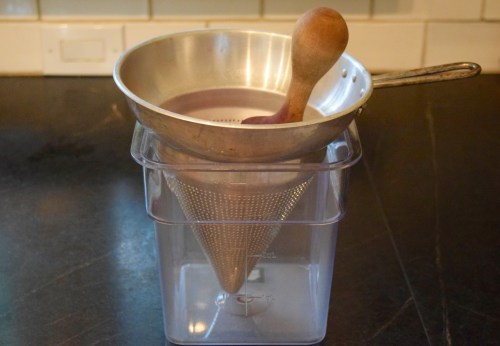
Set up a sieve over a bowl and strain the juice. Here’s where I got lucky. I have had this vintage juice sieve in my basement for 10 years. I had picked it up at a yard sale because I thought it had nice lines. I had no idea about its specific purpose in the kitchen. When I saw cooks using it in jelly-making videos, I was thrilled to learn of its raison d’être and even more thrilled that I hadn’t konmaried it!
DSC_0006

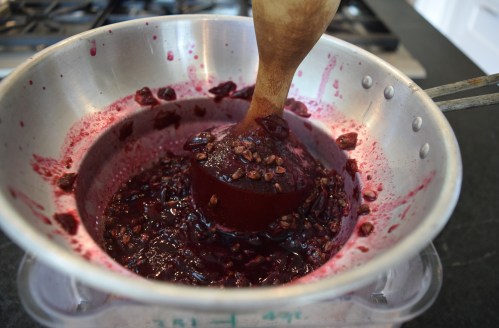
Pour the crushed, cooked grapes through the juice sieve and swirl the dowel to push the juice through the holes.
DSC_0293

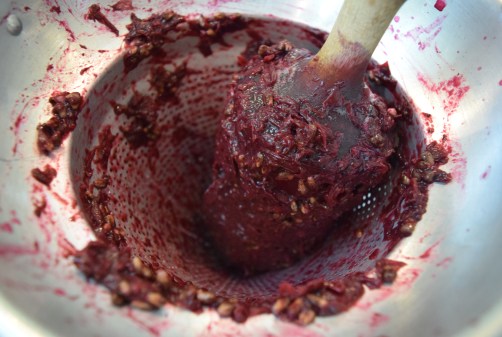
The seeds and skins remain in the well of the sieve and can be composted.
DSC_0297

Here’s an action video:

Error
This video doesn’t exist

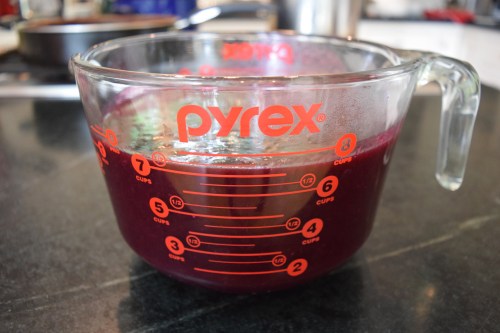
The juice and pulp settle in the bowl.
DSC_0310

Take the juice and pour it back into the clean pot. Add butter and pectin and bring to a boil over high heat. Stir frequently.

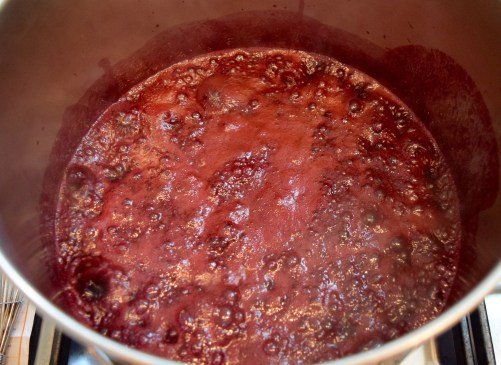
When the jelly reaches the point of boiling rapidly, add the sugar and stir to dissolve. Nine cups seem like a lot of sugar, but that’s what it takes to get the jelly to achieve a good set. Boil rapidly for one minute, stirring constantly. Start timing when the juice returns to a rapid, rolling boil (a boil that doesn’t stop bubbling when stirred). After one minute, remove from heat.
DSC_0312

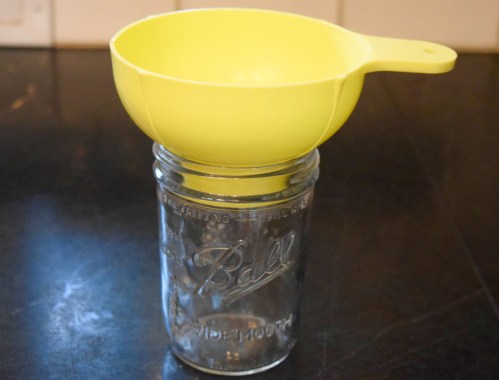
Ladle jelly immediately into prepared jars.
DSC_0004

Cover jars with clean lids. At this point, you may choose to place the sealed jars in a boiling water bath to preserve them through the process of pasteurization, or you can store them in the refrigerator unprocessed for immediate use. Since each of my jars was going to family and friends to be used right away, I didn’t bother to process them.

DSC_0326

IMG_1840 (1)

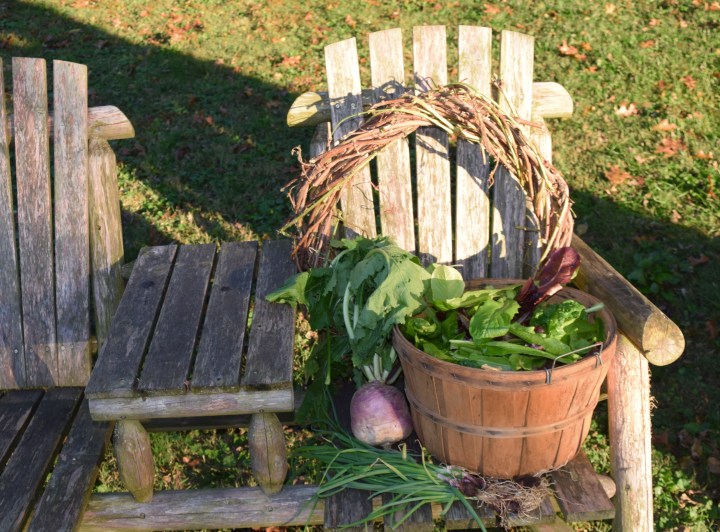
We prune our grapevines way back at the end of the season, leaving us with many long and winding grapevines. I stripped the leaves off and made grapevine wreaths. Now, I get why Martha does this kind of stuff. The long vines were begging to be made into something.

The final fall harvest from last year.
garden harvest before freeze

Early Fall Favorite Posts:
Baked Ziti with Roasted Eggplant, Mozzarella, and Marinara Sauce
Italian Sausage, Peppers, Onion, and Potato Sheet Pan Supper
Award Winning Buffalo Chicken Chili
Putting Your Garden to Bed with a Blanket of Cover Crops
Marion’s Crazy Good Pumpkin Bread with Chocolate Chips
Mrs. Walker’s Cranberry Nut Pie
How Local Canola Crops are Grown

LET’S STAY CONNECTED!

Follow my photos of vegetables growing, backyard chickens hanging out, and dinner preparations on Instagram at JudysChickens.

Never miss a post: sign up to become a follower of the Blog.

© 2014-2023 Judy Wright. All rights reserved. Photos and text may only be used with written consent.

We Will Remember Them

I’ve had a rough yet extraordinary three weeks. My beloved mother died followed three weeks later by the death of my father. I am filled with gratitude for the gifts my parents modeled for me, chief among them, love, compassion, and hospitality.

judymary This prayer from The Rabbi’s Manual was read at my Dad’s gravesite by the presiding Catholic priest. It was read again at the unveiling of my mother’s tombstone. I love these ecumenical words of wisdom and comfort.

In the rising of the sun and its going down,
we remember them.
When we are weary and in need of strength,
we remember them.
When we are lost and sick at heart,
we remember them.
When we have joys we yearn to share,
we remember them.
So long as we live, they too shall live,
for they are now a part of us, as
we remember them.
In the blowing of the wind and in the chill of winter,
we remember them.
In the opening of buds and in the rebirth of spring,
we remember them.
In the blueness of the sky and in the warmth of summer,
we remember them.
In the rustling of leaves and in the beauty of autumn,
we remember them.
In the beginning of the year and when it ends,
we remember them.
From the Rabbi’s Manual, copyright 1988, pp 130-131.

I have been well-loved by these two…

Soldus Bay mom

Scan20062

LET’S STAY CONNECTED!

Follow my photos of vegetables growing, backyard chickens hanging out, and dinner preparations on Instagram at JudysChickens.

Never miss a post: sign up to become a follower of the Blog.

© 2014-2017 Judy Wright. All rights reserved. Photos and text may only be used with written consent.


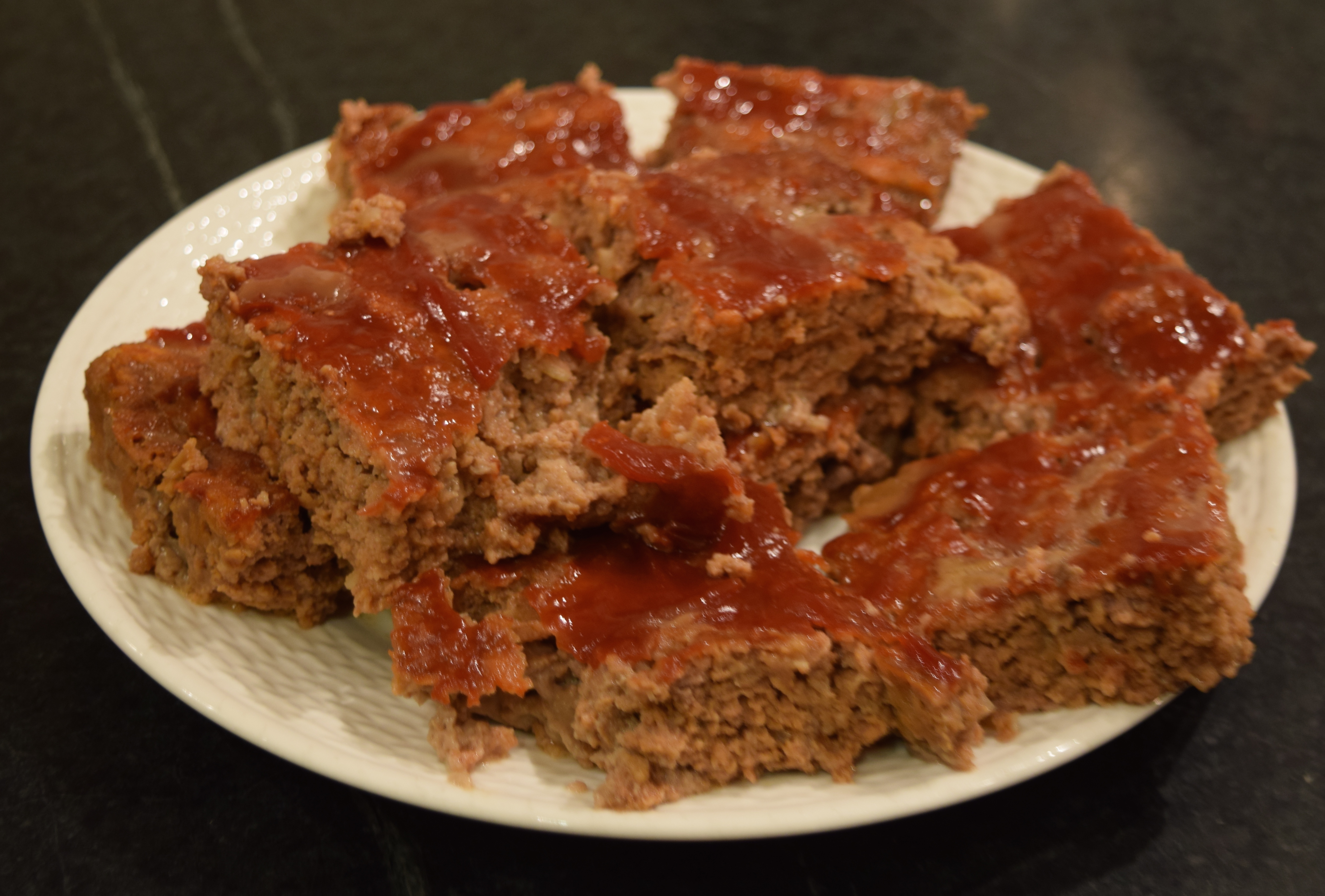
Judy’s Mom’s Meatloaf

For years, every time my mother made meatloaf, her favorite comfort food, I would stand by her side and write down each step she took to make it.

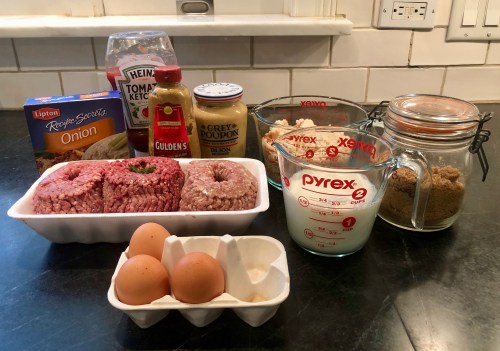
The problem for this recipe writer was she made it differently every time. Like for many experienced home cooks, Mom would grab various amounts of ketchup, mustard, eggs, and meat from the fridge, random amounts of stale bread from the bread bowl, a package of Lipton Onion Soup Mix and a heaping tablespoon of brown sugar from the cupboard. She would mix the ingredients together, add liquid until it felt right, and bake it for an hour in the oven. It consistently came out moist and delicious.

She used a package of soup mix for her seasoning because she needed a reliable way to know the salt and spice amounts were correct without taste-testing it beforehand. The brown sugar balanced out the spiciness from the mustards.

Many years later, when I started cooking dinner at The Nashville Food Project, I reworked the recipe to feed 50 people. That number grew to 100, and then to 150. You can find the scaled-up recipe by clicking on this link: Cook for a Crowd.

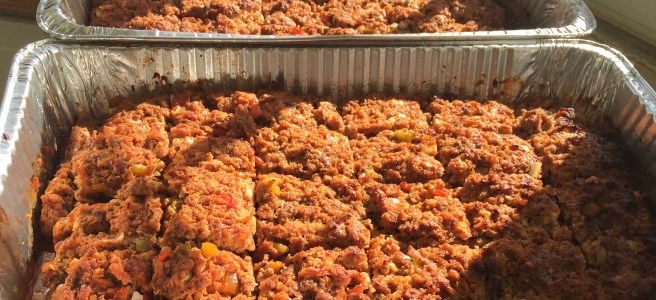
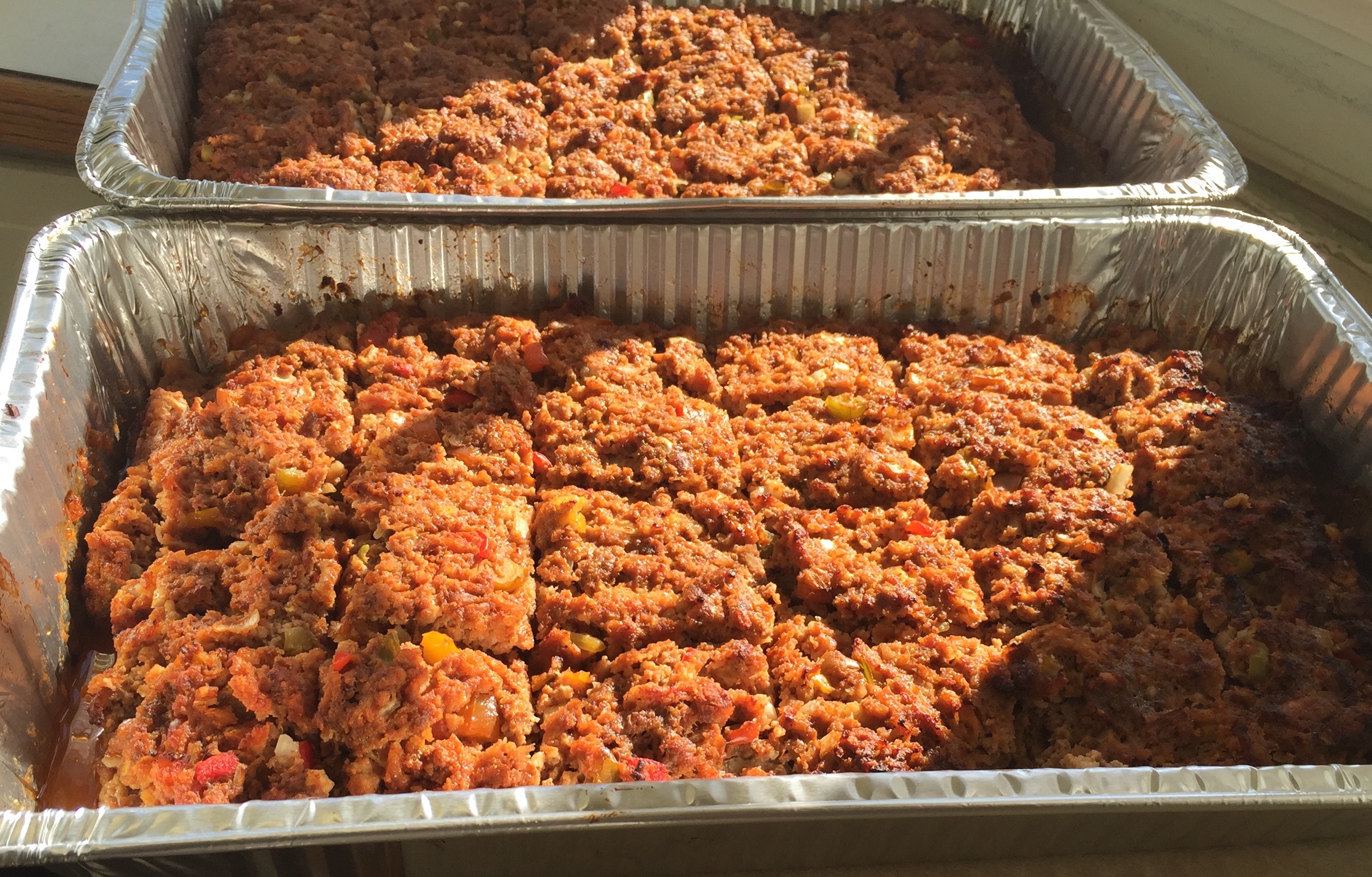
meatloaf tnfp

When we make meatloaf at The Nashville Food Project, we figure 25 servings per hotel pan. For 100 servings we portion out 24 pounds of meat and 24 cups of breadcrumbs between four pans and then add the rest of the ingredients.

IMG_2264

A few words about ingredients…

“Meatloaf Mix” is a pre-packaged mixture of beef, veal, and pork. I use it to make meatballs, too. For the moistest meatloaf, be sure to use meat that has 15% fat, any leaner will cause meatloaf to be dry. The meatloaf mix I use comes from Doris’s Italian Meat and Bakery in Florida

I use a range of 2-3 pounds of meat without changing the other amounts of ingredients in this recipe. I always use 1 egg per pound of meat, so if the package of meat weighs over 2.5 pounds, I would go up to 3 large eggs.

To make bread cubes or crumbs
Cut a stack of five slices of bread into small cubes to yield 2 cups of bread. Or, make breadcrumbs by pulsing stale bread in the food processor. Freeze extras to use later.

DSC_0861 DSC_0867

Yield: 8 servings (¼ pound per serving)

Ingredients:
2-3 pounds ground sirloin. If you can find it, use a Meatloaf Mix,
2 cups cubed bread (from about 5-6 slices)
2 large eggs (or 1 egg per pound of meat)
¾ cup milk or water
1 envelope onion soup mix
¾ cup ketchup
2 tablespoons mustard (try Dijon or spicy brown)
2 tablespoons brown sugar

Instructions:
Preheat oven to 350º.

Mix eggs, milk, soup mix, ketchup, mustard, and brown sugar in a large mixing bowl.

meatloaf

Add meat and bread crumbs and mix slowly for about 15 seconds. I use a mixer because I don’t like to get my hands greasy from the cold meat.

meatloaf

The less you handle meat, the more tender your meatloaf will be. It should look like this when it is sufficiently mixed.

meatloaf

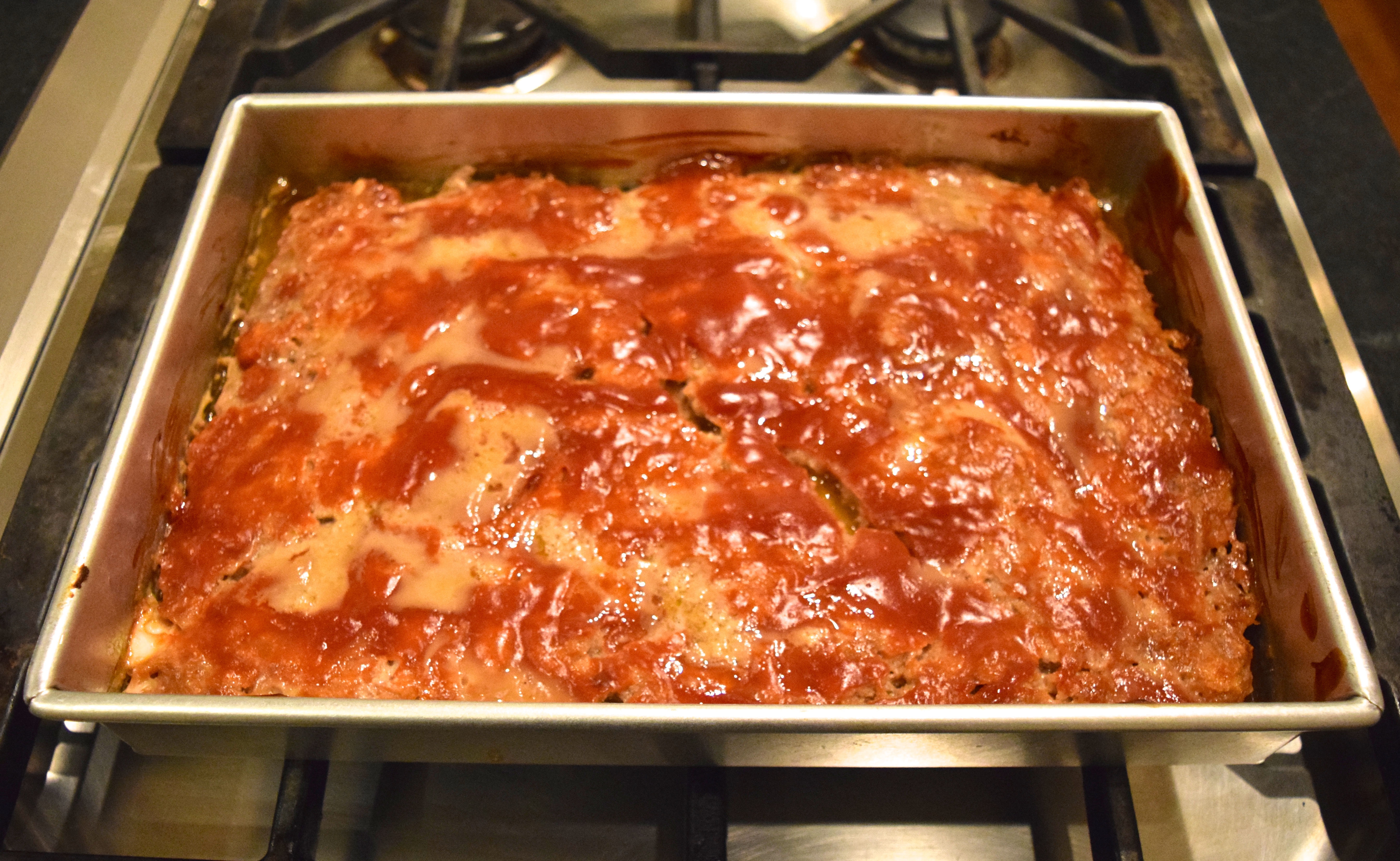
If using 2 pounds of meat, cook in a large loaf pan or an 8-inch square pan. If using 3 pounds, place in a larger pan. Top lightly with ketchup. [I skip this step now.] Bake at 350º for 50-60 minutes.

meatloaf

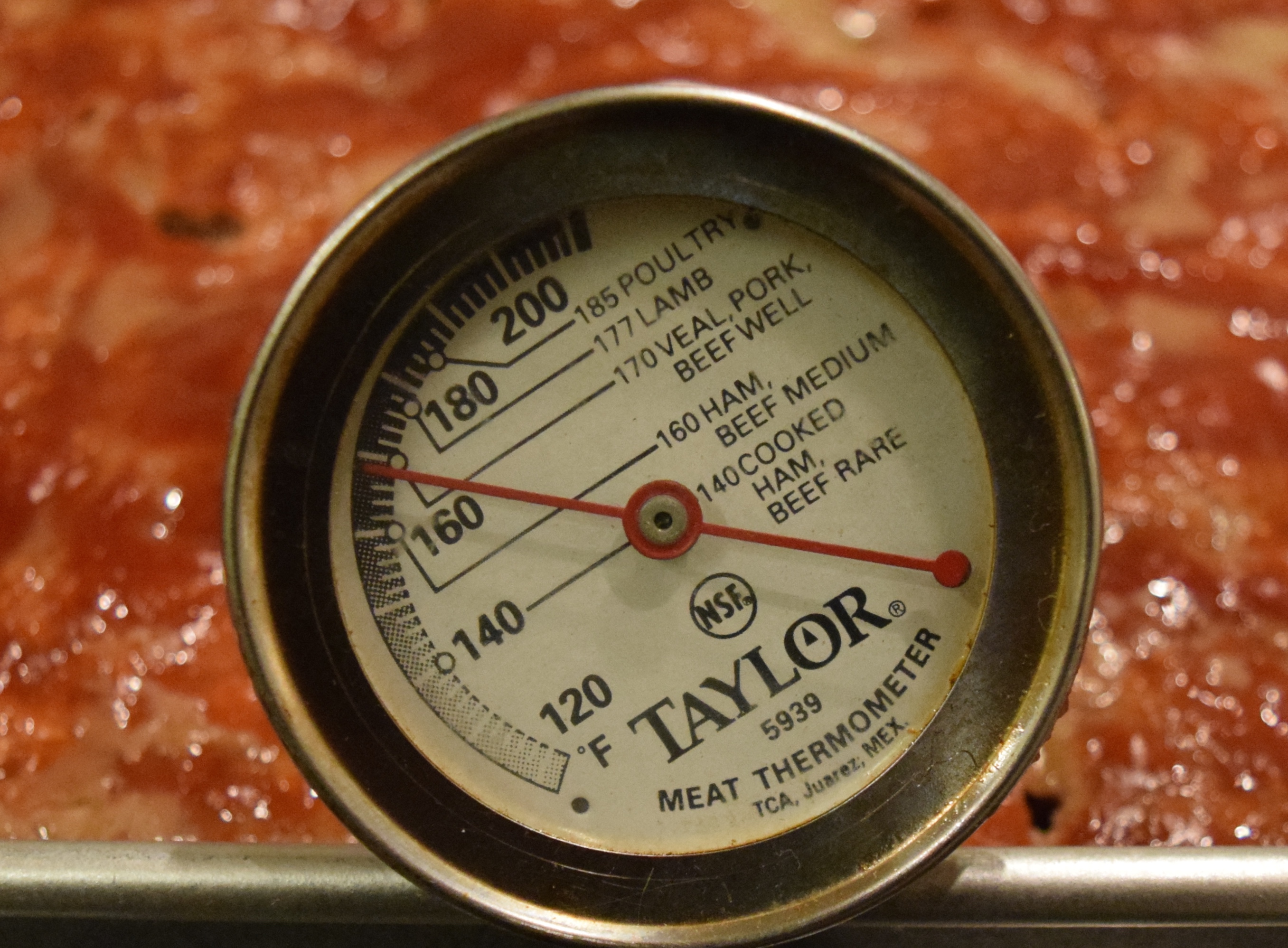
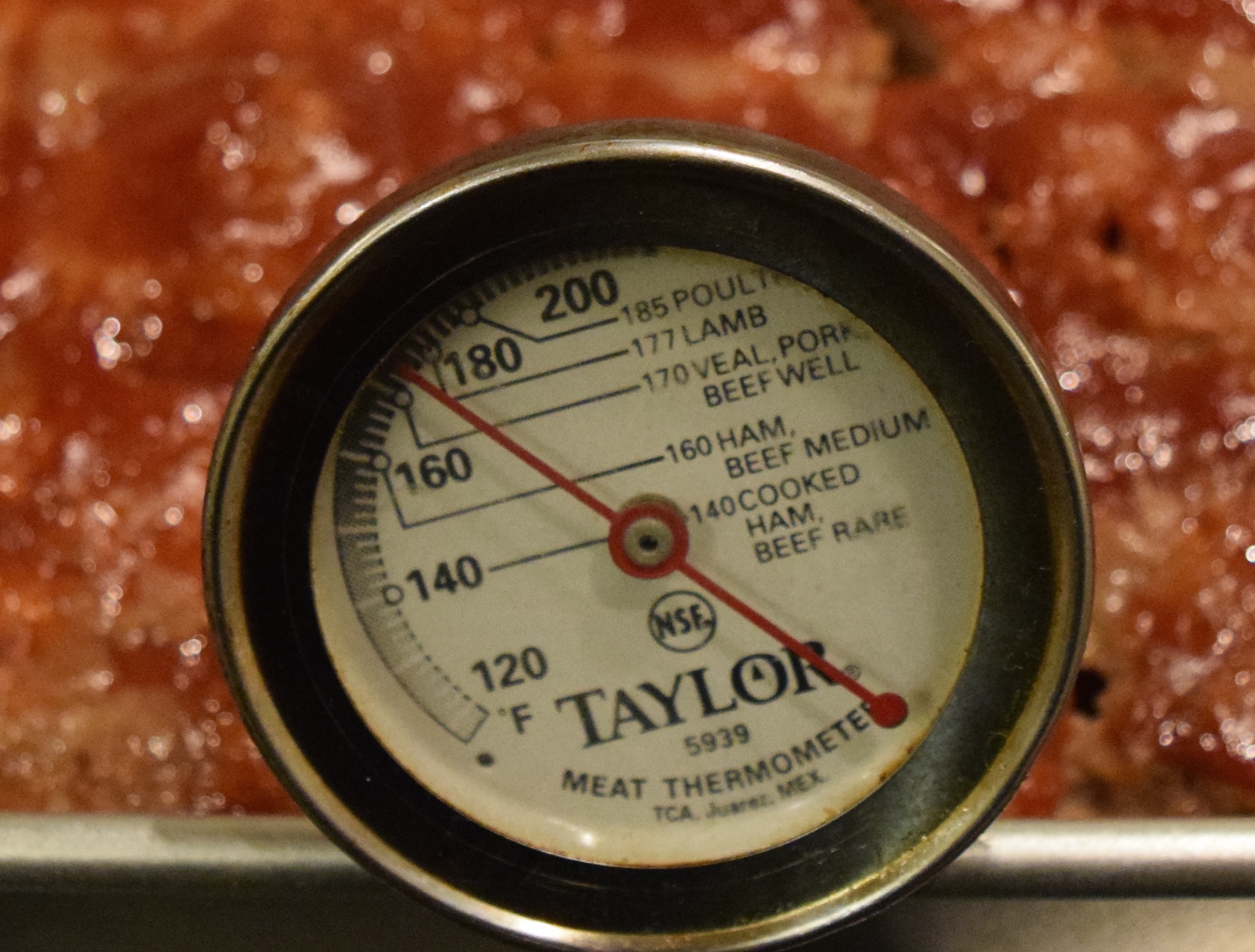
The USDA recommends all ground beef, lamb, pork, and veal mixtures be cooked to 160º, and ground turkey or chicken to 165º. For meatloaf, you can take the meat out of the oven when the meat thermometer says 155º and rely on carryover heat to finish cooking it.

Heat Transfer, aka “carryover heat”, aka “allow meat to rest” — what do all these terms mean?
While meat is cooking in an oven, the meat’s surface temperature is hotter than its interior temperature. When the meatloaf comes out of the oven, a meat thermometer showed an interior meat temperature of 168º. We can assume the meat’s surface temperature was the same as the oven’s, which was 350º. The room temperature was 70º. According to the laws of heat transfer, when meat is taken out of an oven, its surface heat (350º) has to go somewhere to equilibrate with the temperature of the atmosphere (70º). Some of that heat will go into the room, and the rest will transfer into the interior of the meat, causing its internal temperature to rise slightly. In this case, the temperature rose from 168º to 176º in five minutes. That was an eight-degree difference. Not too noticeable in meatloaf, but the difference between medium and rare in a resting steak.
meatloaf meatloaf

Yummy, traditional SIDES!!

If you are going to make a meatloaf, you are going to need some sides. These are kid-friendly.

Old-Fashioned Mashed Potatoes


Kids’ Favorite Sautéed Carrots


Roasted and Mashed Cauliflower


Blanched String Beans with Vinaigrette


Perfect Rice Every Time!


Roasted Rosemary Sweet Potatoes


More comfort food:
Yummy Shepherd’s Pie
Sheet Pan Supper: Chicken, Artichoke, and Lemon
Sheet Pan Supper: Italian Sausage, Peppers, Onions, and Potatoes
50 Ways to Make a Frittata
Fresh Marinara Sauce with Pasta and Mozzarella

If you enjoyed this post, please share and become a follower. When signing up to become a subscriber, be sure to confirm on the follow-up letter that will be sent to your email.

Follow Judy’s Chickens on Instagram and Pinterest @JudysChickens.

Always check my blog for the latest version of a recipe.

© 2014-2020 Judy Wright. All rights reserved. Photos, videos, and text may only be reproduced with the written consent of Judy Wright.