How to Block Print Fabrics (India, Part 2)

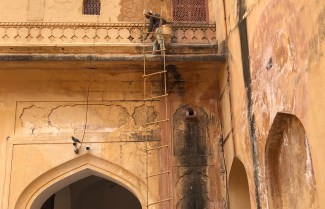
We traveled to Jaipur and toured for two days after leaving Dehli. To picture the city of Jaipur you need only to watch The Best Exotic Marigold Hotel. Much of it was filmed in this magical city where time seems to stand still. Food from the surrounding countryside is delivered by harnessed camels or horses, or wheeled-in on carts pushed by locals. Brooms made from rough-hewn straw are used to sweep the streets. Women are dressed in colorful sarees or in burkas and legs are always covered. Scaffolding and ladders are made of eucalyptus or bamboo lashed together with twine. Street cows, goats, pigs, monkeys, and dogs roam untethered. All of this amid a background of beeping horns and voices of many dialects. There is a vibrancy in this city that is extraordinary.

It is a six-hour drive from Delhi to Jaipur. While on our journey we pulled off the highway in Shahpura where we encountered scores of monkeys scampering about accepting food gifts from drivers — offerings given to the gods for assurance of safe travels. Monkeys are sacred animals in India along with cows, elephants and (can you believe it?) pigeons.

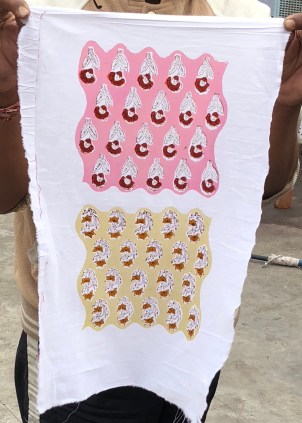
One personal hope for this day was to find a block-printing factory. My son and daughter-in-law had given us a block-printed tablecloth from Jaipur five years earlier. I have wanted to see how it was made ever since. I told this to our driver Ravi, and he was on it. He brought us to Arawali Textiles a store frequented by many tourists. It is located on the road from Jaipur to the Amber Fort. There, we received a brief demonstration of the basics of block printing by a salesman named Surendra whom afterward brought us into a store full of beautiful tablecloths, napkins, and reams of decorative fabrics. As we departed, Surendra gave us the now dry sample of the elephant print.
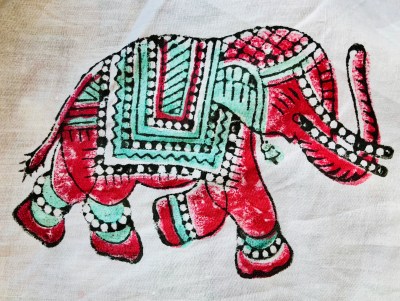
In this video, Surendra shows us how he makes the print.

This introduction to block printing was a good start, but I wanted to see more. I wanted to see fabric being printed in a factory. Once again, Ravi delivered. He found The Gandhi Cottage Textile Factory.
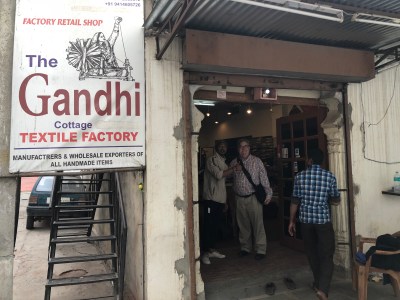
This is where we met a very charming young man named, Ali, a salesman for this family-owned business. Ali gave us a lesson in block-printing and a tour of the factory. It was closing time, but the good-natured Ali invited us to come back early the next morning to see the factory in full production. Then, he sold my husband fabric, called in a tailor, and had a shirt made for him that was ready when we arrived in the morning.

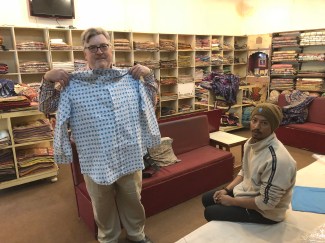
 

What follows are two videos that show the factory in production mode with Ali as the narrator.

Ali’s uncle showed us the post-production stages of newly printed cloth.

He dipped it in a bucket of salt water and lemon juice to set the color. That’s where the magic happened, and the colors exploded. This step is followed by a plain water rinse.
 

In this last video, the adorable Ali talks about dyes, carved blocks, and setting the color.

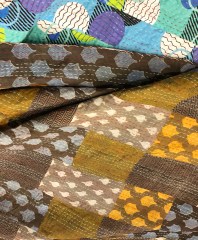
Here are three block-printed tablecloths and coverlets we purchased from the Gandhi and Arawali stores.


Places We Visited in Jaipur

Jal Mahal Jaipur, aka The Water Palace on Man Sagar Lake

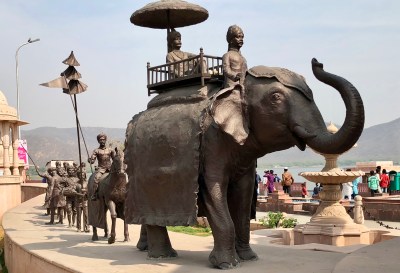
These statues of a royal procession are in a park along Man Sagar Lake directly across from the Water Palace.
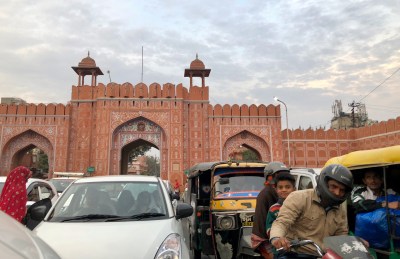
One of the gates that make up the walled old Pink City in Jaipur.
Inside the Pink City: Hawa Mahal, aka Palace of the Winds

The Amber Fort
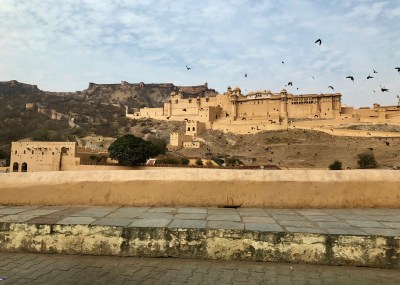
Elephant rides are available at the Amber Fort.

I spied these quilts while on the elephant ride and later purchased the elephant quilt.
 

City Palace of Jaipur

The Peacock Gate in the City Palace

Jantar Mantar Observatory has the world’s largest sundial as well other ways of charting celestial movements. It was built between 1727 and 1734.

Street Life in Jaipur

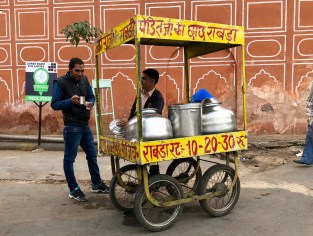
Delivering Milk to the Marketplace.
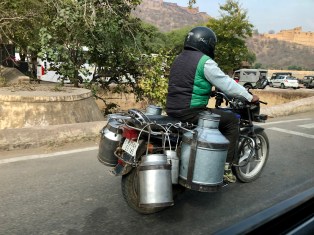
  

Chicken and Yogurt Deliveries
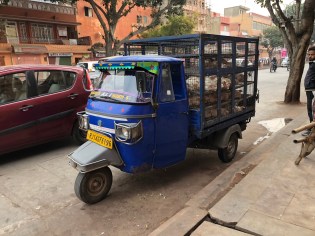
 

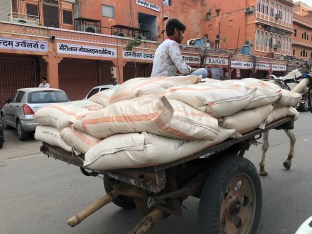
Grain Deliveries
 

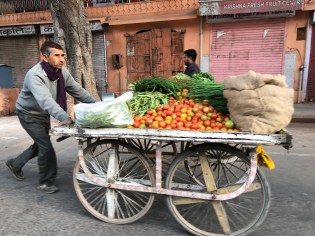
Sugar Cane and Vegetable Deliveries
 

Eucalyptus Scaffolding and Bamboo Ladders
 

My favorite colors, in both food and fabric, abound in India.
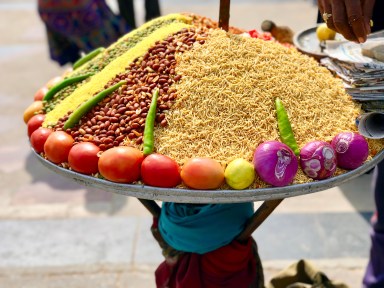
 

Those were the highlights!


Related Posts:
Cooking 35,000 Meals a Day in a Sikh Kitchen in Delhi (India, Part 1)
A Stepwell, Parcheesi, Brick-Making, and Chapati-Making (India, Part 3)
Room with a View: the Taj Mahal in Agra (India, Part 4)
A Cook’s Tour of a Farm in Southern India (India, Part 5)
Shopping for a Saree in South India (India, Part 6)

If you enjoyed this post, please become a subscriber! Be sure to confirm the subscription on the follow-up letter sent to your email address.

Follow Judy’s Chickens on Instagram and Pinterest @JudysChickens.

© 2014-2018 Judy Wright. All rights reserved. Photos, videos, and text may only be reproduced with the written consent of Judy Wright.

Cooking 35,000 Meals a Day in a Sikh Kitchen in Delhi (India, Part 1)

We arrived at Indira Gandhi International Airport in Delhi, via London, at 1:30 in the morning after twenty-four hours of travel and a big dose of nervous excitement.  The airport, much more modern than I had imagined, was unexpectedly crowded for such an early hour but apparently, early morning arrivals are common in this international terminal.

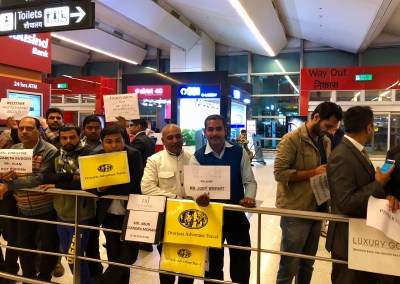
We followed the crowds in a jet-lagged daze through immigration (please let us in), baggage claim (please let our bags be there), currency exchange  (please don’t rip us off), and finally the exit (driver, please, please be there). Thankfully, we spied a sign meant just for us, “Mr. Judy Wright.” Yes, someone, on the other side of the planet, was expecting us! I’m not sure there are words to describe our relief; we had no backup plan.

Our driver, Ravi, smiled when he saw us walk towards him. It was 3:00 in the morning. He took our bags, put them in the trunk of a small white car and drove us to our hotel. It took almost an hour to get there. Ravi asked us what time we wanted to get picked up. We told him 11:00. At the time, I don’t think we fully understood he would be our driver and caretaker for the entire time we explored the “Golden Triangle” cities of Delhi, Jaipur, and Agra.

Why have a driver? Because in India, road lanes are merely suggestions. There are 10 million vehicles in Dehli. The streets are crowded with three-wheeled taxis called “autos,” motorcycles, cars, people, and the occasional street cow, all of them weaving in and out of traffic beeping their horns as they go. Ravi quickly informed us that, in India, a beeping horn means, “I’m here!” not, “I’m angry.” He joked that good drivers must have three things: good horns, good brakes, and good luck. Ravi had much to manage on the road in addition to answering multiple questions from yours truly. We were fortunate to be in the capable hands of such a smart and kind man.

(These videos of road traffic were all shot in Jaipur.)

Sometimes there were harnessed camels sharing the road

Error
This video doesn’t exist

or joyful kids

or multiple children being driven to school on a motorcycle.

That first morning, we drove into downtown Dehli where Ravi pulled over at a busy corner, and like magic, in jumped our red-turbaned tour guide named Daljeet. They decided to take us to Daljeet’s place of worship, a Sikh temple known as Gurudwara Sis Ganj Sahib built in 1783. It is one of ten Sikh gurudwaras in India. It was not on our original itinerary, but it became one of the most memorable, serendipitous stops of our trip for reasons to be explained.

Daljeet gave us a brief history of the Sikh people and explained the tradition of sewa —  voluntary, selfless service on behalf of and for the betterment of the greater community. He said it is their religious mission to respect all humans and to take care of people.

Sikhs do not have a caste system, nor do they discriminate against people of other religions, ethnicities, or gender. Everyone is considered equal; thus, poor people pray and eat beside the more privileged in the gurudwara.

Sikh men wear turbans to hold up the hair they never cut from birth to death. They do not shave their beards, either. Their turban is a symbol of bravery, self-respect, and spirituality.  The women cover their heads, as well.

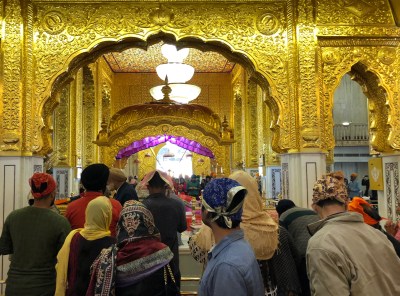
To enter the temple, we had to remove our shoes, place a covering over our head (orange kerchiefs were available for visitors),

wash our hands with soap and water, and rinse our feet in a stream of running water.

Once inside the temple, we knelt down and prayed at the railing of the lavish temple made of marble and covered in gold.

We became intoxicated by the symphony of music and praying.

After visiting the temple, we went out the back entrance to the 20-foot deep holy lake.  Historically, people bathed in this lake; more purification. Daljeet invited us to dip our feet in the holy water.

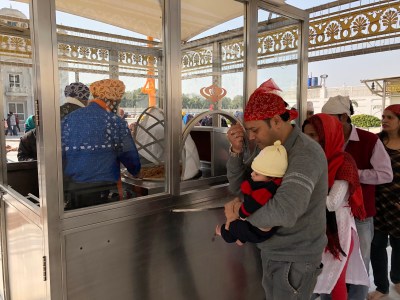
Our second stop was to accept a small portion of Prasad, a sacred pudding served while scripture is recited. It is a devotional offering to God.

The sweet pudding is made with equal portions of whole wheat flour, ghee (clarified butter) and sugar.

.

Here is how one accepts prasad.

“Yes, I would like to see the kitchen.”

Here is a photo of Daljeet. He is calling Ravi to tell him the Americans want to stay longer and tour the interior of the langar, the community kitchen and feeding hall of the gurudwara. He had just finished telling us how the Sikhs feed thousands every day and I wanted to see how they did it. I told him of my passion for feeding people at The Nashville Food Project where we grow, cook and share nutritious food, too.

The Sikhs feed the masses — 35,000 meals are made and served Monday thru Saturday in the langar. On Sundays, 65,000 meals are served. Lunch consists of rice, dahl (black lentils), vegetables, chapati (bread), kheer (a sweet dessert made with rice, milk, sugar, and almonds) and tea. Daljeet fixed me a sample of the food and served it on dried leaves. Delicious.

The Food Hall

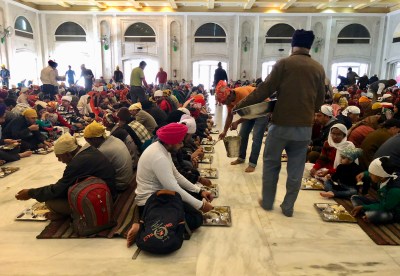
For 500 years Sikhs have been feeding people in this hall that is now air-conditioned. As people exit from one end, volunteers come in and sweep and mop the floors, followed closely by a new group of dinner guests entering from the other end of the building.

The room fills quickly. Stainless steel trays are passed by volunteers. There are no utensils; the diners eat with their hands.

Next, volunteers walk up and down the aisles serving hot food from large stainless steel pails and chapati from bowls.

After dinner, guests drop off their trays as they exit.

Inside the kitchen, the steel plates are washed creating a cacophony of sound. Daljeet said when he has free time, he comes in and washes dishes.

The Kitchen

Our next stop was to tour the kitchen. At the entrance, a group of people sat and prepped daikon radishes, the vegetable of choice that day. I recognized this long white root vegetable as a plant used by American farmers to break up soil in a sustainable way. It is not a plant Americans typically eat. It is currently in season in India. We saw it being transported, along with green onions and cilantro in every town we visited.

I asked if I could help prep the radishes. The women offered me a stool and handed me a knife.

I got to help roll the chapati dough, too.

Here are people cooking the chapati. Each chapati is brushed with a little ghee after cooking.

The cooking area was a beehive of activity.

Most of the people in the kitchen are volunteers. Daljeet told us the congregation employs the chefs only. The temple supports each chef’s family, including educating the children.

A few more pictures:

This team is in charge of refilling the serving bowls of chapati.

These men are refilling the pails of dahl and rice for the servers on the other side of the window. It is a well-oiled machine of food service.

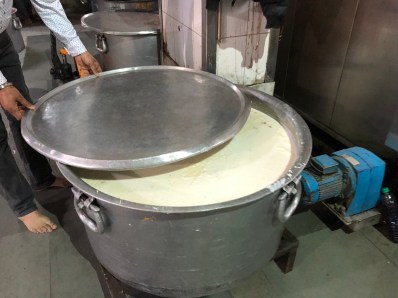
Look at the size of the kettle. It looks very similar to some we saw at the Amer Fort, built in 1592, near Jaipur.

fullsizeoutput_4995 IMG_5626.jpg

This is the rice and milk dessert.

The dry storage room. Much of the wheat and rice stored here are grown by Sikhs in the Punjab. Grow. Cook. Share.

YwOkRaMZQ%+ecsJ1nbhHaA

This video shows the beehive of activity in the kitchen.

We spent almost three delightful hours at the Gurudwara. Of the 18 million people who live in Delhi, I am grateful that Ravi and Daljeet were assigned to be our guides and that I had this remarkable opportunity to see how another organization uses food to provide nourishment and form a sense of harmony and community in a city.

We had been in India for only twelve hours, and already we had driven through a city where people beep to say “I’m here” instead of “I’m angry,” to get to a place where food is used as a way to say, “Welcome, I care about you.” We experienced this pattern of kindness and generosity of spirit throughout our ten-day stay in India.

Namaste. (“I respect you from my heart and soul” as Ravi put it.)

Places we Visited in Dehli

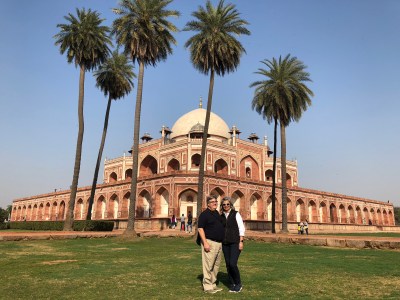
Humayun’s Tomb

India Gate
 

Parliament

Lotus Temple

Related Posts:
Learning How to Block Print in a Factory in Jaipur (India, Part 2)
A Stepwell, Parcheesi, Brick-Making, and Chapati-Making (India, Part 3)
Room with a View: the Taj Mahal in Agra (India, Part 4)
A Cook’s Tour of a Farm in Southern India (India, Part 5)
Shopping for a Saree in South India (India, Part 6)

If you enjoyed this post, please become a subscriber! Be sure to confirm the subscription on the follow-up letter sent to your email address.
Follow Judy’s Chickens on Instagram and Pinterest @JudysChickens.

© 2014-2018 Judy Wright. All rights reserved. Photos, videos, and text may only be reproduced with the written consent of Judy Wright


A Quick and Easy Baked Hummus and Feta Appetizer

Recently, I  hosted my book club’s annual dinner where guests signed up to bring either beef or chicken chili, salad, cornbread, dessert or an appetizer. When Book Hunters member, Janna, uncovered her Greek-style appetizer, the aroma of warm feta and olives wafted through the kitchen attracting us like moths to a flame. Guests started scooping up the dip with abandon, or at least I did. Soon, there was a lot of gushing going on in my kitchen.

Janna said the appetizer was easy to make.  Even better.

Ingredients:

1-pound container hummus
6-ounce container crumbled feta
5 ounces (¾ cup) flavorful tomatoes, chopped
4 ounces (¾ cup) flavorful kalamata olives, cut in half
2 tablespoons extra virgin olive oil

Mise en Place:

Instructions:

Preheat oven to 350º. Allow ingredients to come to room temperature if times allows.

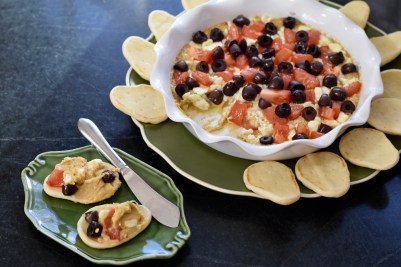
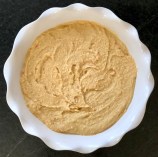
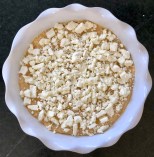
Layer ingredients in an 8″ by 8″ square pan or other ovenproof containers, as shown. Drizzle with extra virgin olive oil.

Bake in a 350º oven for 20-25 minutes.

pagu1UnSQ5Se+Z5dm15SHA

Serve with pita bread or crackers. We loved it with naan dippers.

A few words about the ingredients. I tried this with cherry tomatoes but thought the sliced tomatoes had a lot more flavor. One tomato was enough.

It took me a few attempts to find kalamata olives that were tasty. Make sure the ones you choose are flavorful.

We preferred the dip with the garlic-flavored hummus.

Things to knit while watching the game

How to Knit a Hat and Make a Pom Pom
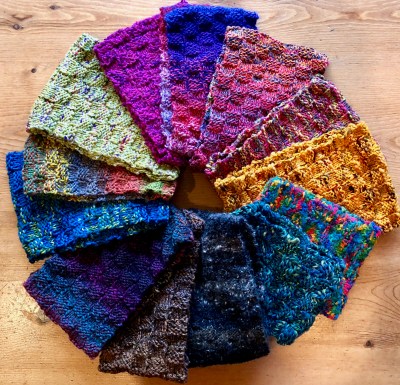
A Birthday Tribute for my Mother: Knitting Neck Warmers with Mom’s Stash
What to Knit for a Baby: a Hat, a Sweater and a Blanket

Foods to serve a crowd on Super Bowl Sunday


How to Knit a Hat and Make a Pom Pom

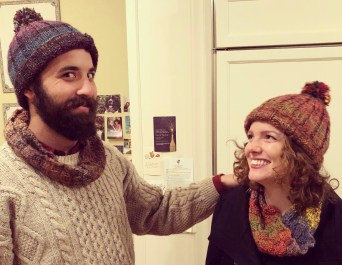
Just before New Year’s Day, temperatures in Nashville dropped to the single digits. Neck warmers were no longer enough to keep us warm.

We needed hats! Wool Hats. Hats long enough to cover our earlobes.

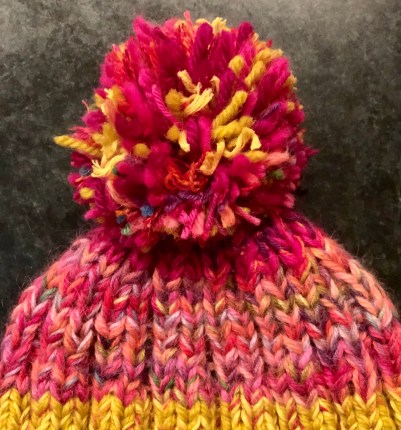
My sons and their girlfriends (and their dogs) were still in and out of the house while on their holiday break. Between having a full house and Arctic temperatures, I decided to stay inside and knit some hats. For the first two hats I knit, I used a mix of two strands of yarn: one a variegated worsted weight and the other a complementary wool in sock weight. My sons’ girlfriends loved them.


I knit a few more using the leftovers from the neck warmers. More of Mom’s stash!

It’s safe to say if you were in our house during any part of the freeze, you got a hat.

A Walk-Through of How I Made My Niece’s Striped Version of the Hat

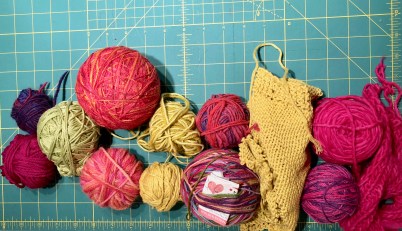
The Yarn
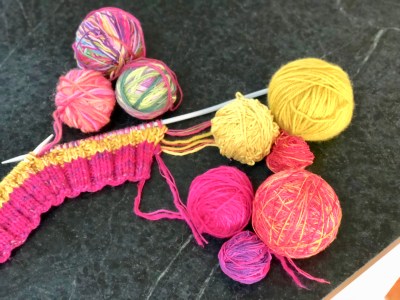
I pulled out all the leftover pink and chartreuse balls of yarn I had. For cooks, it’s akin to pulling out vegetables from the refrigerator and asking yourself, What can I make with these? Better yet, What are they telling me to make?

I used two to three strands of yarn for each stripe. I didn’t make a swatch first because, by now, I knew that one strand of worsted weight and two strands of sock yarn created the right gauge. Using one strand of worsted weight and one strand of DK weight worked equally well. By the way, it doesn’t matter if you run out of one of the yarns as you are knitting; just substitute something similar. Nobody will notice.

Chunky yarns are too thick for this pattern unless you go up in needle size and down in the number of cast on stitches. I stayed away from changing the plan. That would require thinking and I couldn’t do that and binge watch A Place to Call Home. Think Downton Abbey Down Under, post-war.

Ultimately, the yarns in the picture above lent themselves to the color scheme below.

.

The Pattern:
All the hats were knit on size 9 needles with a cast on of 80 stitches.
Row 1: Knit 3, Purl 2. Repeat across row.
Row 2: Knit 2, Purl 3. Repeat across row.
Repeat pattern until the fabric is seven inches long and then start the decreases to shape the top.

The Decreases: 
The decreases are made while continuing in the ribbing pattern. It looks scary, but it’s not as long as you realize it is just a method to decrease 8 across a row while staying in the ribbing pattern.

Row 1 RS (Right side): K2 together, K1, P2, K3, P2, repeat across row. 72 stitches remain.
Row 2 WS (Wrong side): K2, P3, K2, P2. Repeat to end of row.

Row 3 RS: K2, P2, K2 together, K1, P2, repeat across row. 64 stitches remain.
Row 4 WS: K2, P2, K2, P2. Repeat to end of row.

Row 5 RS: K2, P2 together, K2, P2, repeat across row. 56 stitches remain.
Row 6 WS: K2, P2, K1, P2. Repeat to end of row.

Row 7 RS: K2, P1, K2, P2 together, repeat across row. 48 stitches remain.
Row 8 WS: K1, P2, K1, P2. Repeat to end of row.

Row 9 RS: K2 together, P1, K2, P1, repeat across row. 40 stitches remain.
Row 10 WS: K1, P2, K1, P1. Repeat to end of row.

Row 11 RS: K1, P1, K2 together, P1, repeat across row. 32 stitches remain.
Row 12 WS: P2 together, P2, repeat across row. 24 stitches remain.
Row 13 RS: K2 together, K1, repeat across row. 16 stitches remain.
Row 14 WS: P2 together, repeat across row. 8 stitches remain.
Row 15 RS: K2 together, repeat across row. 4 stitches remain.

Cut yarn tail to about 12-inches long. Using a blunt sewing needle, capture the remaining 4 stitches and pull the yarn through them. Do not cut the tail of yarn.

Finishing:

Lay the fabric flat, wrong side facing up. It’s time to clean up the loose threads. I tied a single knot between the strands of yarn where the color changes occurred (example: between the yellow and pink yarn) to secure them. Next, I wove the yarn ends into the ribbing for about one 1½ inches.

I snipped the remaining tails of yarn. Now it is nice and clean.

I tidied up the other loose ends in the fabric from where I had to add more yarn in the middle of a row.

Sewing up the seam:
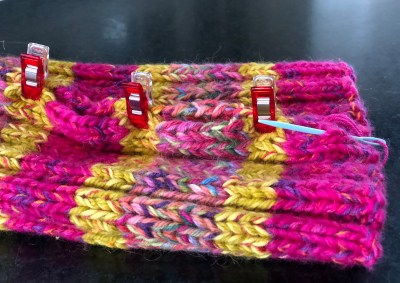
Align the two sides of the hat together with the right sides facing. I use quilting clips to temporarily line up and attach the sides together.

Next, thread a 12-inch strand of strong, matching yarn (I use cotton yarn) through a blunt sewing needle to sew the seam. If the tail of yarn leftover from the cast on row is long enough, you can use it instead to sew the seam.

I use the “mattress” stitch to sew the two sides together. It creates a beautiful, invisible seam. To do so, pick up two horizontal bars of knitted yarn from each edge of the hat. When I get through a few inches of picked up bars, as in the picture below, I pull the sewing needle taught (but not to the point of bunching) and continued sewing.

To say it works magically sounds childish, but every time I pull that thread taught, I think, Magic.


The last step is to pretty-up the bottom cast on row of the hat. After making the bottom edge look neat, I turn the fabric to the wrong side, tuck in the yarn, and snip what remains.


On the wrong side of the fabric, a ridge will be created by the side edges that have been brought together.

How to Make a Pom Pom (without a commercial pom pom gadget)


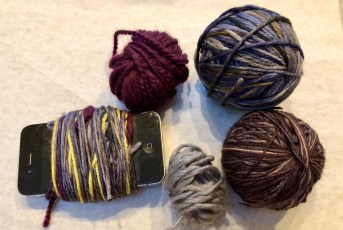
In the olden days, we wrapped yarn around a 2-3 inch piece of cardboard to make a pom pom. Now I use a cell phone, either my husband’s or mine, depending on whether I want a 2-inch or 3-inch ball.

I usually use four or five different colors of yarn to wrap around the phone to give the pom pom more color and texture.


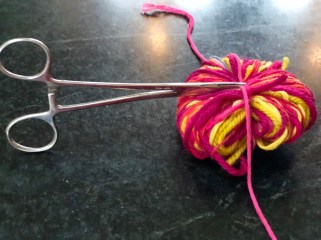
Slide the yarn off the phone or cardboard (or even a credit card– whatever is handy!). Use a 12-inch piece of strong cotton yarn to tie across the center of the wad of yarn. You need a very tight knot to keep all the threads together. I use a hemostat to hold the first knot tight. Tie a second knot to secure it.


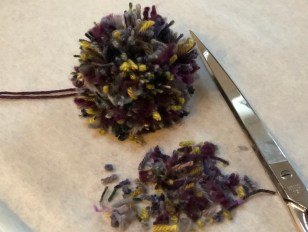
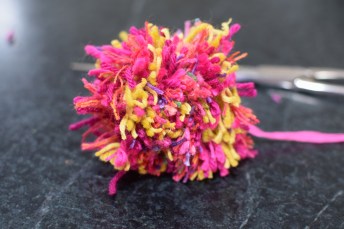
Next, using very sharp scissors, start snipping the loops as shown in the photo. Once the ball emerges, start snipping it to round out the sphere. Hang on to the ends of the cotton used to tie the knot. That’s what you are going to use to attach the pom pom to the hat.

Using your sewing needle attach the pom pom to the hat. Turn the hat inside out and tie the ends to the ends remaining from bind off row. Next, I use the sewing needle to go in and out of the pom pom a couple of times to better anchor it to the hat. Weave in the ends of yarn and you are done!

There are gadgets to help you make the perfect pom pom. I used one of them to make the 1-inch balls for this scarf.

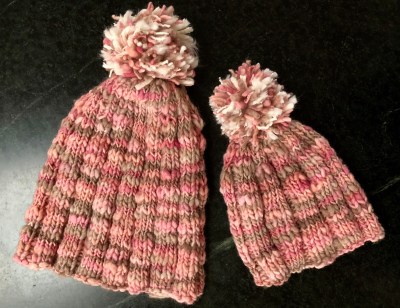
These hats are for my goddaughter Leigh and her daughter who is due in March. Looking forward to having a little girl around — and her grandmother, Becky.

You can do it, Readers! If you have questions, ask them in the Comments section.

Next up: Pot Roast

Related Posts
A Birthday Tribute for my Mother: Knitting Neck Warmers with Mom’s Stash
What to Knit for a Baby: a Hat, a Sweater and a Blanket
Sick Soup, Sometimes Known as Snow Day Soup

Always check the website for the most current version of a recipe or pattern.

If you enjoyed this post, become a subscriber! Be sure to confirm the subscription on the follow-up letter sent to your email address.

Follow Judy’s Chickens on Instagram and Pinterest @JudysChickens.

© 2014-2018 Judy Wright. All rights reserved. Photos, videos, and text may only be reproduced with the written consent of Judy Wright.