Putting Your Garden to Bed with a Blanket of Cover Crops

The number one gardening question I’ve been asked lately by Instagram followers is, What cover crops are you growing? The short answer is buckwheat, crimson clover, and a brassica such as daikon radishes or turnips. The buckwheat will die off with the first frost, the brassica will wither away in the winter, and the crimson clover can be cut down in the spring.
The next question is, Why plant cover crops? Cover crops take up elements from the dirt, air, and rain and use them to nourish microorganisms in the soil. In the process, they prevent topsoil erosion, suppress weeds, and improve the availability of water in the soil. Vegetable garden soil should never be naked.

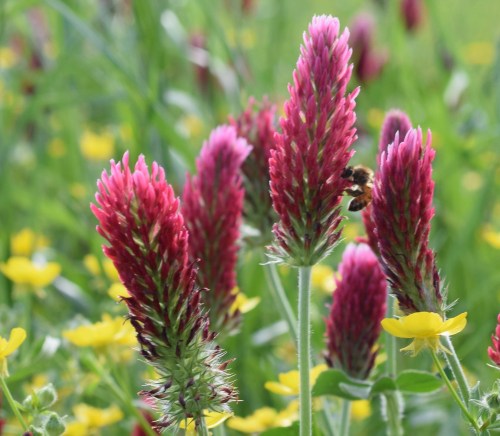
Look how pretty this cover crop, crimson clover, looks in the spring. The red flowers have the added bonus of attracting pollinators to the garden when there is not much else around to draw them in. This is especially important if you plan to plant peas on Valentine’s Day (Patriot’s Day if you live in the North). You will want pollinators around when the pea plants start to flower. Same goes for strawberries which flower around the same time.
A few weeks ago my husband and I attended the Southeast Biodynamic Regional Conference at Jeff Poppen’s farm in Red Boiling Springs, Tennessee. (Jeff is the host of Nashville Public Television’s The Barefoot Farmer.) It was a memorable weekend of education, community, and delicious field-to-table-meals. It was the kind of conference where twelve people officially register to attend and 150 show up … and it’s not a problem. The food, prepared by Chef Paulino Solorzano, never quit coming. The pulled pork, made from a pig that was raised on a farm that practiced biodynamic farming was divine. I am almost positive I can get my husband to attend again next year. [My husband just edited this post and mumbled, “Definitely going back.”]

This is a photo of Jeff Poppen, our leader and host, doing Jeff things like inoculating a compost heap with one of the biodynamic preparations he created on his farm. Farmers who practice biodynamic farming do so to bring health to the land and vitality to the food system or as Jeff puts it: to grow food of the highest quality.

Jeff has one of the oldest and largest organic farms in Tennessee. I read that on his website. If you asked Jeff, he would humbly say he “works with Nature instead of being at war with it.”

This is a photo of one of Jeff’s vegetable fields where he grows food for his CSA customers. He does not irrigate, add fertilizers, or use herbicides (“herbicides kill enzymes so biological processes can’t happen”). He also says things like, “insects are nature’s house cleaners and are our teachers — they tell us what issues we need to address in the soil.” The types of weeds that grow in our gardens also tell us about soil deficiencies.
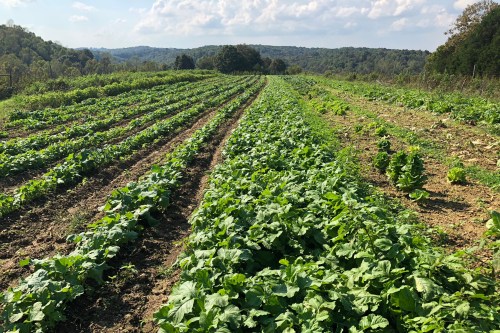
Jeff grows produce that looks like this without irrigation or chemicals.

His soil is so rich and airy, it crumbles in your fingers like pie dough when you first mix the flour and fat together. It is so loose, even his weeds have long, flowing roots.
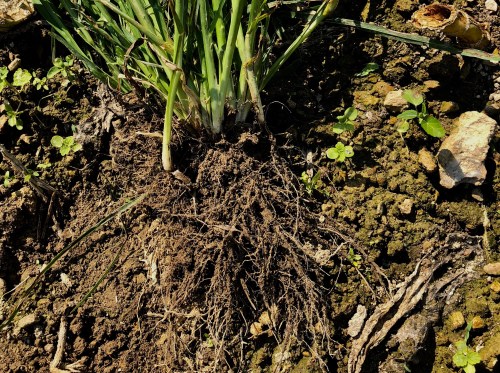
This is one of Jeff’s fields that have been put to bed for the winter. Guess what is growing? Buckwheat, crimson clover, and daikon radish. Jeff is the one who inspired me to start planting cover crops this fall when he repeatedly said, “your spring and summer crops are made before you ever plant them.” 

My biggest take away from Jeff, the one thing I could start doing in my small backyard farm right away, was to plant cover crops and never leave vegetable beds naked between harvestable crops again. With that in mind, I got busy.

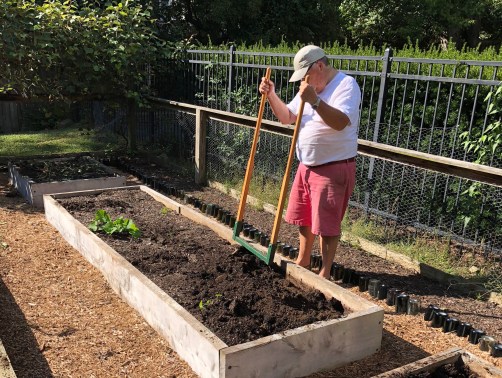
My husband helped me clean up this summer vegetable bed the afternoon we returned home.

We cut the plants down and put them in the compost pile. We left their roots in the ground. We used a broad fork to jiggle the soil so air could get into the ground. Note to readers: my husband is wearing shoes:-)
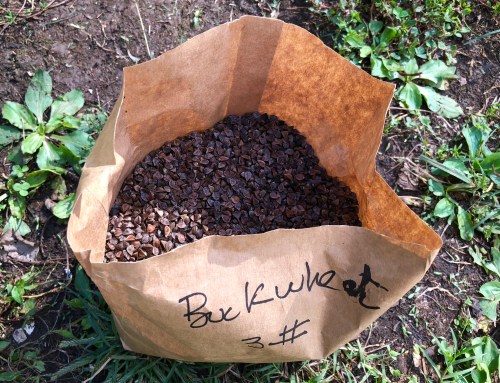
I mixed clover, buckwheat, and daikon radish seeds and broadcast them in the beds. This is buckwheat. When you use buckwheat as a cover crop during the summer, be sure to cut it back before it goes to seed, unless you want lots of seedlings. I heard a great tip at an Herb Society of Nashville meeting: plant buckwheat between tomato plants. It attracts beneficial insects that eat aphids off of tomato leaves.
Here is an “after” picture of the garden.

This is the garden one week later. The buckwheat seeds sprouted in three days.

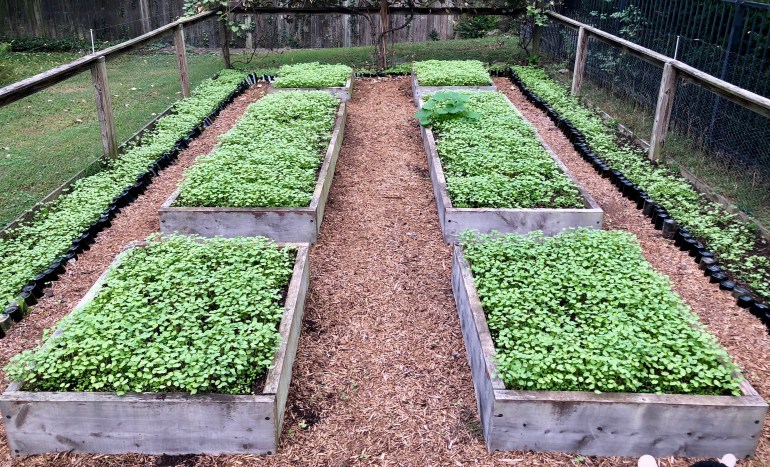
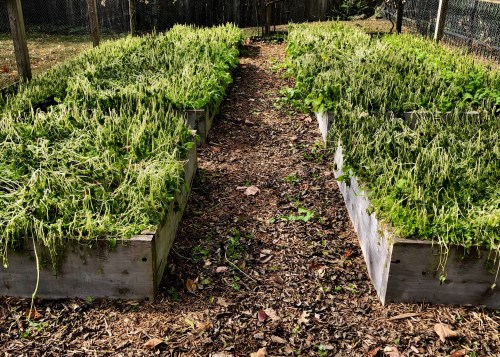
Here is a photo from yesterday. So much prettier than naked raised beds. The chickens love it, too.

November 8th: Buckwheat, turnips, clover
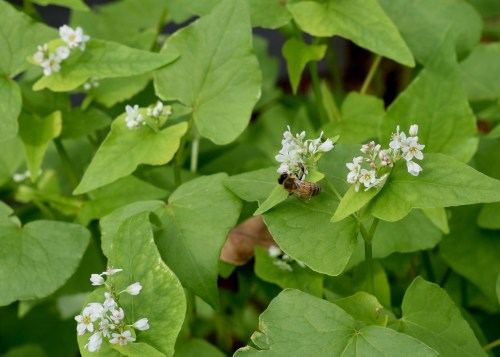
November 11th: after first frost
Related Posts
Family Dirt
Morning Rounds in the Garden, April
Eulogy for a Chicken
Winter Floral Arrangements Using Greenery from the Yard
The Volunteer Gardener An episode of Nashville Public Television filmed in my yard

Don’t miss a recipe! Become a subscriber and have every post delivered to your Inbox.

Follow Judy’s Chickens on Instagram and Pinterest @JudysChickens.

Remember to always check this website for updated versions of a recipe.  

© 2014-2018 Judy Wright. All rights reserved. Photos, videos, and text may only be reproduced with the written consent of Judy Wright.

Group Project: A Shibori Dyed Quilt

I love learning a new word and suddenly having it pop up all over the place. It makes me wonder about all the words I simply gloss over in life. Shibori is one of those words. It comes from the Japanese word “to wring, squeeze, or press.” Also known as resist-dyeing, shibori is a design technique for creating patterns on fabric. The idea of bunching fabric tightly with ties to resist the penetration of color when it is dunked in indigo is a technique that has been around for centuries. Many of us know it as tie-dyeing.

Japanese artists raised the art form to a high level. From the book, Shibori, the Inventive Art of Japanese Shaped Resist Dyeing by Wada, Rice and Barton: “Here [Japan], it has been expanded into a whole family of traditional resist techniques, involving first shaping the cloth by plucking, pinching, twisting, stitching, folding, pleating, and wrapping it, and then securing the shapes thus made by binding, looping, knotting, clamping, and the like. The entire family of techniques is called shibori.

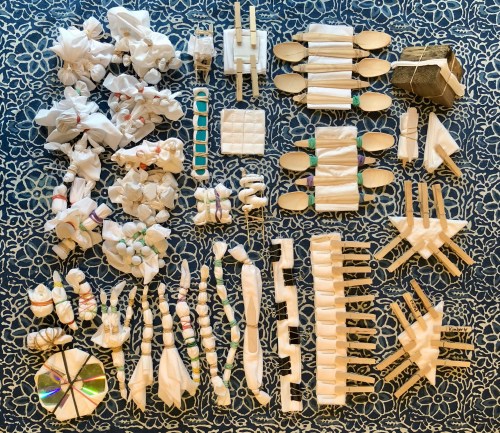
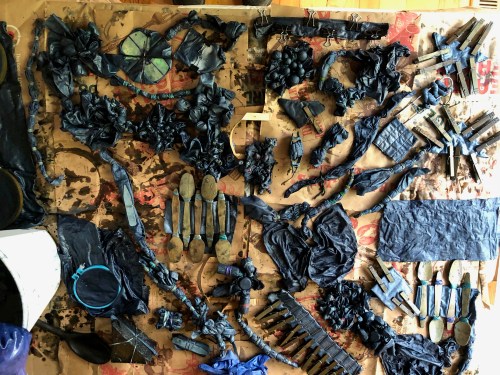
In May, the staff of The Nashville Food Project, a non-profit close to my heart, came up with the idea of making a shibori print quilt as a group wedding gift for beloved TNFP Meals Director, Christa Bentley. It was to be a surprise. The Executive Director of TNFP,  Tallu Quinn, has a degree in art (in addition to her MDiv) and learned the technique in college. She wrote out directions for the project, sent them to participants, and provided pre-cut 12-inch squares of muslin fabric for staff and volunteers to create their tied designs. Here is a partial collection of what was created.

The How-To
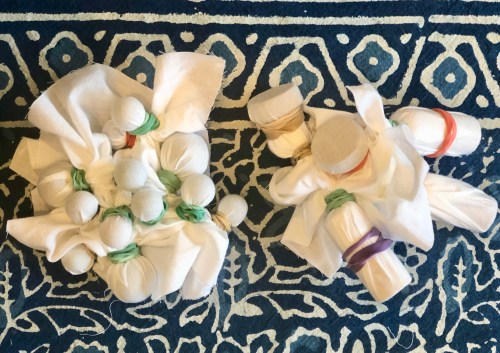
The first step was to tie the fabric to create a design. I used marbles, corks, and rubber bands to create patterns on the two squares I contributed.

This is how they looked after I tied them,

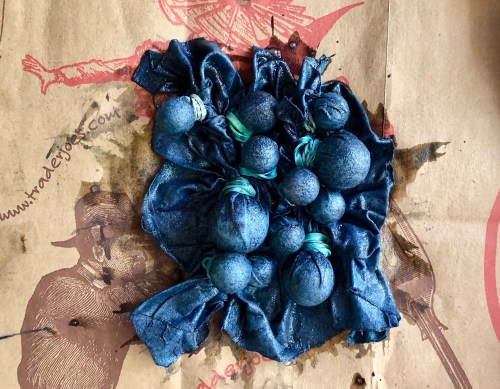
and when they were dyed,

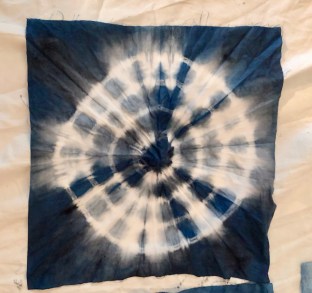
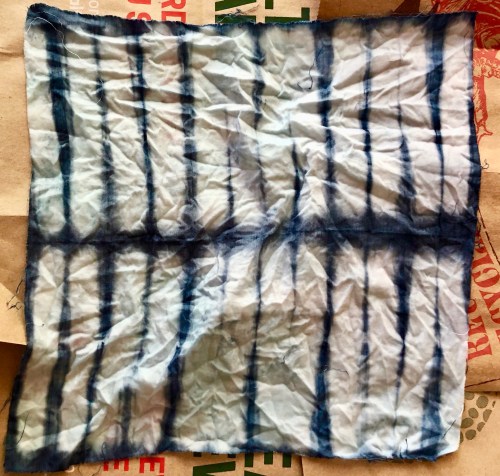
and then after they were dipped and untied.

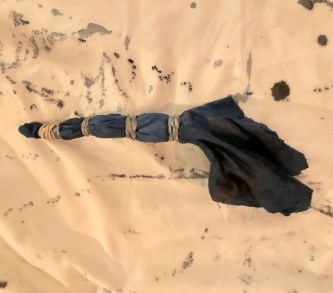
Here is another set of pre and post photos.
 

I wish I had taken more photos of the before and afters. It was exciting to see how each manipulation affected the final design. The design below was made by folding a cloth many times and using bull clips to hold the folds together. I think it is my favorite.

Although, I do love this one.

I thought this technique was interesting, too. The white area is where the fabric resisted penetration of the dye due to compression by a block.

Actually, I love them all, as I imagine Christa must since they were each made in the spirit of love and friendship.

D-Day: The Day We Dyed the Squares of Cloth.
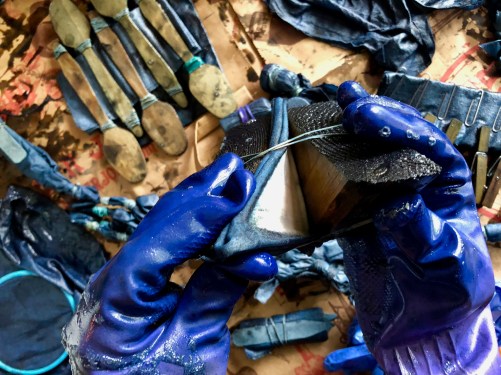
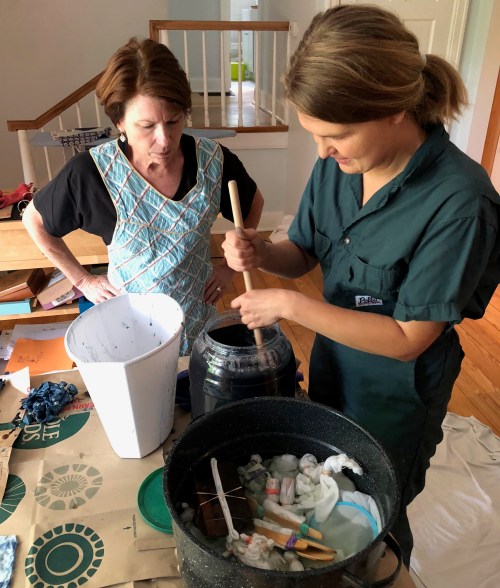
Tallu prepared the dye vat using an all-natural indigo powder she ordered online. She invited me and another volunteer, Paiden Hite, to come over and help dye the squares.

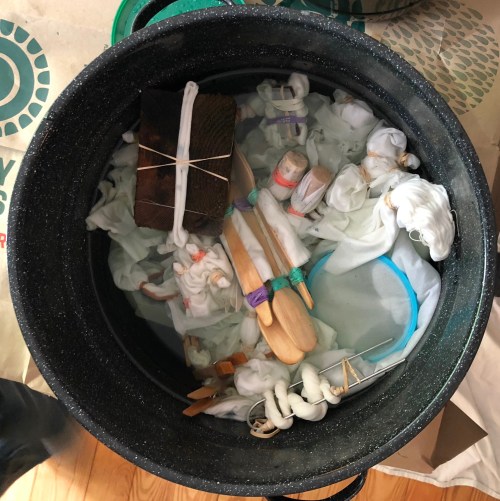
This is the dye vat.

She prepped the tied cloths by soaking them in plain, warm water.

One at a time, we submerged the cloth bundles gently into the vat being careful not to add extra oxygen (in the form of air bubbles or drips) into the liquid. It’s a chemistry thing. I wrote a story about growing indigo, harvesting the leaves and making a dye vat in the post, How to Make Indigo Blue Dye.

As we pulled each tied cloth out of the dye vat, we watched it transform in color from a yellow-green to green-blue, to deep indigo-blue. This transition in color seems magical each time I see it happen.

Here are the squares after their first dipping. A few were dipped twice to intensify their color. Color is added in layers, by a redipping process, not by letting textiles soak for a longer period of time.

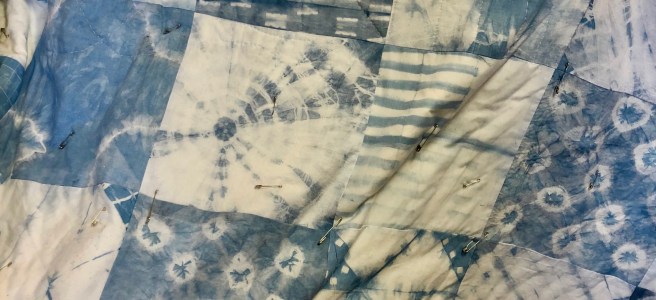
After the squares dried and were ironed, TNFP staff members sewed them together, backed the quilt, and then began the task of hand sewing the layers together.

The quilt was presented, in a semi-finished form, to the delighted couple, Christa and Todd, at a wedding shower given for them by the ever thoughtful and generous TNFP staff.

Here is a gorgeous photo of the newlyweds on their wedding day. I love it because it expresses hope and love within the beauty of nature. The Bentleys grow food and flowers at Sweeter Days Farm using sustainable practices. They sell their goods at farmers markets and through CSA shares. You can follow their vegetable and flower-growing pursuits and their muster of gorgeous peacocks at @sweeterdaysfarm on Instagram. 

I love when projects, whether they be craft-making, cooking, or planting seeds in a garden, are made in community and in the spirit of caring and fun. For me, it is a way of experiencing and expressing love and joy.

Soon, Christa and Todd will have the finished quilt to wrap themselves up in. Hand-quilting takes time!

A few of my favorite maker-projects:

How to Make Cork Bulletin Boards


Knitting Neck Warmers with Mom’s Stash


How to Make Gorgeous Birdhouse Gourds


Homemade Whole Milk Ricotta


How to Make Indigo Blue Dye


How to Make Plant-Based Dyes


Don’t miss a recipe! Become a subscriber and have every post delivered to your Inbox.

Follow Judy’s Chickens on Instagram and Pinterest @JudysChickens.

Remember to always check this website for updated versions of a recipe.  

© 2014-2019 Judy Wright. All rights reserved. Photos, videos, and text may only be reproduced with the written consent of Judy Wright.
How to Clean the Splash Guard of Your Garbage Disposer

A conversation with friends while cooking in a kitchen went like this:

Me: Do you all clean the rubber splash guard of the garbage disposer in your kitchen sink?
Friend 1: I put ours in the dishwasher once a week.
Friend 2: I do it once a month.
Friend 3: Clean what?
Me: How come I never knew about this? Yesterday, I put my hand in the disposer to pull out a hunk of chicken fat that was mucking up the system and out popped the disposer’s rubber splash guard. It was all slime and gunk.

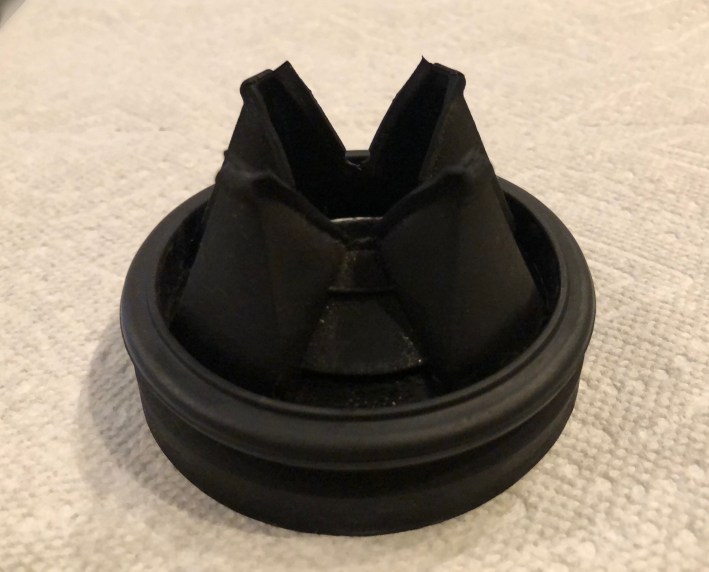
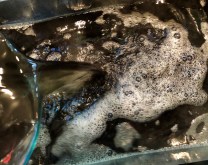
The photo below is about two week’s worth of disposer slime. I know it is gross.

Since I hardly ever used the disposer, I never thought about cleaning it. Now, I clean the splash guard with a scrub brush and hot soapy water and run it through the dishwasher about once a week.

Ahh, like new.

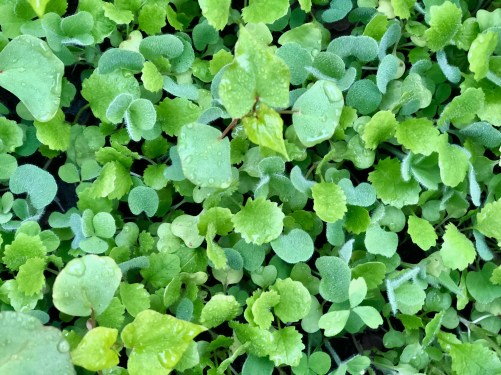
To end on a happier note, this is how I keep the soil clean in my vegetable garden: I plant crimson clover, buckwheat, and turnips as cover crops. These crops are only 10-days old and already look like the lawn of the Emerald City.

Don’t miss a recipe! Become a subscriber and have every post delivered to your Inbox.

Follow Judy’s Chickens on Instagram and Pinterest @JudysChickens.

Remember to always check this website for updated versions of a recipe.  

© 2014-2018 Judy Wright. All rights reserved. Photos, videos, and text may only be reproduced with the written consent of Judy Wright.

How to Make Indigo Blue Dye

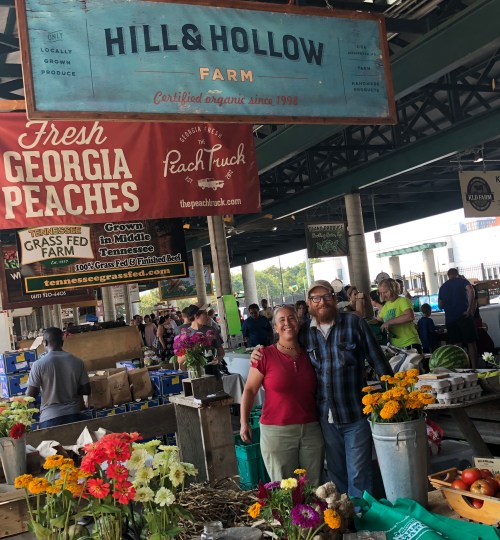
Three summers ago, I was cruising the Nashville Farmers Market when I spied Hill and Hollow Farm’s vegetable, flower, and hand-dyed yarn stand. What drew me in was the color blue. Indigo blue. 

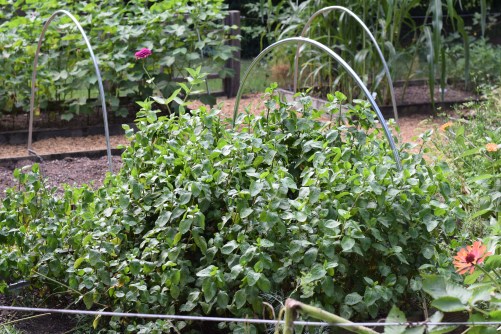
On that June morning, owner, Robin Verson, was selling Japanese Indigo plants; the plants she uses to make indigo dye for her gorgeous yarns. The yarn is milled from wool shorn from her own flock of Jacob sheep. I wanted in on this exciting blue action. I bought four of her seedlings and planted them that day. By September, the plants looked like this.

As the plants matured to the flowering stage, I was surprised to see there was no blue in sight. The leaves were green, the flowers were pink, and the stems were a bronzy-red. With winter approaching, I left my small crop of indigo to die, in situ. Little did I know how easily they would self-seed here in Tennessee. Three years later, I had a bumper crop of volunteer Japanese Indigo plants.

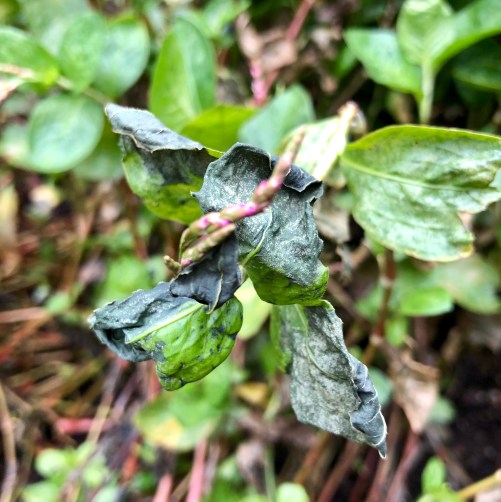
During the summer, I noticed there were hints of blue on some of the bruised leaves. Hmmm. The color was in the leaves. I read up on how to extract indigo pigment from leaves, and I saw words like alkalization, oxidation, and reduction in the directions. Principles of Chemistry– the only course in college that made me call home crying.

Back I went to the Farmers Market, now three years later, to find Robin to look for the help I needed.

It turns out every summer when Japanese indigo plants are ready for harvest, Robin hosts all-day long indigo workshops at her farm in Breeding, Kentucky. I signed up for a Sunday in late August.

Upon arrival, I immediately fell in love with her farm and her sheep. I wanted both!

Robin explained the steps we were going to go through. Two weeks later, when I went to try it myself, I texted her to ask for a quick cheat-sheet version of the directions. Here is what she wrote: strip leaves, steep in water to 160º (measure water first), alkalinize, oxidize and reduce water, wait for reduction to be complete, dye and send me pictures! Robin had walked us through all these steps with humor and grace … and hospitality; she and her husband, Paul, fed us every step of the way.

Step-by-Step Instructions

1. Harvest and Strip Leaves
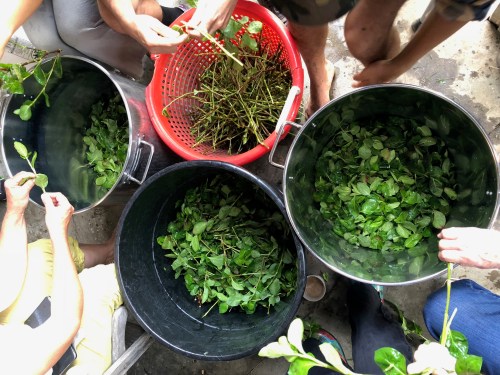
Our first job was to strip the basil-like leaves from the 24 pounds of indigo stems harvested that morning. To create the brightest color, the plants are picked just before they start to flower. Once cut, they need to be processed immediately before naturally occurring enzymes in the leaves start to decay the indigo pigment (aka indican).

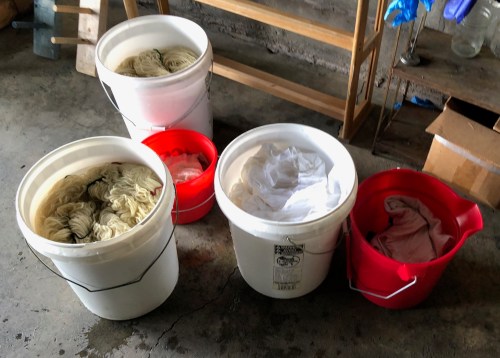
The black buckets were full of fresh stems, the red baskets held the stripped stems, and the two 80-quart stainless steel pots held the fresh leaves.

2. Make the “Indigo Tea,” aka Dyebath
Robin placed the pots of leaves over propane burners. She poured 12 gallons of tap water into each pot (enough to cover the leaves with water) and lit the burners. The water was heated to 160º over a two-hour period. We used a long compost thermometer to keep track of the temperature.

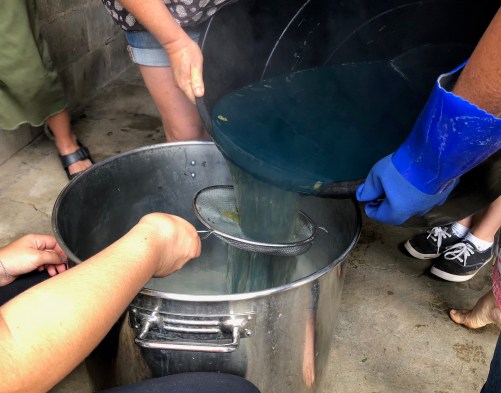
At 145º you could smell the wilted copper-tinged leaves and see why the dyebath is referred to as “indigo tea.” When the tea was 160º, we cut the heat. We put on heat-resistant gloves and used a short rake to scoop out the leaves and squeeze out as much liquid as possible. The leaves went into the orange compost bucket. The tea stayed in the kettle.

We poured the tea through a sieve to remove dirt and debris.

Robin scooped up a jar of the tea to show us the desired color. The indican molecules had broken down into blueish-indoxyl and sugar.

The indoxyl will not stick to cloth in its current state. It needs to be chemically modified by alkalinizing it with ammonia, oxidizing it with oxygen until it becomes blue-green in color, and reducing it by adding sodium hydrosulfite and allowing it to rest until it becomes neon yellow. Here’s the play by play of that:

3. Alkalinization of the Dyebath
We raised the alkaline level from 7 (the pH of water) to 9 by adding household ammonia at the rate of 2 tablespoons/gallon of liquid used. Some people use baking soda, wood ash, or lye to accomplish this.

4. Oxidation of the Dyebath
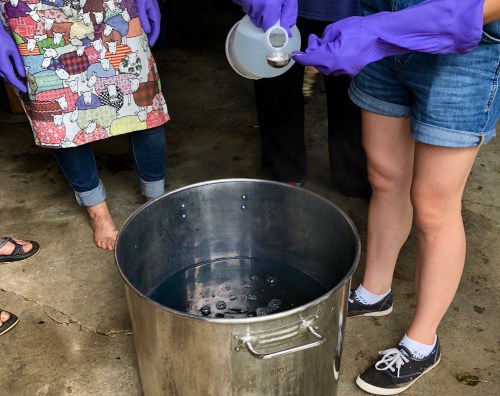
Next, we oxidized the dyebath by introducing oxygen in the form of air. We scooped up and poured bucketfuls of dyebath over and over again for 20 minutes to add lots of air bubbles. The liquid turned a deep green-blue. During this process, the indoxyl is transformed into very fine insoluble blue particles. They still won’t stick to fiber in this state, but we’re getting there.

I found this image of workers in Asia adding oxygen to an indoxyl-laden dyebath at http://www.industryofallnations.com/Jeans-At-Industry-Of-All-Nations-ccid_80.aspx.

5. Reduction of the Dyebath
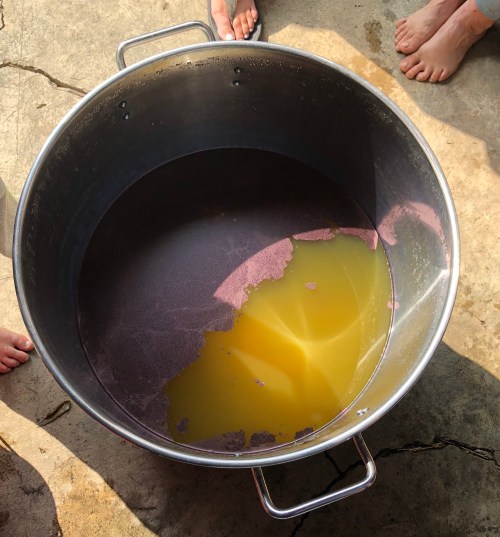
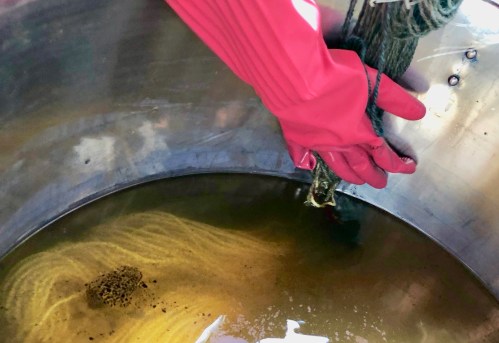
The next step is to reduce the dye molecules in the dyebath. To do this, a reducing agent like sodium hydrosulfite, Spectralite, or Rit Color Remover is added at a rate of 1 tablespoon/gallon of water. Robin had us gently stir in the first two tablespoons of the reducing agent and sprinkle in the rest to not introduce more air. Reducing agents absorb electrons and transform the blue insoluble particles into a neon-yellow color that is now considered in solution. Cover the pot for the two hours it takes the reduction process to happen. The dyebath will look like this when it is ready to dye fibers.

While the mixture reduced, we had lunch. Lunch and dessert were prepared by Robin and her family. The amazing farm-to-table meal was scrumptious. Everyone was gushing. The meal included slow-roasted tomatoes that I loved. Here’s the recipe for them.

Time to Dye!
Before coming to the farm, Robin had asked us to wash the textiles we wanted to dye to remove all dirt and grease. She soaked them in warm water before we dyed them.

The pre-soaked textiles are now added slowly to the warmed dyebath (100-120º). Absolutely no stirring is allowed (to prevent another oxidation). The garments or yarn stay submerged for 15 minutes. It is during this soaking period that the textiles lose their color and become “indigo white” which is in fact, more like “neon-yellow.” The items are removed slowly along the side of the pot to diminish the chance of drips introducing air bubbles.

6. Re-Oxidation
As the textiles are removed, the yellowish indigo particles adhere and penetrate into the fabric’s crevices and transform into insoluble indigo blue as the air mingles with the dye and re-oxidizes it. To intensify the color, let the textiles rest and then redip for another 15 minutes to add more layers of color. Never leave items in the dyebath for more than 15 minutes per dip.

As the re-oxidizing is happening, you’ll see the fibers turn yellow, then green, then green-blue, and ultimately indigo blue. It’s kind of magical.


Give the yarn a bath in clean water and vinegar to set the color and then allow to dry. As an aside, notice the four ties spaced intermittently around each skein of yarn. That’s what keeps yarn from getting tangled while dyeing. In all of my years of knitting, I never considered why those ties were there.

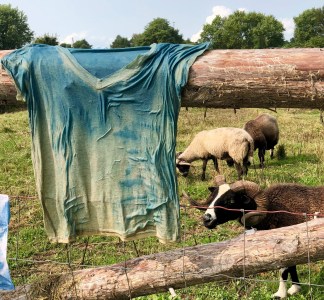
I dyed yarn and this shirt.

I can’t thank Robin enough for her instruction and hospitality while we were with her. I urge anyone interested in learning more about this artform to sign up for one of Robin’s classes next year. You can find her here.

And so what did I do with my crop of indigo? Did I try this at home? You Betcha.

I harvested, weighed, and stripped the leaves, and stewed them in water to 160º.
  

I removed and strained the leaves, alkalinized the dyebath, oxidated it for 20 minutes, and finally, reduced it for 2 hours in the kitchen sink.
  

I unwound a ball of yarn, rewound it around a chair, and loosely tied it (so it wouldn’t leave marks), soaked it in the reduced dyebath for 15″, and later, rinsed it in a vinegar and water bath to fix the color.
 

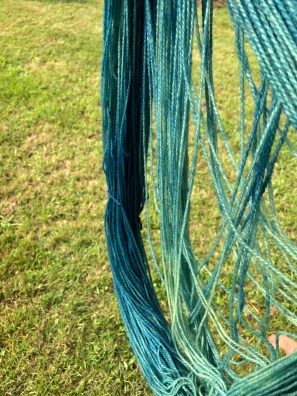
The results were terrific. I dyed both skeins of blue yarn in the photo, one with indigo dye made at Robin’s workshop using her super fresh indigo leaves and the other, a lighter blue, in my sink using my not so fresh leaves (they had already flowered). I also over-dyed a gray linen shirt I had made for me in India. I love it!
 

Once you get started and have a sink full of dye, you start searching the house for things that would look good blue. These muslin dish towels painted for me by my beautiful friend, Mary Carter, were dingy and stained. Now they are a pretty indigo blue.

If it wasn’t time for dinner, I would have re-dipped everything to add another layer of color, instead, with a roomful of hungry family looking at me (it was now 6 pm – this took all day!), I opened the drain and let the dye go.

My favorite, most satisfying days are the ones where I get lost in a project and lose all sense of time. Trying my hand at making dye extracted from plants I grew in my yard provided for one of those exciting and memorable days. Please write a comment if you have anything to add to this epic post. I still have so much to learn about growing plants and making natural dyes.

A Good Book
For a good read about the history of indigo farming and dyeing in Colonial America, I suggest, The Indigo Girl, by Natasha Boyd. The book tells the story of Eliza Pinckney, who, as a young, industrious farmer learned to successfully grow indigo in South Carolina. It’s a page-turner.

One last indigo image: the inspiration for this indigo journey started during our trip to India in February. Little did I know, when I took this photo of an IndiGo Airlines bus from our airplane window in New Dehli, how far my curiosity about this rich color would take me.

Related Posts
Making Homemade Plant-Based Dyes
Group Project: A Shibori Dyed Quilt
Morning Rounds in the Garden, July
To Dye For: Making Naturally Dyed Easter Eggs
Learning How to Block Print in Jaipur (India, Part 2)
Shopping for a Saree in South India

Don’t miss a recipe! Become a subscriber and have every post delivered to your Inbox.

Follow Judy’s Chickens on Instagram and Pinterest @JudysChickens.

Remember to always check this website for updated versions of a recipe.  

© 2014-2018 Judy Wright. All rights reserved. Photos, videos, and text may only be reproduced with the written consent of Judy Wright.