New Year’s Day Fare: Collards, Pine Nuts and Cranberries

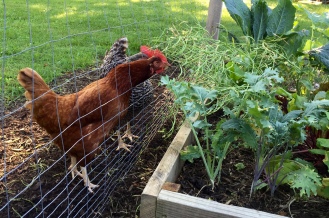
New Year’s Day is all about starting over. A clean slate. A fresh start. I’m game for all of it. Since moving South, I’ve learned you can improve your chances of having a healthy and prosperous year by eating three foods on this auspicious day: collard greens, black-eyed peas, and pork. The greens represent the color of money and thus, economic fortune, the peas (lentils, in the Italian tradition) represent coins, and plump pigs represent prosperity. Pigs also root forward with their noses representing progress. Compare that to chickens who walk backwards while scratching the dirt for food. No looking back. No chicken for New Year’s Day. I can get into all of it. I consider these foods to be charms for the easy life. But if I’m the one doing the cooking, I’m going to Italianize them; there will be olive oil and garlic used in the preparation of each of them.

To prepare black-eyed peas, check out this blog-favorite recipe, Marlin’s Black-Eyed Pea Salad.

blackeyedpeas11

To prepare the pork, try Brooks’s Pork Tenderloin.

dsc_0065

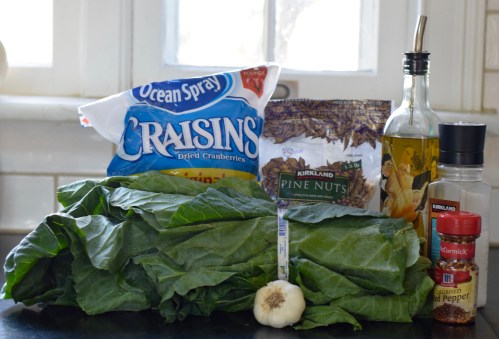
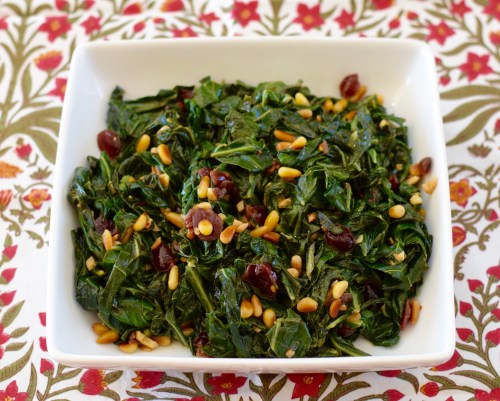
To prepare the leafy greens, try this recipe for collard greens sweetened with dried cranberries or golden raisins, and toasted pine nuts, all of it sautéed in olive oil and garlic.

About the Leafy Greens: Growing and Cooking Collards

Cooking with collards has been a new adventure for me. After seeing how beautifully they grow in the production gardens of The Nashville Food Project (where I frequently volunteer) and after cooking and serving them for years as a side dish for TNFP’s Meal Distribution Partners, I figured it was time to jump in and grow them myself. I’m so glad I did! They are like the Giving Tree of vegetables. Even as I write, on this cold winter morning, my crop of collards, unprotected from the winter elements, continues to happily produce greens. I’ve been picking from this same raised bed of collards since early October.

img_4078

Collards are a great crop for the first time gardener to grow, too; they are very forgiving. For eight months of the year, you will be rewarded with a continuous production of hearty greens that are great added to soups, or when used in a sautéed medley with other leafy greens.

Technique Tips

Chiffonading Leafy Greens:
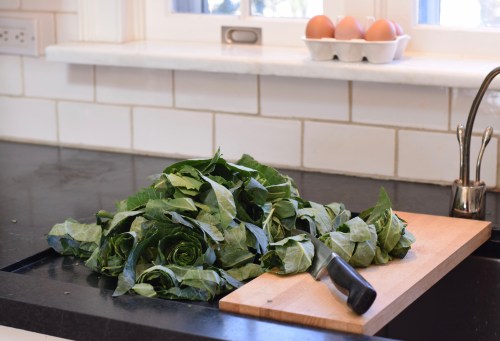
Chiffonade is a cooking technique used to describe a way of cutting leafy greens into thin, pretty ribbons. The technique is mostly used to cut herbs like basil. I’ve adopted it for cutting all leafy greens for sautéing. To chiffonade, stack about five leaves, roll them together, and then cut through the stack. I use scissors for small, tender leaves, like basil and Swiss chard, and a knife for bulky leaves like kale and collards.

dsc_0995-1 dsc_0578

Toasted Pine Nuts
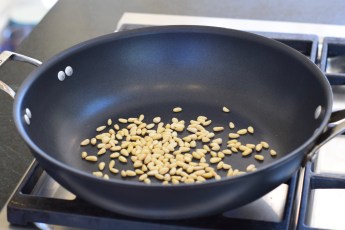
Add a single layer of pine nuts to a pan. Set heat to medium. Stir nuts about every 15 seconds. Cook for about two to three minutes, or until the nuts become fragrant and are lightly browned. When done, immediately remove nuts from pan to stop the cooking process. You can toast sesame seeds in the same way.
dsc_0604 dsc_0607

Ingredients:

dsc_0326

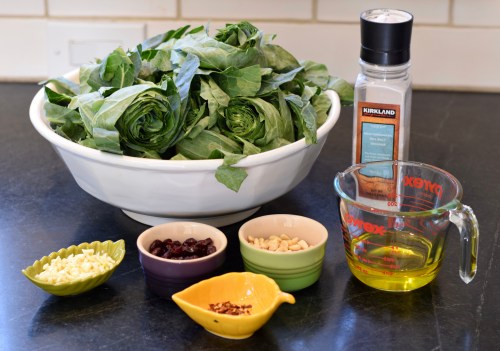
1½ pounds collard greens or Swiss chard (once trimmed will equal about 1 pound)
¼ cup pine nuts, toasted
⅓ cup olive oil
⅓ cup dried sweetened cranberries or golden raisins
6 cloves garlic (equals about 2 tablespoons, chopped)
½ teaspoon red pepper flakes
½ cup hot water
salt to taste

Mise en Place:
dsc_0588

Wash and dry collard greens. I let them air dry on dishtowels, patting the puddles of water that collect on top with another dish towel.

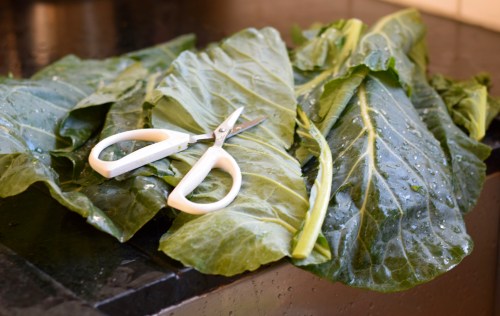
Remove the tough central rib from the leaves. To do this, fold the leaves in half and remove the rib with a scissor. Some people just tear the rib out.
dsc_0343

Chiffonade the greens.

dsc_0550

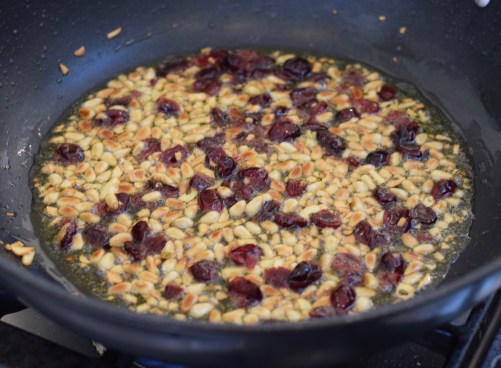
To cook the greens: Heat oil and garlic in a large six-quart sauté pan. Sauté for about one minute. Be careful not to brown the garlic as that could make it taste bitter. Add pine nuts, cranberries, and red pepper flakes. Stir.
dsc_0619

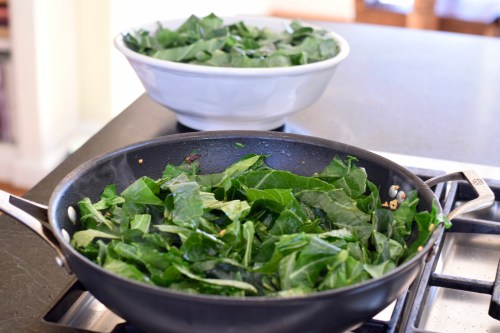
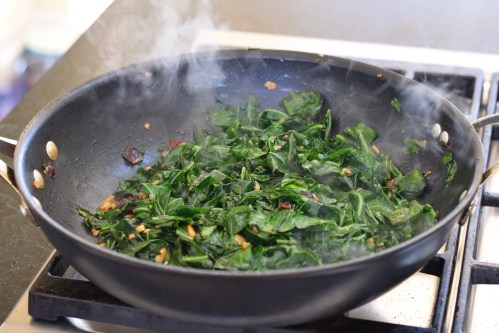
Add half the collards. Once they start to soften and shrink, add the rest. Add water and sauté for about 5-8 minutes until the collards are tender and the cranberries become plump.
dsc_0621

Add salt to taste: if the collards taste bland add more salt until the flavors pop.
dsc_0629

This is a side dish that is slightly bitter. We had it last night with lamb and parsley potatoes, and it was a delicious combination.
dsc_0643

When you go to set the table, consider looking in your yard for greenery for a centerpiece. My friend, Mary, said she was so inspired by Lou Ann working her design magic using greenery from my yard (check out Winter Floral Arrangements Using Greenery from the Yard ) that she went out in her yard and used greenery to create this quickie, yet elegant centerpiece.

img_4091

LET’S STAY CONNECTED!

Follow my photos of vegetables growing, backyard chickens hanging out, and dinner preparations on Instagram at JudysChickens.

Never miss a post: sign up to become a follower of the Blog.

© 2014-2019 Judy Wright. All rights reserved. Photos and text may only be used with written consent.


Oven-Roasted Strawberry and Rosemary Jam

Summer. In. A. Jar. The local strawberry season is too short; just six weeks long. Have you ever wanted to capture the smell and flavor of a just-picked, warm, lusciously ripe strawberry? If so, try making a jar of this oven-roasted strawberry and rosemary jam with a touch of lemon juice or balsamic vinegar. My friend, Malinda Hersch, Program Director at The Nashville Food Project, gave me this recipe. She made it for TNFP’s Patron’s Party gift baskets.

DSC_0700

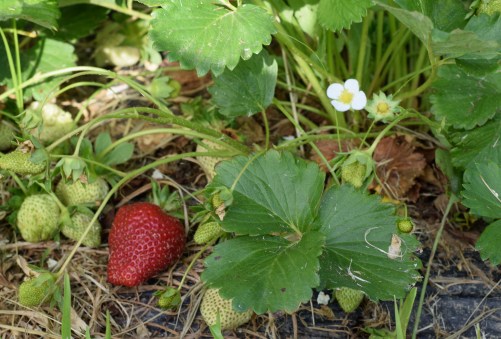
The idea for this post started when I read in Edible Nashville, a gorgeous publication on local food trends, that Tennessee’s first strawberries were coming in. On a whim, I emailed Hank Delvin at Delvin Farms to see if his strawberry crop was ripe. He said they were getting ready to pick that morning and invited me to join them.

DSC_0336

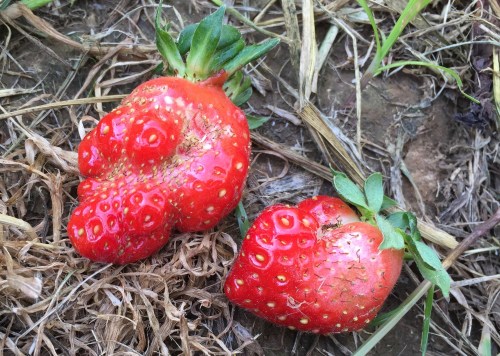
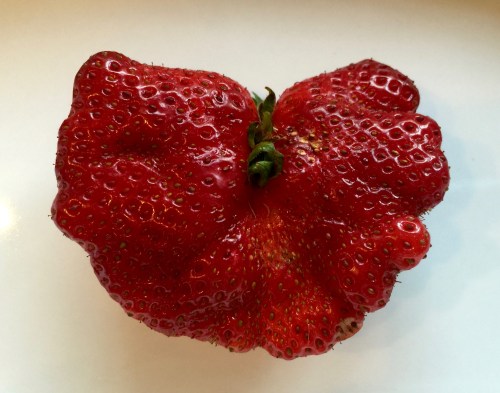
I love driving out to Delvin Farms in College Grove. It’s a beautiful drive, and I know I’ll always learn something new about organic farming practices from Hank or his dad. Check out this post from last year when I chronicled a morning spent gleaning vegetables for TNFP at Delvin Farms. The most interesting tidbit I learned on this visit was the concept of incomplete pollination. Like for many of you, I’ve seen the results of incomplete pollination — misshapen berries like the ones in the photos below; I just didn’t know there was a name for it — or a reason.

IMG_7253

Some misshapen berries are lovely!

IMG_7267

Hank plants new June-bearing strawberry plants in plastic-covered raised beds every September. The plants go dormant for the winter and start growing again in the spring. The plastic keeps the weeds out and warms the soil in spring.  Once the flowers begin to bloom, they must be protected from frost.

DSC_0318

To this end, Hank’s staff covers each row of strawberries with an agricultural cloth whenever the temperatures dip. There were six touches of frost this spring in the three weeks preceding the first harvest.

Plant Sex

Strawberries are considered self-pollinators, and as such, their male and female parts are on the same flower. It takes gravity, wind, rain, and insect pollinators to move the pollen across the flower’s reproductive parts. If the plants are covered, the wind and bees can’t do their part, leading to a higher incidence of incomplete pollination. It doesn’t take much wind though; I was amazed to see the plants’ leaves waving in a wind I couldn’t feel.

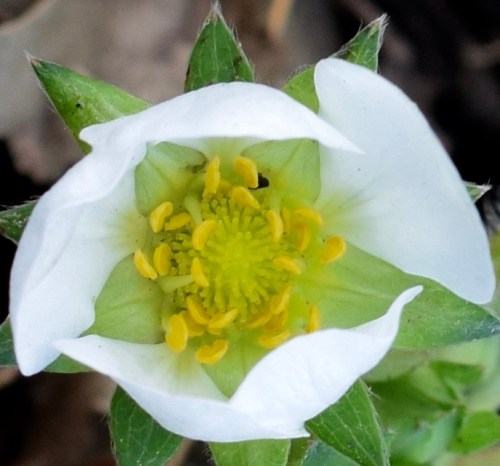
Pistils and stamens. Remember them?

DSC_0980 (2)

The strawberry flower is not your typical flower. Yes, it has the male parts, the yellow pollen-coated anthers known as stamens. And it has the female part, called an ovule, that connects to an ovary and is collectively known as the pistil. However, whereas most flowers only have one pistil, the strawberry is an aggregate fruit and has as many as 500 spike-like ovules, each one an immature egg needing to be pollinated so it can produce seed. The more of those ovules that get pollinated, the bigger, puffier, and more perfect the strawberry.

DSC_0316

The Recipe!

Yield: 4 cups of jam
DSC_0634

8 cups (2 quarts) strawberries, stems removed and berries quartered
4 cups granulated sugar
¼ cup lemon juice or balsamic vinegar
4 bushy sprigs fresh rosemary (1/2 ounce).

Clean and hull two quarts of strawberries. Figure on four cups of berries per quart container.

DSC_0471 (1)

Slice berries into lengthwise quarters.

DSC_0474

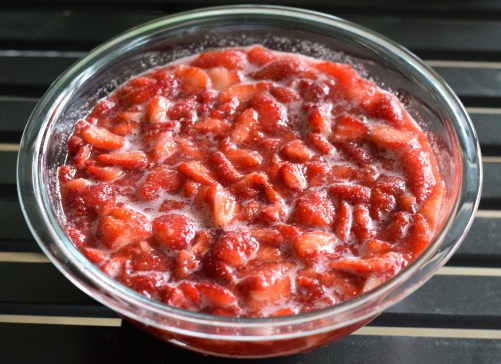
Add strawberries and sugar to a mixing bowl, stir and allow to macerate, which means to break down and soften.

DSC_0482

Allow berries to macerate for two hours, or up to 24 hours, stirring regularly to re-incorporate the sugar that sinks to the bottom. Don’t skip this step. It’s what helps the berry chunks to keep their shape.

DSC_0491

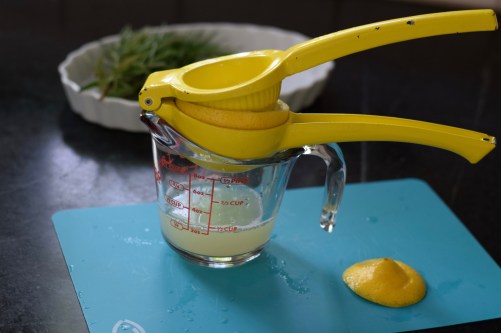
Squeeze the juice out from one large lemon and set aside.

DSC_0524

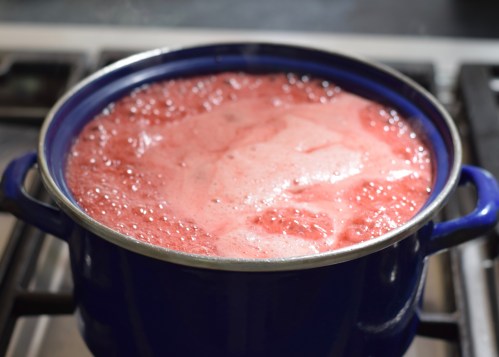
Pour the macerated strawberries and lemon juice or vinegar into a saucepan. Bring to a full rolling boil over high heat watching carefully, so the juice doesn’t boil over. A rolling boil is one that doesn’t stop boiling when you stir it.

DSC_0686 (1)

Once the mixture reaches a full boil, reduce the heat and simmer uncovered for ten minutes. About five minutes into the cooking time, add the rosemary sprigs, stir, and continue to simmer.

DSC_0555

The lemon juice and vinegar are acids and when heated help release the pectin in berries. Pectin is a gum-like substance that is needed to “set” jams and jellies. It occurs naturally in fruits, but more can be added in the form of powder if a faster set is desired.  For more on pectin, read my posts about making grape jelly and crabapple jelly.

Now it is time to roast the berries.
Preheat oven to 150º. If your oven’s lowest temperature setting is a little higher than that, no worries. You could even set the oven to convection roast and cook it in half the time, but I prefer the slow cook method.

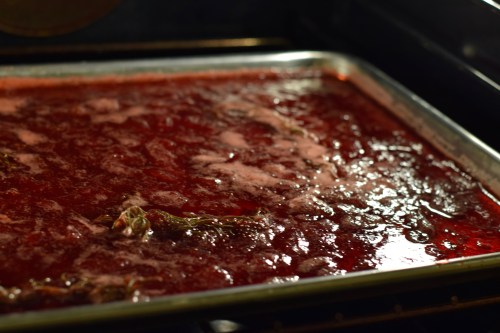
Pour the mixture, including the rosemary, into a  13″ by 18″ baking pan. Place pan on the middle oven shelf and roast for 10 hours, or until the syrup is thickened and has a gel-like appearance. I often put it in the oven at bedtime and take it out the next morning.

DSC_0578

How to test hot jelly for gel formation: Use a chilled wooden spoon to scoop up the preserves. Allow to cool and then tilt the spoon, so jam starts to drips. If the drips form a triangle-shaped thick flake, it is ready. Don’t get too hung up here with the testing. After 10 hours, assume it is going to be great!

DSC_0591

Ladle into four 8-ounce hot, clean jars using a large-holed funnel and either
1) process in a water bath for 10 minutes, using the appropriate two-part jar caps, aka “canning,” or
2) cover with lids, turn upside down, allow to cool, and store in the refrigerator, right side up, until ready to use, or
3) freeze in plastic containers.

DSC_0739

I love the combination of strawberries, sugar, and balsamic vinegar, so I often substitute four tablespoons of balsamic vinegar for the lemon juice. The vinegar not only flavors the jam, but it gives it a smoother, earthier taste than the lemon juice.

DSC_0614

This jam is great spooned over @judyschickens granola and plain, low-fat yogurt.

About The Nashville Food Project

The Nashville Food Project brings people together to grow, cook and share nourishing food, with the goals of cultivating community and alleviating hunger in our city. Their primary fundraising event, Nourish, will take place on Thursday, July 20th this year in the gorgeous dining hall at Montgomery Bell Academy.

Other Recipes with Strawberries
Strawberry Rhubarb Pie
Very Berry Clafoutis

Other Jelly Recipes
Crabapple Jelly
Grape Jelly

Other Breakfast Foods
DIY Yogurt and Yogurt Cheese
Sorghum, Oats, and Cranberry Granola
The Biscuit King
Mom’s Monkey Bread, circa 1970

LET’S STAY CONNECTED!

Follow my photos of vegetables growing, backyard chickens hanging out, and dinner preparations on Instagram at JudysChickens.

Never miss a post: sign up to become a follower of the Blog.

© 2014-2022 Judy Wright. All rights reserved. Photos and text may only be used with written consent.

Tomatoes: The Crown Jewels of the Summer Kitchen Garden

The hustle and bustle of getting my vegetable garden planted over the last several weeks came to a halt yesterday (albeit temporarily — gardening never ends) when finally, I got my tomatoes in the ground. After a fun few days spent chasing down favorite plant varieties at local garden centers, I felt a peaceful sense of satisfaction as I dug that last hole in the ground and planted a Green Zebra tomato, scored from Gardens of Babylon at the Farmers Market. That the big planting happened on Earth Day made my gardening day even more special.
vegetable gardens vegetable gardening

This year, I am on a mission to get more than 5-10 tomatoes from each tomato plant. To that end, I chose plant varieties based on flavor, growth habit, success in prior years, and color. I even rebuilt my tomato bed to offer stronger vine support, did a soil test at the Elmington Agriculture Center, and then amended the soil based on the results.

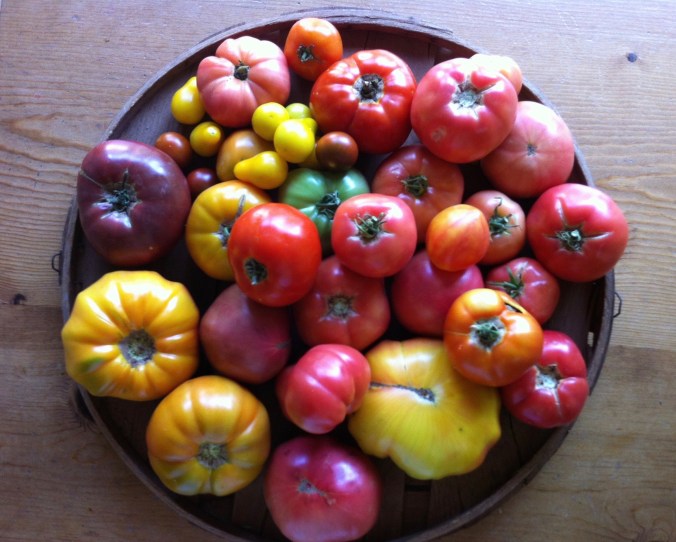
The plants I chose to grow are Cherokee Purples, San Marzanos, Hughs, Bradleys, German Queens, a Mr. Stripey, and a Green Zebra. To see my choices for cherry tomatoes, check out my post, The Full-Bodied Cherry Tomato.

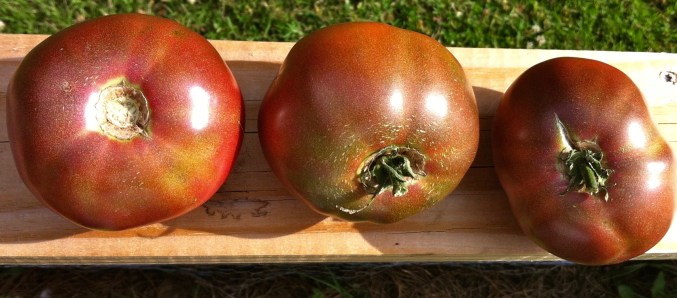
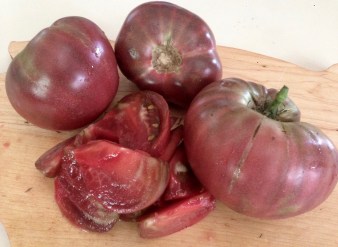
Cherokee Purples (6 plants): Indeterminate. Heirloom. Very sweet and large fruit. Their color is a dusty rose with what looks like purple bruises. When very ripe, and deep purple, they are gushingly good. They are my favorite tomato.
DSC_0107 lake barkley, ky july 4th week

San Marzanos (4 plants): Indeterminate. Heirloom. A meaty, deep red “paste” tomato. They have a thicker flesh and fewer seeds than the regular Roma tomato. They are sweet and low acid. This variety is my favorite for cooking.
IMG_3870

Hughs (2 plants): Indeterminate. Heirloom. Strong, sweet flavor and very meaty.  I first tasted this tomato last summer while cooking at The Nashville Food Project. I’ve been lusting for them ever since. I’m grateful TNFP’s Garden Director, Christina Bentrup, saved two young seedlings for me from Project Growa popular Nashville vegetable plant CSA. The tomatoes are pale yellow and large.
TNFP tomatoes IMG_7166

Bradleys (2 plants): Semi-determinate. Heirloom. Fruit is pinkish-red and ranges in size from 7-10 ounces. This was my favorite tomato to grow until I learned about Cherokee Purples. They are sweet with just the right amount of acidity. As with other determinate varieties, they set their fruit and then they are done for the season.
bradley3

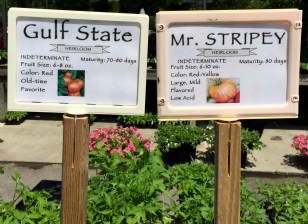
Mr. Stripey (2 plants): Indeterminate. Heirloom. Fruit is large and very sweet. Their color is yellow with pinky-red undertones. These tomatoes are luscious. I love them sliced and in a sandwich. I tend to photograph them a lot!

tomato art vegetable gardening

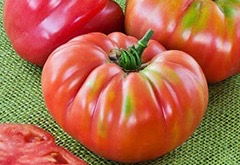
German Queen (1 plant): Indeterminate. Heirloom. Fruit is sweet and low-acid. They are large and pinky-red with green undertones in the shoulders.  Great for slicing. This photo is from Bonnie Plants
tomato-heirloomgermanqueen-m

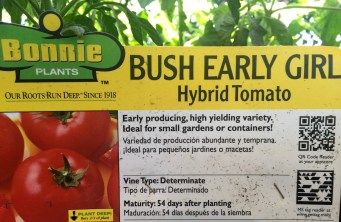
Bush Early Girls (2 plants): Determinate. Hybrid. I planted these just to watch their growth habit. They are advertised as an extra-early variety, compact at 18 inches tall, productive and bred for disease resistance. This photo is from Burpee Seed Company.
prod000981

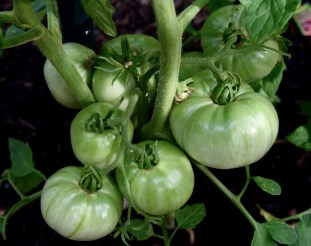
Green Zebra (1 plant): Indeterminate. This tomato is the result of four heirlooms bred together. I grow it for its two-tone vertical stripes in shades of green which begin to become slightly pale yellow at maturity. The fruit is small, the flesh is pale green, and the flavor is mild. I grow them to round out my color palette.
tomatoes walkers RI Tomatoes

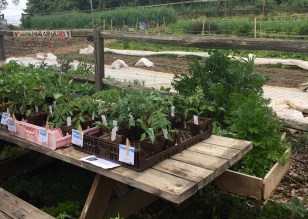
The Growth Habit of Tomatoes: everything you need to know is on the plant’s label!
IMG_6697 IMG_7195

Determinate & Indeterminate

Simply put, there are two types of growth habits for tomato plants: determinate where the plant bears all of its fruit at one time and indeterminate, where the plant bears fruit all season long right up to the last frost.

Determinate Varieties:
Also known as bush and patio tomatoes, this variety grows on one main trunk to a pre-determined height of two to four feet and sets a finite number of fruit. They should not be pruned. They produce tomatoes for a concentrated time span of four to six weeks and then they are finished for the season. This makes them great for commercial growers who can plan on one harvest for the season.

Indeterminate Varieties:
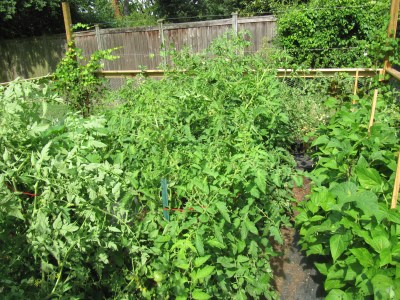
If you think of indeterminates as vines that need to be staked and pruned, it may help you plan ahead on how you are going to accommodate their unwieldy growth habit. Tomato vines grow like a weed and, left unpruned, will eventually topple over from the weight of their continuously growing stems, leaves, and fruit. I found this picture of my tomato garden taken on June 4, 2012. There are no subsequent photos of this garden. You know what they say; History is written by the victors. This kind of unpruned growth is unsustainable.

vegetable gardens vegetable gardening

Suckers! This brings us to the topic of pruning suckers, those new vines that grow in the crotch of the 90-degree angle formed by new leaf growth off of the main stem. Left unpruned, the new vines that they grow into, can each grow from 3-10 feet, depending on who you talk to! This year, my plan is to snip those suckers. I found an informative article on the topic of pruning tomatoes at Fine Gardening. Check out the article. I’m a believer now that I understand what is going on.
tomato sucker tomato sucker

Heirloom and Hybrid
Heirloom varieties are plants that have been around for at least 50 years and are either open or self-pollinated.

Hybrids are plants that have been bred for disease resistance, heat tolerance, fruit size, and flavor. “F1” on a plant label means it is the first generation of the cross-mating of two different parent plants. The next generation of hybrids will become known as F2, F3, etc. Hybrids that have withstood the test of time can become known as heirlooms after 50 years.

Open-Pollinated or Self-Pollinated
How a flower is pollinated is important to know if you intend to practice seed saving, otherwise, you do not need to consider it when growing tomatoes.

Open-pollinated (OP) flowers require insects or wind to move the pollen from the male to the stigma of the female. Once fertilized, the plant will set fruit in the ovary of the plant.

Self-pollinated flowers have both male and female parts in the same flower and do not need bees to set fruit. They are often referred to as the “perfect” flower. Have you ever noticed how flowers on a tomato plant point down? That’s nature’s way of assuring self-pollination through gravity alone.
DSC_0595 (1)

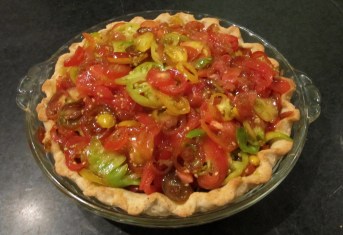
Now for a little tomato joy — last summer, these tomatoes, became a pie! This recipe and hopefully many more will come about once my huge tomato crop starts to roll in!
 

Tomato Update: May 6

DSC_0913

LET’S STAY CONNECTED!

Follow my photos of vegetables growing, backyard chickens hanging out, and dinner preparations on Instagram at JudysChickens.

Never miss a post: sign up to become a follower of the Blog.

© 2014-2017 Judy Wright. All rights reserved. Photos and text may only be used with written consent.

How Canola Oil is Made (from plants grown locally)

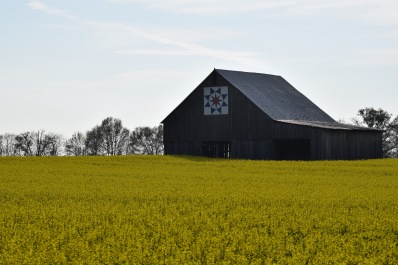
Last April, I wrote a story about the gorgeous yellow fields of canola that were growing along I-24 in Cadiz, Kentucky. You can read all about it and see the photos here.
DSC_0637

This is Part 2 of that story. The part where after seeing a dramatic increase in the number of yellow fields from the year before, I called the plant manager at the local AgStrong Canola and Sunflower Seed Processing Plant that I had read about in the paper and asked, What gives? Why are we suddenly seeing so much yellow? When he started to explain, I realized I had a lot to learn and asked if I could drive over to meet him and get a tour of the plant. An hour later Mark Dallas was giving my husband and me a tour. Not exactly the way I thought my day would turn out, but I do love a good backroads detour.

As background information, can-o-l-a oil, or “Canada-oil-low-acid,” is made from crushed canola seeds. These seeds are about the size of poppy seeds. Even having seen how canola oil is extracted from these seeds, I still shake my head in disbelief that anything that small, even in huge numbers, could produce something as useful as cooking oil.

A very short botany lesson about plant reproduction:
Flowers have one job, and one job only: to induce reproduction. To that end, flowers that are fertilized will make seeds. Those seeds will make new plants. That the plants grow and produce tasty fruits and vegetables that we like to eat, is bonus. Botanically speaking, those fruits of the plants are actually ripened ovaries full of seeds waiting to be planted. The flesh of fruit is sweet so animals will eat it and disperse the seeds in their travels. Tree nuts work in the same way; Mother Nature is counting on squirrels to bury nuts and thereby assure they will sprout and there will be more trees in the future.

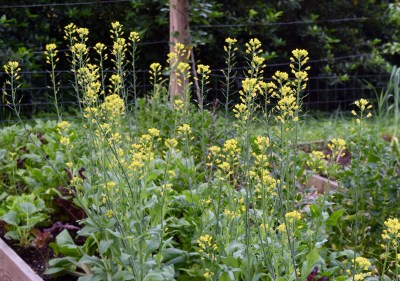
Back to canola flowers and seeds. Like winter wheat, canola is planted in the fall, sprouts, goes dormant in the winter,​ and perks up again in early spring. It flowers in mid-April, and the seed pods are harvested in mid-June. Farmers like to grow winter wheat and canola because then they can double-crop their fields, meaning there is time left in the warm summer months to raise another crop, such as soybeans, in that same field. By comparison, in most northern climates, there’s only time to grow one crop like wheat or canola.

The photo on the left was taken from a stem of canola flowers on April 17th. The photo on the right was taken on June 12th, just a few days before the pods were harvested by the combines I wrote about in this article.
Version 3 DSC_0495

You may have seen similar seed pods develop in your own gardens if you ever let broccoli or bok choi plants flower and “go to seed.” If you look closely at the flowers below, you can see the early development of seed pods. They look like little spikes. Canola is in the same Brassica family as bok choi and broccoli.

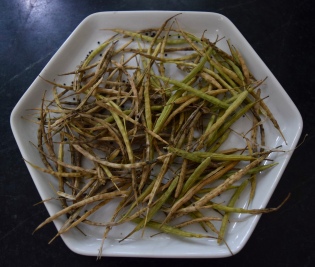
The next photos are of fully mature canola seed pods that I dissected at home to release the seeds within. You can see how small these seeds are. It’s amazing to think cooking oil is extracted from them.
DSC_0141 DSC_0147

AgStrong contracts with local, family-owned, farms to plant nonGMO canola seeds in their fields. NonGMO means the seed’s genetic material has not been manipulated in a laboratory through genetic engineering to make it more disease or insect resistant. A few other tidbits I learned about growing canola: canola has a 5-6 inch tap route which acts as a natural tiller in the soil, and canola brings in $8.10/bushel compared to wheat’s $5.25/bushel.
IMG_7716 a53cfd_4562ef1f791a498283dc60749c982789.jpg_srz_p_371_272_75_22_0.50_1.20_0.00_jpg_srz

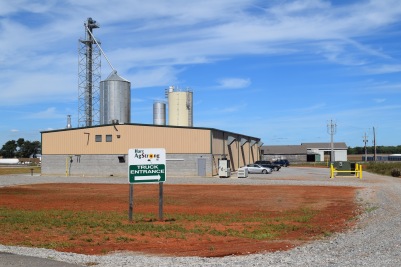
Here is a photo of the canola oil processing plant in Trenton, KY.
DSC_0307

It takes a lot of seeds to make canola oil and these fifty-foot silos are full of them.
DSC_0289

This is what the inside of one of those silos looks like.
DSC_0290

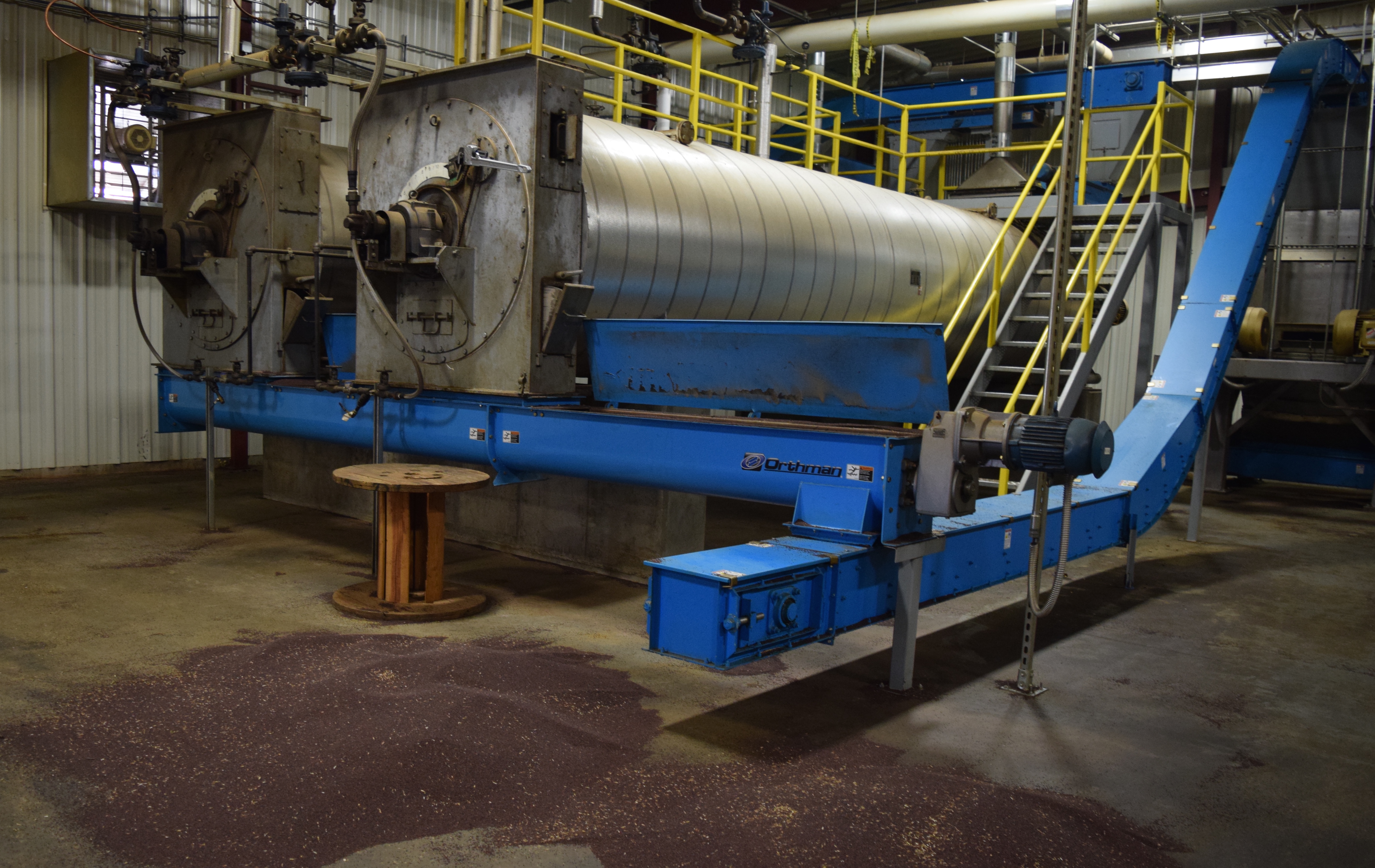
The first stop on the tour was the long silver cylindrical oven used to warm the seeds to no more than 120º. Warming the seeds made them easier to press. The low oven temperature kept the process in the category of cold-pressed. The blue conveyor belt brought the warmed seeds to a machine that cracked the hard outer shells.
DSC_0257

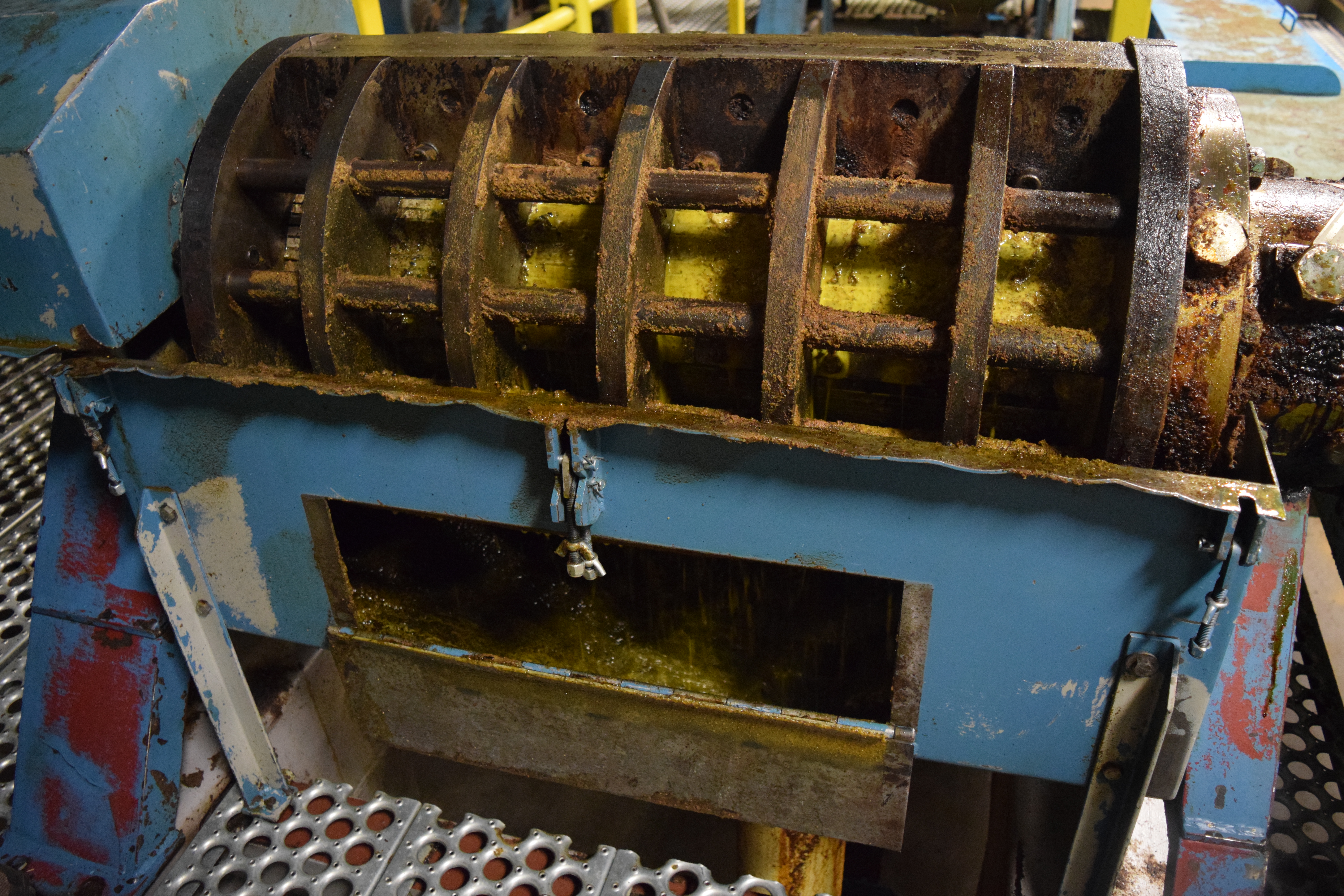
Next stop was the seed crusher. This was where the magic happened. This machine crushed the seeds and expelled the golden canola oil into the blue well. The oil will still need to go to an offsite refinery before it can be bottled.
DSC_0266

Here’s a video of the mechanical magic happening:

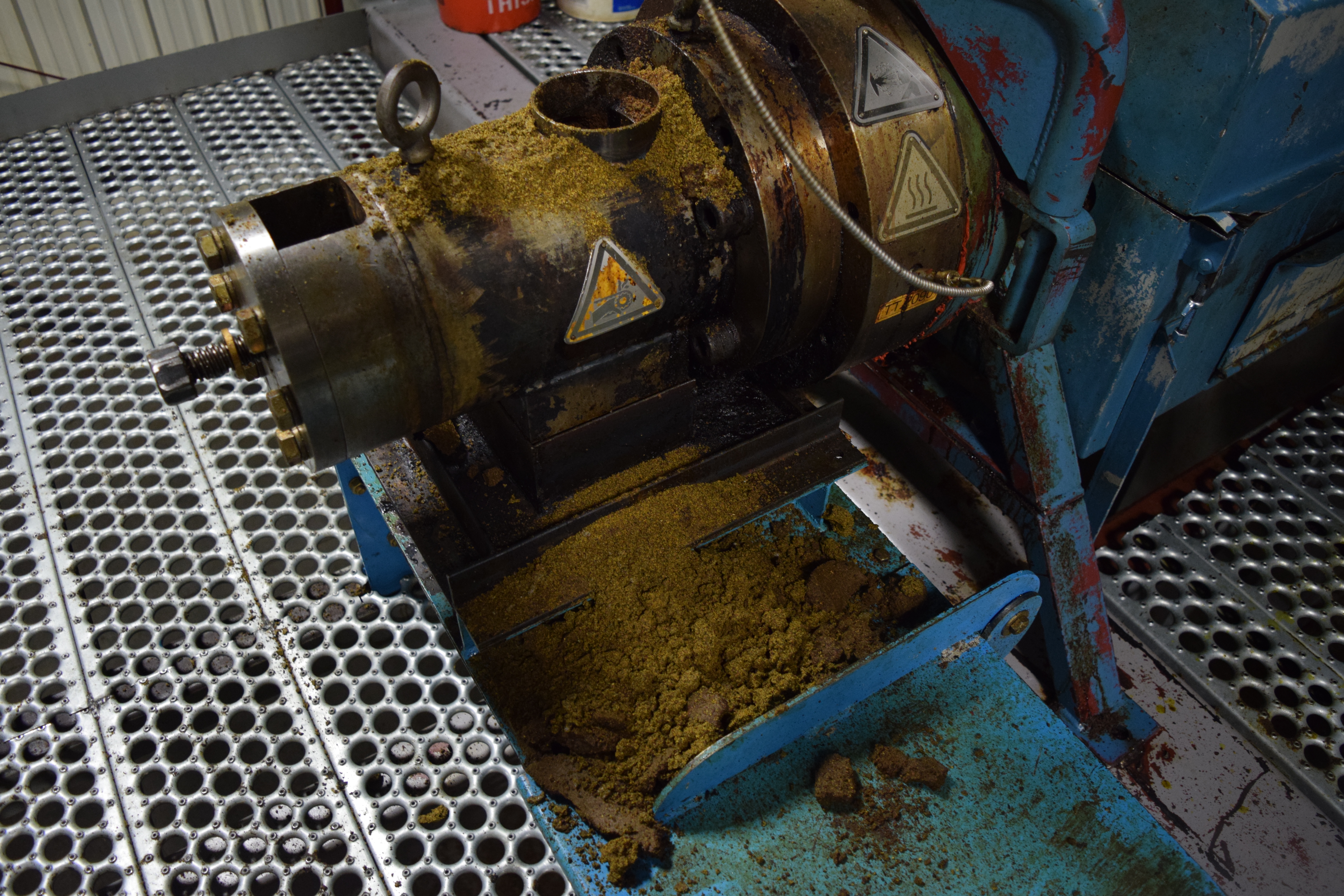
Here was the residual seed meal as it dropped onto a conveyor belt.
DSC_0274

This meal was delivered to the green machine for a second pressing to remove the last traces of oil. At this plant, there are no chemical solvents, like hexane, used to extract these last drops of oil. That’s where the expression “all natural expeller press” comes from.
DSC_0283

Here’s the residual meal as it came off the conveyor belt after the last of the oil had been pressed from it. The meal is used to feed livestock.
DSC_0277

This is the transport room. It’s where the seeds, collected from farmers, are gathered and delivered to the silos for storage. And later, after pressing, where the extracted oil is weighed and distributed, via trucks, to be delivered to Georgia for the final refining process and …
DSC_0286

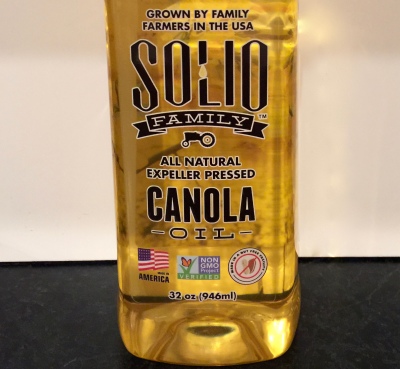
bottling. You can find Agstrong’s Solio Canola Oil at Whole Foods stores.
IMG_3031

But the story doesn’t end there. As a volunteer chef and Board member of The Nashville Food Project my antennae is always up for opportunities for food donation and food recovery. Canola and olive oil are two expensive staples we use in abundance at TNFP. I asked if Agstrong would consider partnering with us and donating their locally grown and manufactured Solio oil to TNFP, which they have graciously done. Here was the Plant Manger, Mark Dallas, donating a 35-pound container of oil to TNFP, on the spot.
Version 2
And that’s how this one little detour ended up providing cooking oil for TNFP whose mission is “Bringing people together to grow, cook, and share nourishing food with the goals of cultivating community and alleviating hunger in our city.”
DSC_0447
The story, however, didn’t end there, either. I happened to “pull” a few young canola plants from the side of the road last April to plant in my vegetable garden, so I could watch and learn how these plants matured to the seed stage. Once the plants produced seed pods and dried out, I was pleasantly surprised to walk out to my garden one day and see my chickens poking their heads through the chicken wire and eating the canola seeds.
IMG_0787
It looks like Agstrong’s byproduct of meal for livestock was a winner.
I’ll leave you with a video of my chickens enjoying canola seed pods:

Related Posts on Commercial Farming:

LET’S STAY CONNECTED!

Follow my photos of vegetables growing, backyard chickens hanging out, and dinner preparations on Instagram at JudysChickens.

Never miss a post: sign up to become a follower of the Blog.

© 2014-2017 Judy Wright. All rights reserved. Photos and text may only be used with written consent.