

My mother taught me to knit when I was ten. She worked full-time and I remember pacing the house waiting for her to get home to pick up my dropped stitches. The first thing I knit was a gray skirt for a Barbie doll. I remember it turning out like an hourglass-shaped pencil skirt. It was fraught with common beginners’ mistakes: added on and dropped stitches. Eventually, I got the hang of it and loved nothing more than to sit by Mom and knit.
By the time I found out I was going to be a grandmother, I’d been a lapsed knitter for many years. Not so any longer. I’m right back in it and probably for good this time. I love knitting for the baby.
Here are three things I love that I have knitted for my grandson.
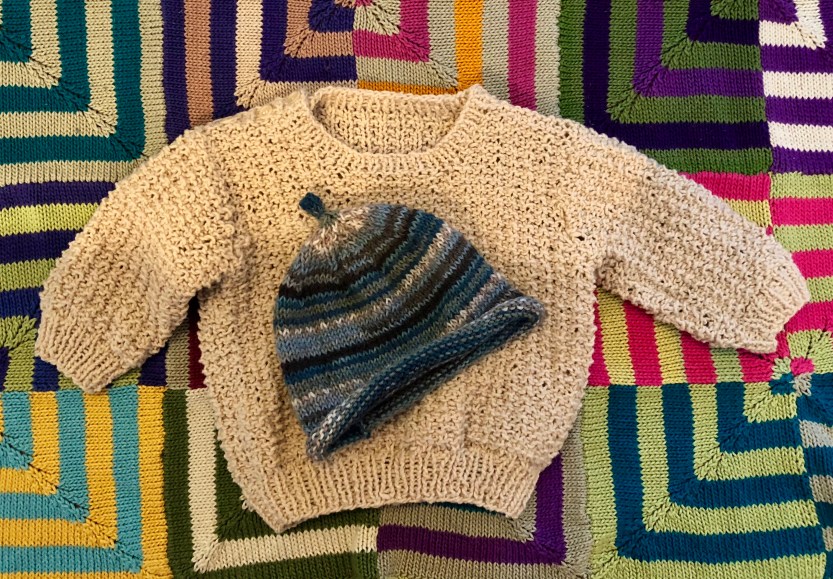
The first item is my favorite blanket pattern, the “Mitered Square Blanket” from Mason Dixon Knitting. I started the pattern when my daughter-in-law first told us she was pregnant. Because we didn’t initially know the sex of the baby, I made the first squares in shades of pink and blue.
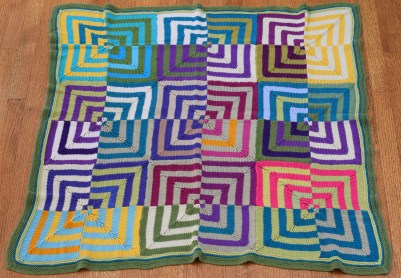
Almost like my grandmother did in 1957 when she crocheted this baby blanket for me. I’m just now noticing that Grandma and I both liked two-toned geometric designs!
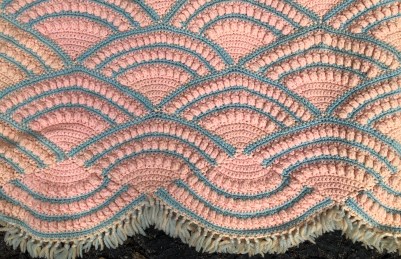
Next, I made quite a few of these quick and easy rolled edge hats.

After that, I made my favorite baby sweater pattern called Home-Team Player. It has three buttons on the shoulder which is helpful when slipping a sweater on and off a baby’s big head. I enjoy knitting to the rhythm of this pattern very much. It is also quite forgiving size-wise, meaning there is room for the baby to grow into the sweater, but still look okay while it is a little too big. I made at least a half-dozen of these for my children and friends.
This is a picture of my darling grandson wearing the sweater I knit for him. He has his favorite blankie, too.

A few weeks after finishing his sweater, I stumbled upon this picture.

It’s of my mother holding my son, Jesse, circa 1987. Jesse is wearing the sweater made from the same pattern I used for his son! Same color, even!
So which pattern should you try first? If you are a beginner, I’d suggest starting with the baby hat, then moving to the sweater, and then the mitered square blanket for an exciting and fun challenge.
The Baby Hat
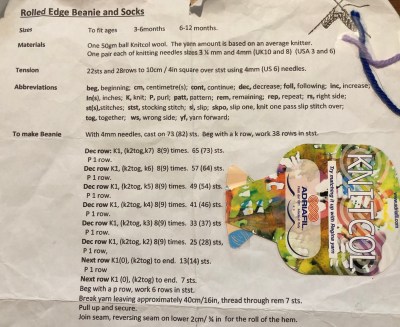
We took a trip to New Zealand a few months before the baby was born and while traveling to Queenstown came across a fantastic handicraft store called The Stitching Post in the charming town of Arrowtown. They had so many adorable samples of baby items to knit and quilt that I had to tell my husband to go off and explore the village without me. I needed to soak all the gorgeousness in. For this hat, the Stitching Post recommended a soft superwash merino wool called Knitcol by Adriafil. I love it and left the store with quite a few skeins … and a set of size 6 needles … and their free pattern. No time like the present to get started.
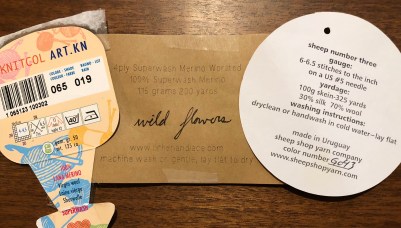
The yarns I used for these hats.
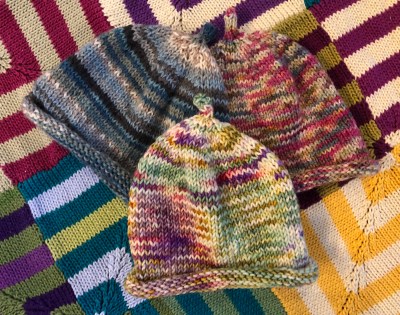
The blue/gray yarn is Knitcol. On the Stitching Post’s website, they show how the Knitcol colorways look when knit up. Take a look.
The variegated pink yarn on the hat on the right is by the Sheep Shop Yarn Company. It is an old yarn made with a blend of silk and wool. It is no longer available.
The green/pink yarn is called Lichen and Lace and is a superwash merino wool sold through Mason Dixon Knitting. Because the yarn was a little thicker than the Knitcol, I cast on 64 stitches instead of 73 and bumped up the needle size from a US 6 to size a US 8.
A word about yarn choices for baby hats.
I like to use a non-itchy yarn for baby hats because their heads get hot and sweaty and sometimes itchy while wearing a woolen hat. Look for soft yarn with the words “superwash merino” on the label. Cotton doesn’t always work for this pattern because it doesn’t have “give” or enough stitch recovery to make the edges roll. Cotton hats need a pattern with a few rows of ribbing to grip a baby’s head.
For a good explanation of what “superwash” means check out this article from Lion Brands Yarns’s website.
The Baby Sweater

The Home Team Player sweater pattern came from the now-defunct Conshohocken Cotton Company and has been my favorite baby sweater pattern since the 1980s. The pattern is nowhere to be found for purchase on the Internet or in stores, so I’ve included it in this post. My pattern looks like an old family recipe. It is as well-loved as Mom’s Apple Pie!
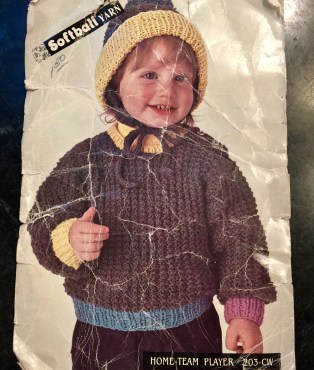
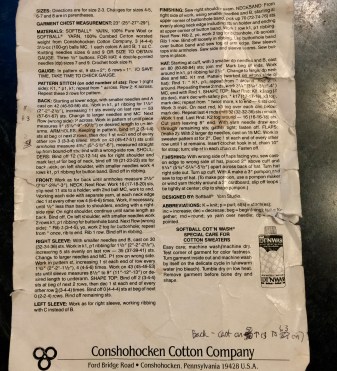
This sweater is knit on 6 and 9 needles with worsted weight yarn. I find that many baby patterns make the arm length too long so for this pattern, I shortened the arms by at least two inches. One tip I use when determining arm length is to measure the length of the arm from a baby sweater I already like. **I’ve added a bigger photo of the pattern at the end of this post.
The Mitered Square Blanket

Stardate April 17, 2006. This was the moment I fell in love with the Mitered Square Blanket made famous by my good friend, and neighbor, Ann Shayne and New Yorker, Kay Gardiner in their first knitting book, Mason-Dixon Knitting: The Curious Knitter’s Guide. This photo was taken at their Nashville book signing. I’ve been smitten by this blanket ever since. I’ve made five of them! The one pictured above is for a queen-size bed. It’s huge! The pattern is now available online. Here’s a link.

The morning after the book-signing, I beelined it over to Ann’s house so Kay could give me a private tutorial on how to knit the squares. Mitered squares start out as a straight row of stitches, and then through a series of decreases up the middle, the sides are drawn inward to create a square. You will feel so excited the first time you see the square emerge from the horizontal row of stitches. It’s magical.
The next thing that will excite you is the thrill of choosing colors and seeing how beautifully the squares come together when seamed. After a while, I started to think of the hanks of Tahki Cotton Classic yarn as tubes of paint. I honestly felt like an artist after making just three squares! Knitting the squares becomes addictive, I promise!

You might even find yourself carrying a little baggie with a mitered square in progress for when you have downtime. I used a short round needle for portability.

Finally, a sweet ending to a long yarn: a picture of my great-grandmother, MamaNika, knitting on the patio of my grandparents’ home. You can read all about her and the other beautiful, female role models in my life, all domestic goddesses, here.

Blog Favorites: Recipes from My Family
Grandma’s Italian Fried Cauliflower
Baked Ziti with Eggplant
Italian Ricotta and Lemon Cookies
Mom’s Apple Pie (with a cheddar streusel topping)
Judy’s Mom’s Meatloaf
Mom’s Pumpkin Pie
@judyschickens Everyday Salad Dressing
Mom’s Monkey Bread, circa 1970
Aunt Bridget’s Chicken Soup with Little Meatballs
Rachelle’s Italian Sausage, Onions, and Peppers
© 2014-2017 Judy Wright. All rights reserved. Photos and text may only be used with written consent.













 @judyschickens