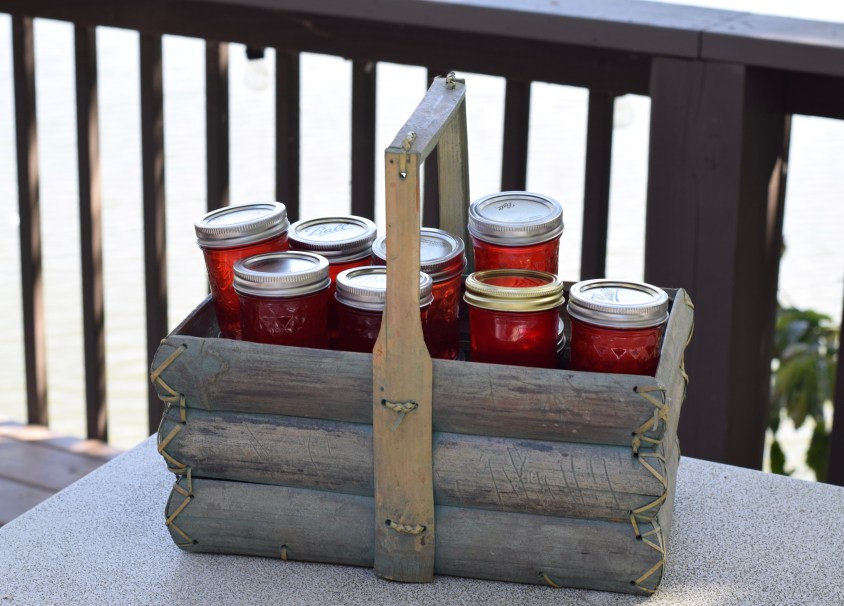
Crab Apple Jelly

dsc_0303

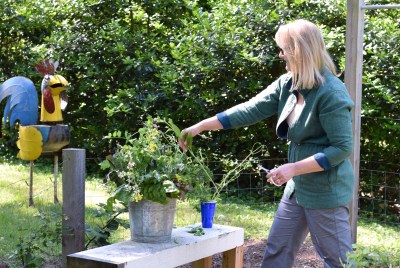
The first year that I noticed my two crab apple trees were loaded with fruit, it was because my mother was outside cutting branches from them to use in floral arrangements for a party.

Elephant Painting

My mother would make beautiful arrangements from random plants when she visited; crab apple decorations shouldn’t have surprised me. What did surprise me was the trees were loaded with gorgeous, red fruit and the fruit was edible. The next year, I picked every last crab apple off those trees and canned my first jars of crab apple jelly.

Growing Crab Apples

We have two crab apple trees in our backyard, both planted by the Nashville Electric Service through their Tree Replacement Program. It took about five years for them to start producing fruit. They are hardy and do not require extra care.

The trees bloom in mid-April.

dsc_0947

If pollinated, they set their fruit in early May.
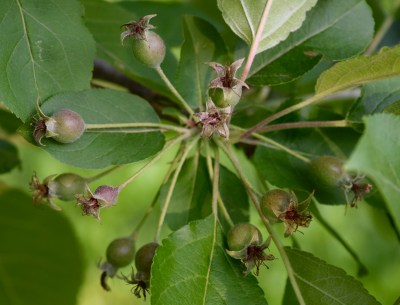
crab apple

The fruit starts ripening in September and is ready for harvest by mid-October.
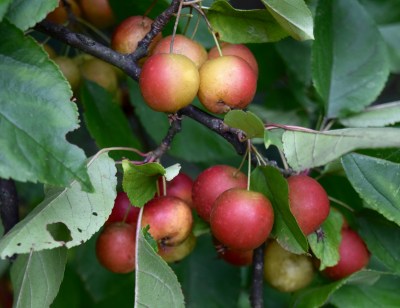
crab apple fall garden

Harvest day

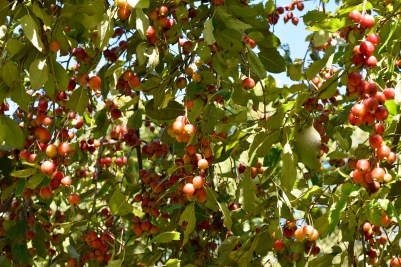
This fall, when I went to check on my trees for fruit, they were bare. I have no idea what happened; the trees were loaded in early August. Fortuitously, my good friend Deb Hudson’s, crab apple tree was full of fruit and my husband and I were able to pick fourteen pounds in no time.

crab apple – Version 2

It’s raining crab apples, hallelujah!
dsc_0882

Making Jelly

Jelly is made from the strained juice of cooked whole fruit, whereas jam is made with thin-skinned berries or tree fruits (the ones with easily extracted nuts, i.e. peach) that are crushed and the pulp retained. Both jellies and jams use a high concentration of sugar as the preserving agent and rely on pectin for the congealing or thickening agent.

Making jelly requires two cooking steps. First, fruit is cooked and strained to release the pectin from the fruit’s cell walls. Second, the pectin-laden juice is boiled vigorously with sugar until the sugar and water concentration hit the sweet spot — the point at which the mixture will congeal when it is at room temperature.

That sweet spot is known as the “set point” in the world of jelly-making. If you cook the jelly mixture past the set point, you end up with hard candy. If you don’t cook it long enough, you end up with a fruity syrup. Get it right, and you have a home-made delicacy at the ready in your refrigerator. This very small risk of utter failure, that, let’s face it, is of no consequence to the world, is one of the things that make successful jelly-making such a thrilling and deeply satisfying experience for cooks.

Establishing the set point can be tricky. There’s a reason you never see the direction “cook jelly until it sets” in a cookbook. If you cooked the fruit mixture until it thickened to a gel, by the time it cooled, it would indeed be hard candy. Instead, you need to learn how to test for the set point while you are cooking so you can remove the mixture from the heat at the correct time. Fortunately, cooks have developed a few time-honored methods for making this determination that we’ll get to.

dsc_0296

To improve your chances of achieving a good set, it helps to understand the key players in the process: pectin, sugar, and acid.

Pectin Demystified

The word pectin comes from the Greek “pekitikos” and means curdled or congealed. As fruit is cooked, its cells expand and rupture, releasing pectin into the pulp. Pectin strands are complex chains of carbohydrates found in the leaves, stems, flowers, and fruits of plants. Pectin gives structure to plants.  Accordingly, as fruit becomes overripe, its pectin content diminishes, and the fruit looses its shape. Jelly is made from a balanced mixture of strained fruit juice and sugar, held together by a webby network of these long pectin strands.

Before you begin making jelly, it helps to have an idea about the natural pectin content of the fruit you are preserving. Check out this chart to learn the pectin and acid content of most fruits. One thing you will notice right away is that pectin and acid levels often correspond to one another.

Acid? What’s acid got to do with it?

Acid helps release pectin from fruit. Later, it helps with the gelling process by creating the right environment for pectin strands to bond. It also improves the color and flavor of jelly. Some fruits are acidic by nature, especially the tart ones like crab apples and cranberries. Others, like pears and strawberries, are sweet and subsequently lower in acid. They often need an outside source of ascorbic acid. Lemon juice is the most common acidifier used when making jams and jelly.

Sugar 

Sugar is a mighty natural preservative. It is right up there with salt as an ingredient that will draw out moisture from fruit and stop micro-organisms from growing and spoiling food. Don’t add sugar to fruit until after it has softened as sugar inhibits the release of pectin. Once the fruit is softened and ready to be boiled down, the addition of sugar helps the pectin to gel.

Fruit juice needs sugar, and lots of it to preserve fruit for long-term storage. As a rule of thumb, add sugar to juice using a 1:1 ratio (one cup juice gets one cup sugar) for high-pectin, high-acid fruits. You can play around with this amount as you gain experience with the various amounts of pectin and acid in fruit.

Testing for Set Point

To test for set point, first take the pot off the heat. I use the “flake” or “sheeting” test. Scoop up about a teaspoonful of hot liquid with a wooden spoon. Let the liquid sit there for five seconds to cool slightly and then tilt the spoon and watch the liquid drip. In the beginning, the drops will drip in a steady stream indicating the liquid needs to boil more. Soon, the drops will form into tiny triangles indicating the pectin network is forming. When the mixture is ready, the last drops pouring off will run together. This is known as sheeting.

By removing the test liquid from the heat and air-cooling it, you’ve given yourself a quick glimpse of what the liquid will do when it cools down to room temperature. You’ve made an educated guess.

Photo Timeline of Sheeting Test

11:36 (stream), 11:54 (small triangle drop), 12:02 (sheeting). Know that the timing is different for every batch of jelly as it all has to do with how much water needs to be evaporated from the juice and how long that will take.

dsc_0172 dsc_0206 dsc_0216

Take a look at my post on making grape jelly to learn about making jelly that requires the addition of commercial pectin.

Recipe for a Small Batch of Crab Apple Jelly

My husband and I made two batches of jelly; one was a small batch that used 3.5 pounds of apples and the other was a large batch that used the remaining 10.5 pounds. It took 12 minutes for the small batch to reach set point and 45 minutes for the large batch. The difference in time was due to the large amount of water that had to be evaporated from the large batch.

Before you start cooking wash jelly jars in the dishwasher. You want the jars to be warm when you fill them. Boil the lids in water for five minutes before using. Use tongs to handle jars and lids.

dsc_0201

Small Batch Jelly Yield: 6 cups

Ingredients:
3½ pounds firm, crab apples (8-9 cups) which yield 3½-4 cups of juice
Enough water to be level with apples in the pot (3-4 cups)
3  5-inch sprigs fresh rosemary
zest of half a lemon
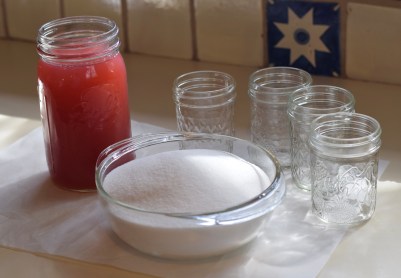
about 4 cups granulated sugar (1 cup sugar: 1 cup juice)

Mise en place for cooking the fruit

dsc_0083

Mise en place for cooking juice and sugar mixture to make jelly
dsc_0229

Instructions

First: Cook the Fruit

Wash crab apples and remove leaves and most of the stems. Inspect fruit for rot and black spots. Discard less than perfect fruit.

Place apples, zest, and rosemary in a 6-8 quart stainless steel saucepan. Pour water into the pot until it is level with the crab apples, about 3-4 cups. Do not add sugar, yet.

dsc_0092

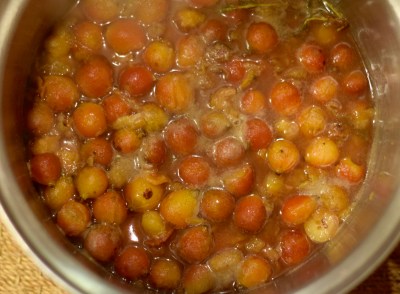
Bring fruit and water to a boil over medium heat. Turn heat to low and simmer for 15 minutes, stirring occasionally.
dsc_0113

Remove pot from heat and use a potato masher to break up the apples. Return to heat and continue to simmer until fruit is soft — another 5 or 10 minutes. Do not cook longer because you will run the risk of destroying the pectin.

dsc_0116

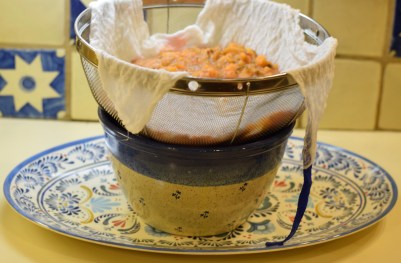
Place a muslin-lined sieve over a large, clean bowl. Pour cooked fruit in and allow mixture to drain overnight. If you push it through the sieve with force, your juice will likely become cloudy.
dsc_0136

Measure juice. You should have about four cups. If you don’t, place a heavy object on top of the pulp to slowly release more juice. Sometimes I drizzle a little hot water over the pulp and use what drips out to make up the difference and get me to four cups.

Next: Make the Jelly

Pour juice into a clean, deep, wide, heavy-bottomed saucepan that allows room for boiling a liquid that is going to froth and rise about four inches.

Bring fruit juice to a simmer over medium heat. Add sugar and stir over low heat until sugar has dissolved.

Turn up the heat to medium and bring mixture to a low rolling boil. A rolling boil is when the entire surface of the liquid is boiling, not just the edges.  After five minutes start checking the juice for set point. Remove the pot from the heat each time you check.

At first, the rolling boil will be frothy and rise up the sides of the pot. Watch carefully and control the frothiness by adjusting the heat. Otherwise, the mixture will boil over and make a mess.

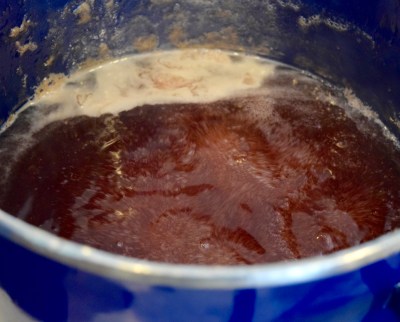
As the mixture cooks, it changes from a frothy boil

dsc_0244

to a ploppy boil.

dsc_0202

Continue to test for sheeting until you reach set point. Immediately remove pot from heat it is reached. Skim any surface residue with a slotted spoon.

Here’s a photo of sheeting from my recipe for my oven-roasted strawberry jam. This set point test method works for both jellies and jams.

dsc_0591

Finally: Store the Jelly

Ladle hot jelly into clean, warm jars, leaving ¼ inch of headspace. Wipe the rims with a clean damp cloth. Cap them and turn them upside down and allow to cool. This helps give the jars a good seal without processing, but unless they are processed in a boiling water bath, they will need to be stored in the refrigerator until ready to use. Alternatively, you could heat process them.

DSC_0004

Crab apple jelly tastes equally great on toast or served alongside roasted pork or chicken.

Another floral arrangement with crab apples!

Flowers by Mary

Beautiful floral arrangements, delicious jelly, and gorgeous colorful fruit — crab apple trees give a lot of bang for the buck. Plus, they are good pollinators.

Other Posts About Making Jelly, Jam, and Chutney
How to Make Grape Jelly (and grow the grapes)
Grandma’s Cranberry Chutney
Oven-Roasted Strawberry and Rosemary Jam
Raising Sorghum Cane

LET’S STAY CONNECTED!

Follow my photos of vegetables growing, backyard chickens hanging out, and dinner preparations on Instagram at JudysChickens.

Never miss a post: sign up to become a follower of the Blog.

© 2014-2017 Judy Wright. All rights reserved. Photos and text may only be used with written consent.

WWMD? A Bucket of Spring Veggies as a Centerpiece

When my mother was alive, she would go out in my backyard, cut flowers, interesting greens, flowering branches, and even flowering weeds, and make the most beautiful floral arrangements. She would set them around my house in small vases. Even her choice of containers was unusual, antique blue bottles, ceramic jars, and porcelain or metallic bowls. Her sense of style and creativity was legendary.

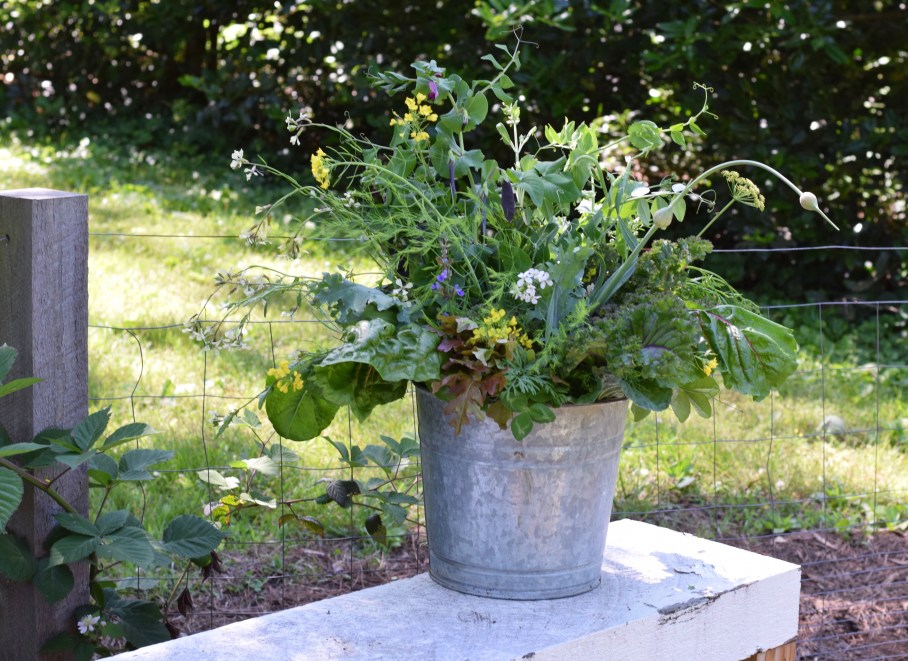
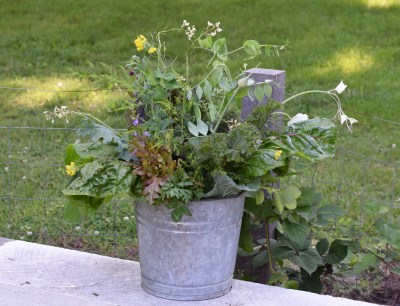
Monday, I needed to come up with a floral arrangement for my book club, the Book Hunters’, annual luncheon. As I stood in my backyard early in the morning watering vegetables, I wondered WWMD? What would Mom do? I had gorgeous leaves of every shape, size, color, and texture. Some of my herbs were flowering. I got the idea to make an edible arrangement using one thing from every vegetable and herb growing in my yard. I got a bucket, filled it with water and started picking. I ended up with this.

DSC_0855

Unfortunately, it lacked oomph.

I made a quick SOS call to my flower-arranging friend and fellow Book Hunter, Mary. Could she come over a little before the meeting and pretty this arrangement up? Mary, my mother’s name, by the way, arrived and got busy arranging while I searched the garden for more color.
DSC_0875

I picked flowers, seed pods, garlic scapes and even a few flowering stems from my beloved Heirloom Desiree Dwarf Blauwschokkers pea plant. It was painful to cut that one knowing those flowers would have turned into peas. Purple peas, no less.
IMG_7917

These purple peas become a focal point wherever they show up, whether growing on the vine, served as a side dish, or used in an arrangement. This a fun plant to grow, readers.
Version 2 DSC_0936

By the time everyone arrived, Mary had worked her magic, and we had an arrangement full of color, texture and whimsy. And all of it was edible.
DSC_0968 (1)

Plants Used
Leaves: Winterbor Kale, Red Russian Kale, Bright Lights Swiss Chard, Kookaburra Spinach, Red Romaine, Freckled Romaine, Red Oak Leaf Lettuce, Alcosa Cabbage, Red Clover, Red Ace Beet, Bull’s Blood Beet, Hakurei F1 Hybrid Turnip, Easter Egg Radish,  Lorane Improved Broad Fava Bean, Spring Onion
DSC_0922

Plumes: Dill, Jersey Knight Asparagus, Calliope Blend Carrots, Scarlet Nantes Carrots, Purple Haze F1 Carrots

Shapes:  Sugar Snap Pea, Oregon Sugar Pod 2, Desiree Dwarf Blauswshokkers, Garlic

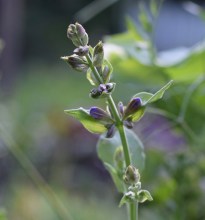
Flowers: Arugula, Sage, Red Meat Radish
DSC_0091 (1) DSC_0092 (1) DSC_0922 (2)

More flowers: Mustard, Pea, Parsley, Garlic
DSC_0940 (1)  DSC_0093 (1)

Mom would have approved. The chickens did.
DSC_0101

The story didn’t end there. Last night, I deconstructed the arrangement to make dinner. I placed parts to be sautéed in one bowl, parts for a salad in another, flowers for a small arrangement in a vase and stems and such in the compost bucket for the chickens.
DSC_0159

I sautéed the vegetable and herbs with spring onions and garlic in olive oil, mixed in four cups of leftover cooked farro and added the meat from a rotisserie chicken. When the food was all mixed, seasoned, and heated, I squeezed lemon juice over all of it and stirred in grated parmesan cheese. We had it for dinner.
DSC_0226

For more details about planting a spring vegetable garden, check out this post: Urban Farming: Spring Planting. I also have a post called Urban Farming: Fall Planting if you are thinking of taking the plunge into backyard farming this Fall.

Version 2

Other How-tos
How to Make Cork Bulletin Boards
How to Make a Freezer Thaw Detector

LET’S STAY CONNECTED!

Follow my photos of vegetables growing, backyard chickens hanging out, and dinner preparations on Instagram at JudysChickens.

Never miss a post: sign up to become a follower of the Blog.

© 2014-2017 Judy Wright. All rights reserved. Photos and text may only be used with written consent.
Tomatoes: The Crown Jewels of the Summer Kitchen Garden

The hustle and bustle of getting my vegetable garden planted over the last several weeks came to a halt yesterday (albeit temporarily — gardening never ends) when finally, I got my tomatoes in the ground. After a fun few days spent chasing down favorite plant varieties at local garden centers, I felt a peaceful sense of satisfaction as I dug that last hole in the ground and planted a Green Zebra tomato, scored from Gardens of Babylon at the Farmers Market. That the big planting happened on Earth Day made my gardening day even more special.
vegetable gardens vegetable gardening

This year, I am on a mission to get more than 5-10 tomatoes from each tomato plant. To that end, I chose plant varieties based on flavor, growth habit, success in prior years, and color. I even rebuilt my tomato bed to offer stronger vine support, did a soil test at the Elmington Agriculture Center, and then amended the soil based on the results.

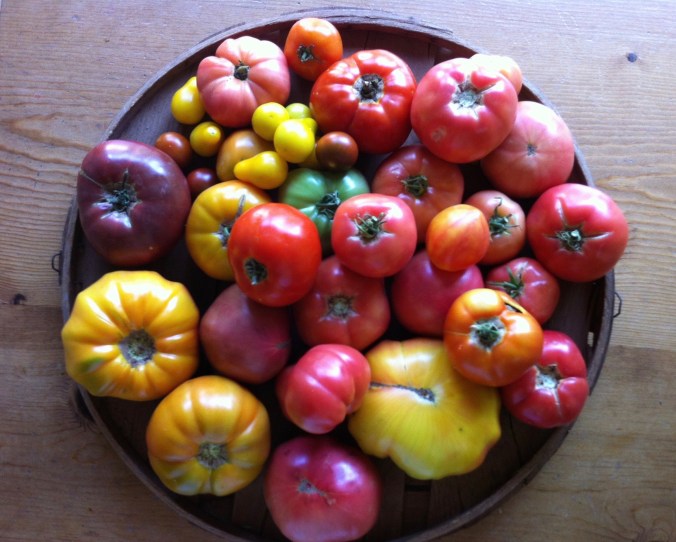
The plants I chose to grow are Cherokee Purples, San Marzanos, Hughs, Bradleys, German Queens, a Mr. Stripey, and a Green Zebra. To see my choices for cherry tomatoes, check out my post, The Full-Bodied Cherry Tomato.

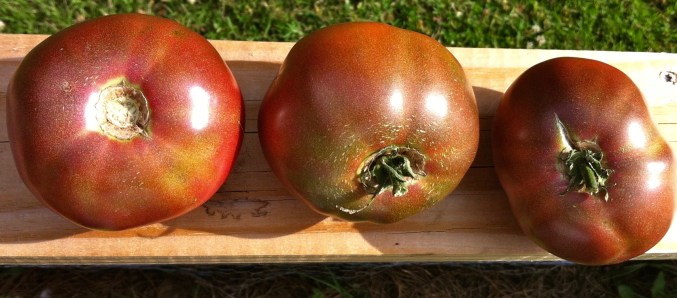
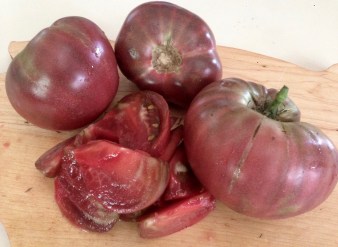
Cherokee Purples (6 plants): Indeterminate. Heirloom. Very sweet and large fruit. Their color is a dusty rose with what looks like purple bruises. When very ripe, and deep purple, they are gushingly good. They are my favorite tomato.
DSC_0107 lake barkley, ky july 4th week

San Marzanos (4 plants): Indeterminate. Heirloom. A meaty, deep red “paste” tomato. They have a thicker flesh and fewer seeds than the regular Roma tomato. They are sweet and low acid. This variety is my favorite for cooking.
IMG_3870

Hughs (2 plants): Indeterminate. Heirloom. Strong, sweet flavor and very meaty.  I first tasted this tomato last summer while cooking at The Nashville Food Project. I’ve been lusting for them ever since. I’m grateful TNFP’s Garden Director, Christina Bentrup, saved two young seedlings for me from Project Growa popular Nashville vegetable plant CSA. The tomatoes are pale yellow and large.
TNFP tomatoes IMG_7166

Bradleys (2 plants): Semi-determinate. Heirloom. Fruit is pinkish-red and ranges in size from 7-10 ounces. This was my favorite tomato to grow until I learned about Cherokee Purples. They are sweet with just the right amount of acidity. As with other determinate varieties, they set their fruit and then they are done for the season.
bradley3

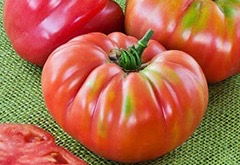
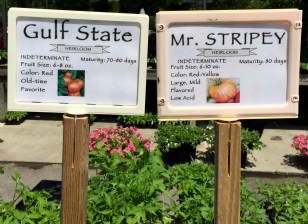
Mr. Stripey (2 plants): Indeterminate. Heirloom. Fruit is large and very sweet. Their color is yellow with pinky-red undertones. These tomatoes are luscious. I love them sliced and in a sandwich. I tend to photograph them a lot!

tomato art vegetable gardening

German Queen (1 plant): Indeterminate. Heirloom. Fruit is sweet and low-acid. They are large and pinky-red with green undertones in the shoulders.  Great for slicing. This photo is from Bonnie Plants
tomato-heirloomgermanqueen-m

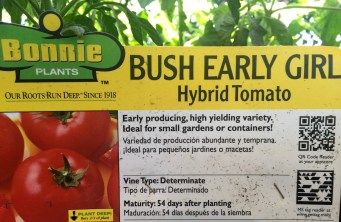
Bush Early Girls (2 plants): Determinate. Hybrid. I planted these just to watch their growth habit. They are advertised as an extra-early variety, compact at 18 inches tall, productive and bred for disease resistance. This photo is from Burpee Seed Company.
prod000981

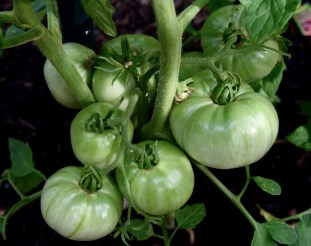
Green Zebra (1 plant): Indeterminate. This tomato is the result of four heirlooms bred together. I grow it for its two-tone vertical stripes in shades of green which begin to become slightly pale yellow at maturity. The fruit is small, the flesh is pale green, and the flavor is mild. I grow them to round out my color palette.
tomatoes walkers RI Tomatoes

The Growth Habit of Tomatoes: everything you need to know is on the plant’s label!
IMG_6697 IMG_7195

Determinate & Indeterminate

Simply put, there are two types of growth habits for tomato plants: determinate where the plant bears all of its fruit at one time and indeterminate, where the plant bears fruit all season long right up to the last frost.

Determinate Varieties:
Also known as bush and patio tomatoes, this variety grows on one main trunk to a pre-determined height of two to four feet and sets a finite number of fruit. They should not be pruned. They produce tomatoes for a concentrated time span of four to six weeks and then they are finished for the season. This makes them great for commercial growers who can plan on one harvest for the season.

Indeterminate Varieties:
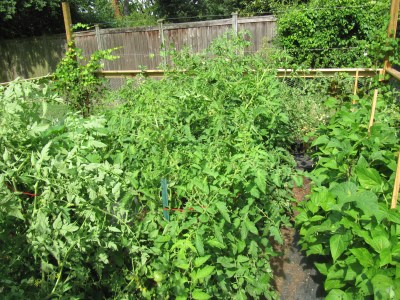
If you think of indeterminates as vines that need to be staked and pruned, it may help you plan ahead on how you are going to accommodate their unwieldy growth habit. Tomato vines grow like a weed and, left unpruned, will eventually topple over from the weight of their continuously growing stems, leaves, and fruit. I found this picture of my tomato garden taken on June 4, 2012. There are no subsequent photos of this garden. You know what they say; History is written by the victors. This kind of unpruned growth is unsustainable.

vegetable gardens vegetable gardening

Suckers! This brings us to the topic of pruning suckers, those new vines that grow in the crotch of the 90-degree angle formed by new leaf growth off of the main stem. Left unpruned, the new vines that they grow into, can each grow from 3-10 feet, depending on who you talk to! This year, my plan is to snip those suckers. I found an informative article on the topic of pruning tomatoes at Fine Gardening. Check out the article. I’m a believer now that I understand what is going on.
tomato sucker tomato sucker

Heirloom and Hybrid
Heirloom varieties are plants that have been around for at least 50 years and are either open or self-pollinated.

Hybrids are plants that have been bred for disease resistance, heat tolerance, fruit size, and flavor. “F1” on a plant label means it is the first generation of the cross-mating of two different parent plants. The next generation of hybrids will become known as F2, F3, etc. Hybrids that have withstood the test of time can become known as heirlooms after 50 years.

Open-Pollinated or Self-Pollinated
How a flower is pollinated is important to know if you intend to practice seed saving, otherwise, you do not need to consider it when growing tomatoes.

Open-pollinated (OP) flowers require insects or wind to move the pollen from the male to the stigma of the female. Once fertilized, the plant will set fruit in the ovary of the plant.

Self-pollinated flowers have both male and female parts in the same flower and do not need bees to set fruit. They are often referred to as the “perfect” flower. Have you ever noticed how flowers on a tomato plant point down? That’s nature’s way of assuring self-pollination through gravity alone.
DSC_0595 (1)

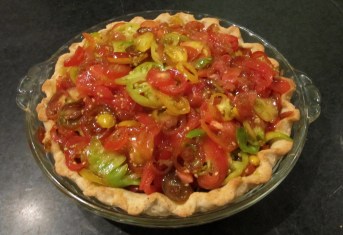
Now for a little tomato joy — last summer, these tomatoes, became a pie! This recipe and hopefully many more will come about once my huge tomato crop starts to roll in!
 

Tomato Update: May 6

DSC_0913

LET’S STAY CONNECTED!

Follow my photos of vegetables growing, backyard chickens hanging out, and dinner preparations on Instagram at JudysChickens.

Never miss a post: sign up to become a follower of the Blog.

© 2014-2017 Judy Wright. All rights reserved. Photos and text may only be used with written consent.
The Full-Bodied Cherry Tomato

IMG_2299

Whether you are a seasoned farmer or a first-time vegetable gardener, planting cherry tomatoes in your garden will give you a lot of joy and bang for your buck. The flavor in a cherry tomato is intensely sweet, and their gorgeous color and shape will make any salad or salsa more beautiful. They will also start producing before your regular-sized tomatoes ripen and will continue to produce right up until the first frost in October. Their only limiting factor is their fruit grows on vines, and those vines tend to spread so they will need a structure upon which to climb. I like to grow them along the chicken wire fencing that surrounds my kitchen garden.

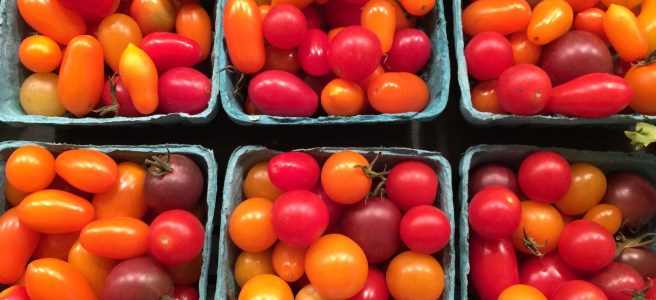
My dependable faves in the cherry tomato category are Juliettes, Sun Sugars, or Sun Golds, whichever you can find, Yellow Pear, and Matt’s Cherry Wild — in that order of preference. To give you an idea of sizes and colors, take a look at this photo taken last summer on July 6th.

IMG_1377

Juliette’s are like small Romas, meaty, packed with flavor and not overly sweet. They are the first tomato to ripen in the spring and the last to produce in the fall. They are big; I often cut them in half when I put them in a salad. If I only grew one cherry tomato, this would be the one.

tomatoes fall garden

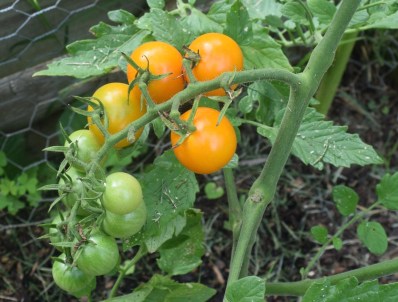
Sun Sugars are a golden orange color when ripe and grow as a cluster of grapes on a vine. They are very similar to Sun Golds. They are intensely sweet and tend not to crack.

DSC_0091

Yellow Pear. Their name says it all. Another tomato with great color, shape, and taste.

DSC_0377

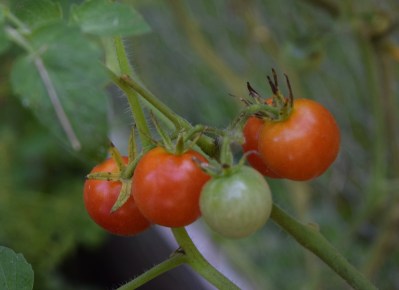
Matt’s Wild. They are tiny, deeply red in color, and intensely sweet. They grow like a cluster of grapes on a vine. They are so small; they hardly ever make it to the dinner table as we often pop them in our mouth right off the vine.

DSC_0595

This year, I’m going to add one more variety to the mix, the Black Cherry. My reason for wanting them is to round out my tomato color palette. Here is a picture of Black Cherry tomatoes from Johnny’s Selected Seeds website.

88G

Happy planting, but please wait to plant until after the last frost date for your area; the tomato plant’s leaves are very tender, and the plant will wilt and likely die if there is a frost.

LET’S STAY CONNECTED!

Follow my photos of vegetables growing, backyard chickens hanging out, and dinner preparations on Instagram at JudysChickens.

Never miss a post: sign up to become a follower of the Blog.

© 2014-2017 Judy Wright. All rights reserved. Photos and text may only be used with written consent.