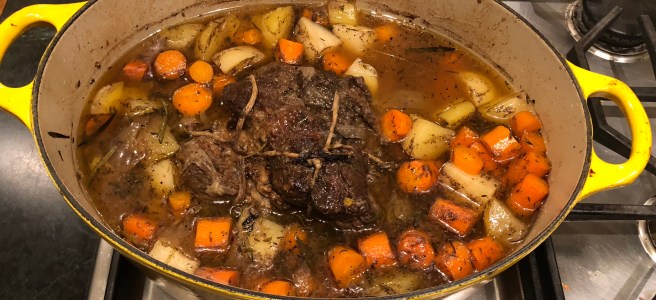
Pot Roast with Herbs and Root Vegetables

I’ve been on a pot roast making jag for the last two months.
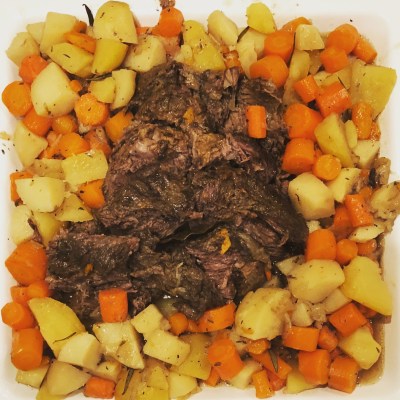
When my children were young I made pot roast regularly — the very quick way. I put a chuck roast in a Crock-Pot, sprinkled it with onion soup mix, added water, potatoes, and carrots and let it cook all day. It was good enough, but apparently not memorable. I know this because once my children moved out, I forgot all about pot roasts.

In January, I visited the newly opened Bare Bones Butcher in The Nations in Nashville. I told Wesley Adams, one of the owners, that I wanted meat for a pot roast. He gave me a list of cuts that would work, and we settled on the classic chuck roast, cut from the shoulder of a cow. The meat at Bare Bones comes from locally raised livestock who graze on grasses (“pasture-fed”) until a few months before slaughter when grains are added to their diet to bulk them up (“grain-finished”).

When I got home, I realized how much I didn’t know about cuts of meat. I found this video online that was produced by Bon Appétit. It helped me feel better informed.

I brought the meat home, browsed through my cookbooks, came up with a cooking plan, and made my first pot roast in perhaps five years, sans onion soup mix. It was delicious!


To write a reproducible and tasty recipe, I had to make a lot more pot roasts. I bought subsequent chuck roasts at a nearby Kroger. I asked the butcher to show me a nice looking chuck roast, and he picked this one.

Meats used for pot roasts are generally more fibrous than other cuts and need to cook slowly, with low heat, and in a moist environment, to break down the connective tissue between the muscles. Cooked in this way, the meat comes out well done, has beautiful flavor, and fall-apart tenderness.

Take a look at these vintage charts to see the meat cuts of a cow.

Yield: Serves 6

Ingredients:
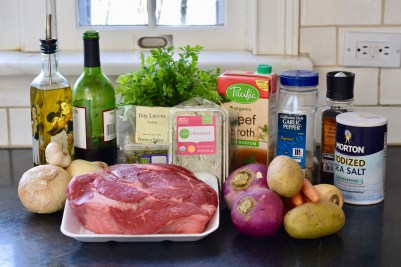
3 tablespoons olive oil
6-8 cloves garlic, smashed
1 large onion (12 ounces, about 2½ cups), rough chopped
4 pound chuck roast
salt and McCormick garlic pepper
1 cup dry red wine (omit for Whole30)
2 cups beef broth
5-8 stems thyme
3-5 stems rosemary
4-5 fragrant bay leaves
2½-pounds total of carrots, turnips, and gold potatoes
Add more salt to taste, if needed.

Instructions:
Preheat oven to 300º.

Wash the root vegetables. Peel the onion and roughly chop it. Take the garlic cloves, smash them with a meat mallet, and remove the skins.

Add olive oil to a heavy-bottomed, oven-proof pot. Warm the oil and add the onion and garlic. Sauté mixture for 10 minutes on medium heat until translucent and lightly browned. Add herbs, stir and sauté for one more minute. Use a slotted spoon to remove the onions, garlic, and herbs to a small bowl. Set aside.

While the onion is cooking, prep the meat. Rub approximately one teaspoon each of salt and garlic pepper on each side of the roast. If desired, tie the meat using four feet of cotton string. Set aside while you finish cooking the onion mixture.

Once you have removed the onion mixture from the pot, turn the heat up on the burner, put the exhaust fan on, and add the roast to the oil-coated pot. Brown the roast quickly on all sides for a total of about two minutes. Please note: in some of these pictures I tied the roast and in others I didn’t. Tying makes it easier to turn the roast over and to remove it from the pot.
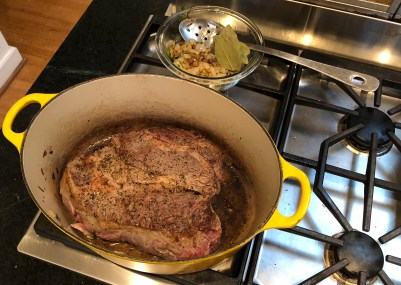
Remove the roast from the pot, add wine, and deglaze the pan using a wooden spoon to dislodge the small pieces of meat and onion that may remain.

Add the beef broth and heat until liquids are hot. Add back the onion and herb mixture and the meat to the pot. Do not boil the meat in the broth. Cover the pot and cook in the oven for 2 hours.

Isn’t this beautiful?!

Meanwhile, prep the root vegetables.
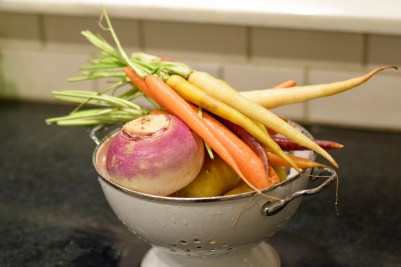
If the vegetables are fresh, I wash and scrub them, without peeling. If the skin is thick, I peel them. Cut veggies into two-inch dice. The addition of unpeeled turnips bumps up the flavor. Set veggies aside.

When the roast has cooked for 2 hours, remove it from the oven. Turn it over (easier to do when it is tied) and add the root vegetables. Poke the vegetables into the liquid. Set timer for 1 hour.
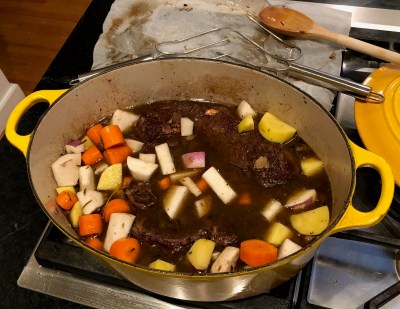
After the roast has cooked for a total of 3 hours remove the pot from the oven. Taste the broth to see if it needs more salt. Let rest until ready to serve.

When ready to serve, remove meat to a cutting board. This next step is optional, but one I always do now that I’ve tried it: pour juice from the pot into a fat-separator and set aside while you trim and slice the roast.

I often trim and remove the visible chunks of fat before slicing.

Remove the herb stems from the vegetables in the pot.

Arrange the vegetables around the meat on the platter. Pour some of the defatted juice over the meat. Put the extra juice in a gravy bowl and serve on the side. The broth is good enough to sip!
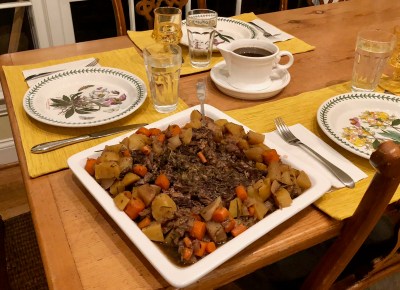
Serve with a salad and cornbread, to sop up the lovely broth.

Other Good Options for Dinner:
Yummy Shepherd’s Pie
Judy’s Mom’s Meatloaf
Rachelle’s Italian Sausage, Onions, and Peppers 
Chicken Cacciatore or Hunter’s Chicken
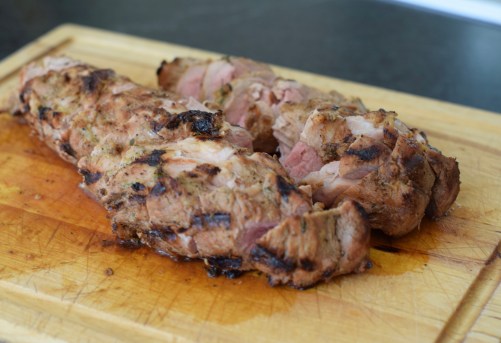
Brooks’s Pork Tenderloin with the Most Amazing Marinade
Lemony Grilled Chicken Breast

Don’t miss a recipe! Become a subscriber and have every post delivered to your Inbox.

Follow Judy’s Chickens on Instagram and Pinterest @JudysChickens.

Remember to always check this website for updated versions of a recipe.  

© 2014-2018 Judy Wright. All rights reserved. Photos, videos, and text may only be reproduced with the written consent of Judy Wright.

Baked Ziti with Roasted Eggplant, Mozzarella, and Marinara Sauce

Last night, my son and grandson joined my husband and me for dinner. I made baked ziti with eggplant.

The nicest compliment came when my son said this newest rendition of baked ziti was among the top five meals I had ever made. He said he wished it was served in a restaurant so he could get more whenever he wanted. (No need for that, honey; just say when.) It was all music to my ears. I had been working on a recipe for baked ziti and eggplant for years.

I love roasted eggplant. I was taught by my mother to sweat (salt and drain) eggplant before cooking to rid it of its bitterness. Indeed, for most of my adult life, I equated the brown liquid that dripped from the colander during sweating as the color of bitterness. The more brown liquid in the sink, the more successful I thought I would be in making a delicious eggplant dish. But recently I learned the true reason for sweating had nothing to do with bitterness and everything to do with the anatomy of eggplant. Eggplant is porous; it is full of small air pockets that absorb oil like a sponge. Sweating draws out water from the eggplant’s cells which fill the air pockets so cooking oil can’t’ occupy the air space.

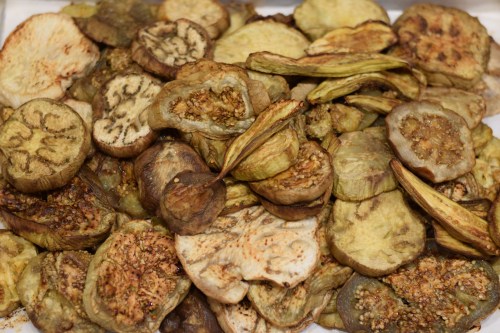
Since I no longer fry eggplant, this summer I eliminated this time-consuming step of sweating and instead lightly brushed each raw slice of eggplant with olive oil before roasting.

The results have been delightful. At a recent dinner party, guests started gobbling down unadorned roasted eggplant slices before I got a chance to smother them with marinara sauce and mozzarella.

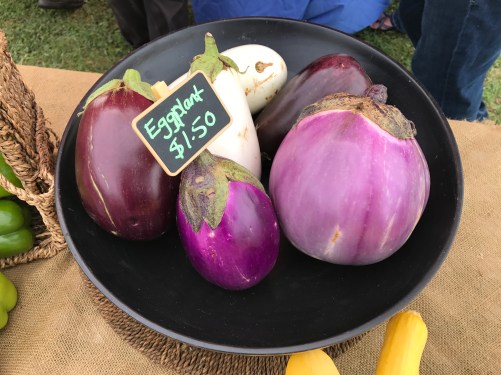
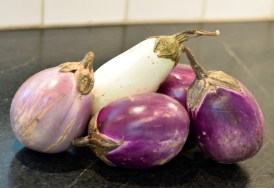
Recently, I went to the Richland Farmers Market in Nashville and bought these gorgeous, svelte, Italian eggplant (melanzana, in Italian) from Corner Spring Farm. They had delightful names like Violeta di Toscano, Rosa Blanca, Clara, and Beatrice.

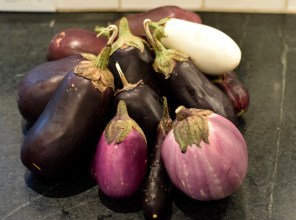
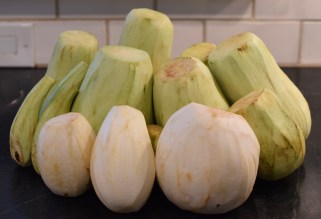
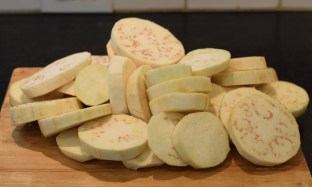
When I got home, I added them to the hefty stash of Black Beauty and Japanese eggplants I had harvested from my garden. I decided to make a day of it and cook all the eggplants at once. When I trimmed and peeled the skin, I was surprised to see the contrast in color of my stash of eggplants and the Italian varieties. Their flesh was so much whiter. Once roasted, I noticed the Italian eggplants were denser and maintained their shape better. Plus, they had the mouth-feel of artichoke hearts. Yum. Now I know why my mother would always choose Italian eggplants when we visited farmers markets; there is a difference. Next summer, I’m planning on growing more of the Italian varieties.

Yield: serves 8-10 as a main course

Ingredients 

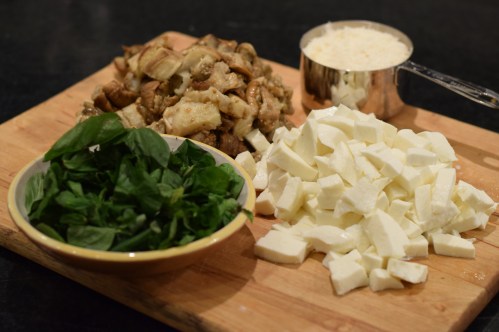
The ingredients list is divided into each of the cooking steps:  roasted eggplant, marinara sauce, pasta, and basil and cheese layers.

3 medium to large eggplants, about 3 pounds
3 tablespoons of extra virgin olive oil

Marinara Sauce (about 1⅓ quarts)
¼ cup extra virgin olive oil
6 cloves garlic, crushed and chopped
2 28-ounce cans whole Italian plum tomatoes
2 teaspoons fine sea salt
¼ teaspoon cayenne pepper or dash of cayenne pepper
¼ cup fresh basil leaves, roughly chopped
2 teaspoons granulated sugar (optional)

6 quarts water
1 tablespoon fine salt
1 pound ziti or penne pasta, cooked to al dente

1 pound sliced and then chopped, mozzarella
1 cup finely grated parmesan ( about 3 ounces)
1 cup basil leaves, about ¾ ounce

Mise en Place

Instructions

Preheat oven to 425º

Remove the stem, and peel and slice the eggplant. Slice them about one-half inch thick; better to err on the side of thicker than thinner slices.
 

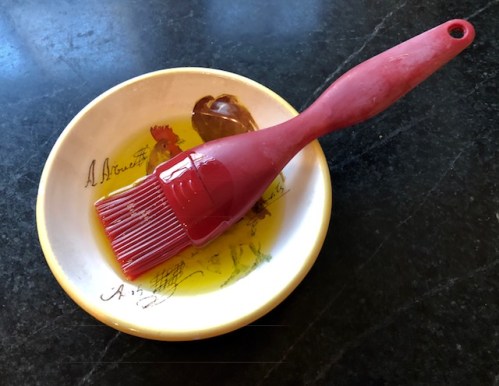
Pour olive oil in a bowl and brush each side of each slice very lightly with oil. I only used 3 tablespoons of oil for all the eggplants pictured above.
IMG_2499

Arrange the eggplant slices on parchment paper-lined baking sheets. Roast for 30-40 minutes. If you want them browned on each side, turn them over after about 20 minutes. I do not bother with this extra step. They should only be lightly browned when done. If you can’t decide if they are cooked enough, try tasting one. That’s what I do. You want them to be firm enough to hold their shape.

At this point, you could store the slices for one or two days in the refrigerator, or freeze. To prep for this recipe, measure out one pound (about 3 cups) and chop into 1.5 to 2 inch segments. Set aside.

DSC_5175.jpg

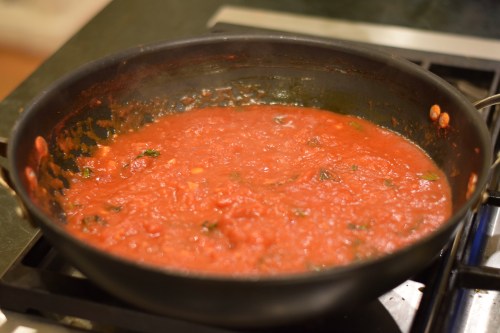
While eggplant is roasting, start the marinara sauce. Heat olive oil in a 6-quart frying pan over low heat. Add garlic and sauté for about 2 minutes. Do not allow garlic to brown. Pour the tomatoes into the pan breaking them up with your fingertips as you do. Add salt, cayenne, and sugar. Bring to a boil over high heat stirring frequently. Turn heat down to medium-low and simmer for 15 minutes. Stir in the fresh basil and turn the heat off. Set aside.

While the sauce simmers and the eggplant roasts, start a large pot of salted water over high heat for the ziti. When water comes to a full boil, add the ziti, bring it back to a full boil, stirring frequently, and cook until al dente. Drain the pasta. The pasta will cook more as it bakes.

Now you are ready to layer all the ingredients into a 9 by 13-inch casserole.

Preheat oven to 400º.

Pour one heaping cupful of sauce into the bottom of casserole pan.
Add half of pasta, half of eggplant, half of basil, half of mozzarella and one-third of parmesan,

Repeat layering starting with half of the remaining sauce, the rest of the pasta, basil, and mozzarella, and a third of the parmesan. End with the remaining sauce followed by the last of the grated parmesan.

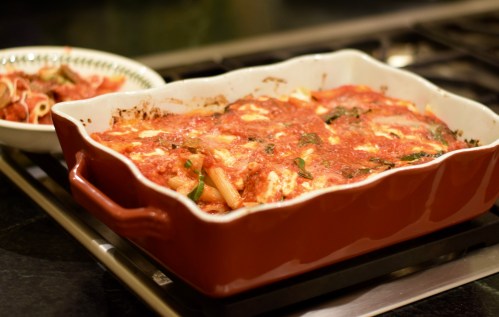
Bake for 20 minutes on the middle rack of the oven.

Related Italian Dishes:
Tomato Pie for a Crowd
Grandma’s Italian Fried Cauliflower
@judyschickens Marinara Sauce
Peperonata!
Spiralized Zucchini (aka Zoodles) with Marinara Sauce
Roasted Tomatoes, Burrata, and Basil
Roasted Ratatouille
Pasta, Mozzarella and Marinara Sauce
Tomatoes: The Crown Jewels of the Summer Kitchen Garden
My Favorite Gazpacho

Always check the website for the most current version of a recipe.

© 2014-2017 Judy Wright. All rights reserved. Photos and text may only be used with written consent.

Tomato Pie for a Crowd

fullsizeoutput_cc2b

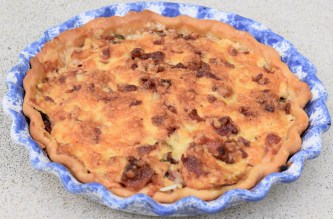
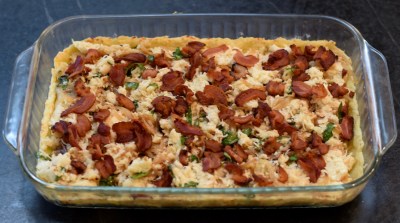
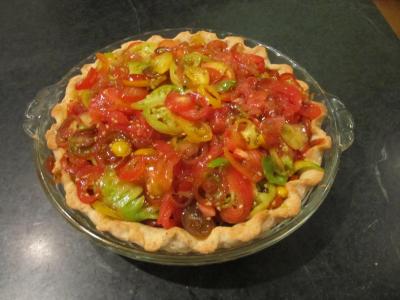
Tomato Pie, like Pimiento Cheese, is one of many fabulous culinary treasures of the South. Basic tomato pies combine the goodness of ripe tomatoes, with melted cheese and a crunchy pie crust. If you add to that bacon, onions, basil, and cheese in the crust, now you’re talking about a DELUXE and savory tomato pie.

fullsizeoutput_cc29

Like for pimiento cheese, there are many ways to make a tomato pie. Some have the cheese on the bottom, and the tomatoes on top and some have it reversed.


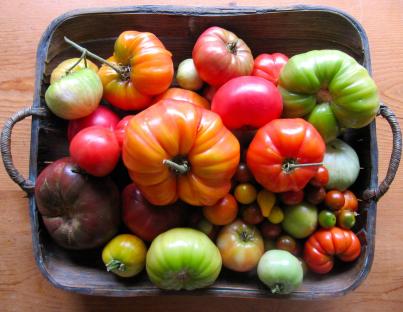
The key to making a great tomato pie, in fact, the only must-do after you gather colorful heirloom tomatoes (see Tomatoes: The Crown Jewels of the Summer Kitchen Garden)


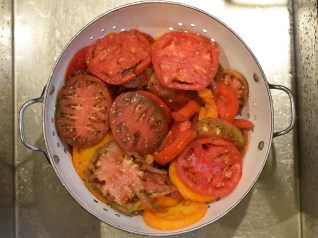
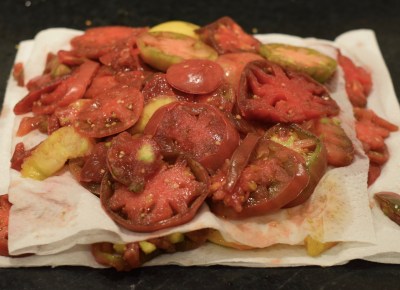
is to core, slice, salt, and drain the tomatoes to divest them of their watery juice and thereby prevent a soupy, soggy, messy pie.

My favorite way to make tomato pie is with a crunchy cheese crust and tomatoes that are piled high and deep on top.

This pie’s problems are that there is never enough to go around, definitely not enough for seconds, and too many calories in the crust for an “everyday” meal. To fix these problems, I first tried to develop a larger pie (lasagna pan-sized) without a crust. However, I found the soft texture of the tomatoes and melted cheese demanded a crunchy crust, so I added the crust back, but only on the bottom, and loaded the dough with nutty parmesan cheese. My family loved it.

Yield: Makes one 9 x 13-inch pan, 10-12 servings

Pie Crust Ingredients

¼ cup cornmeal
1 cup all-purpose flour
¼ teaspoon fine sea salt
½ cup grated parmesan, somewhat packed
1 stick (½ cup) very cold or frozen butter, sliced into many pieces
4 tablespoons ice-cold water

Tomato Filling Ingredients

5 pounds ripe heirloom tomatoes, sliced ¼ inch thick
1 teaspoon sea salt
12 ounces unflavored bacon, about 12 strips
1 pound sweet onion (red or yellow), sliced thinly
2 tablespoons olive oil
½ cup homemade breadcrumbs
20 large or 30 medium-large leaves basil, chiffonade
½ cup mayonnaise (not the low-fat, sweet, or whipped varieties)
1 pound mozzarella cheese, shredded
½ cup parmesan cheese, shredded

Game Plan
I’m not going to lie about the amount of prep work needed for this recipe; this pie takes time. I streamlined the process by buying already shredded mozzarella and parmesan cheese and by using homemade breadcrumbs from a stash in the freezer. As a time-saver, you could forego the homemade cheese crust and use a single layer, pre-made roll of uncooked dough, reshaped to fit in a 9 x 13 pan. Or, you could make the cheese crust version the day before and store it uncooked in the fridge.

1) Prep Mise en Place for Pie Filling

Slice tomatoes about ⅓ inch thick. Place in a colander, add 1 teaspoon of salt and gently mix to distribute the salt. Place a weighted object on top of the tomatoes to help squeeze out the juice. I put a collection bowl under the colander to capture the juice and save for something else (like soup broth). Gently stir and squeeze the tomatoes every 5 or 10 minutes. Let them continue to drain while you finish the prep work.


Chop the bacon into two-inch pieces. Sauté until cooked, then drain the fat, and pat the bacon dry with paper towels.

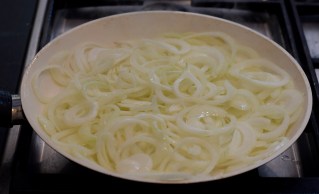
 Thinly slice the onions. Salt very lightly with a pinch of salt and sauté in 2 tablespoons of olive oil over medium heat for about 10-15 minutes.


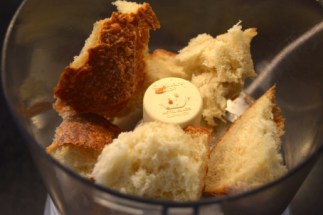
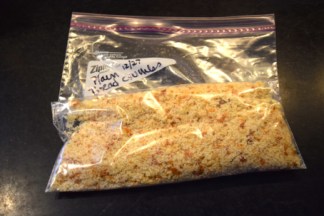
If you don’t have a stash of homemade breadcrumbs​ in the freezer, make some now in the food processor.

Stack, roll and cut basil into thin ribbons.


2. Prep Mise en Place for Pie Crust

3. Make the Pie Crust
Add the flour, cornmeal, salt, and parmesan to a food processor with the regular blade attached. Pulse 2 or 3 times to blend. Add the butter slices and pulse 7 or 8 times until you can see little chunks of butter covered in flour and meal.

Add the chilled water and pulse a few more times until dough is just blended and forms pea-sized balls. I know this doesn’t look like it is blended enough, but as those little balls melt, they create steam that causes the puffiness in a flaky crust. We want them to melt in the oven and not in the food processor which is why we keep the dough cold and underworked.

Dump the crumbly dough onto a sheet of parchment paper. Fold the right side of the paper over the dough and roll it with a rolling-pin. Now fold the left third of the paper over the dough and roll again. Notice how you can still see the chunks of white butter in the dough in the third picture.

DSC_4040

Roll the dough out, between two sheets of parchment paper until it is at least 9 x 13 inches.  Test for proper size by laying the pan over the dough to see if it fits.

Remove the top sheet of parchment paper and flip the dough over into the baking pan. Center the dough by using the edges of the top sheet of parchment paper. Once centered, remove the top sheet of paper.

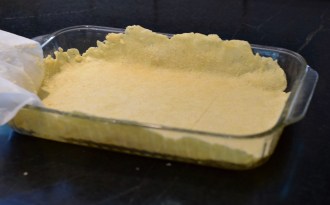
Trim the dough and use the trimmed pieces to patch the crust until it fits in the pan neatly. Use the tines of a fork to poke holes in the crust. Lots of holes. This allows air to escape while baking, so you don’t end up with a lot of air bubbles.

Preheat the oven 375º. While it heats, place the dough-lined pan in the fridge to chill for the 15-20 minutes it takes to heat the oven. This is a necessary chilling period.

Bake for 15 – 20 minutes, or until crust is golden brown. About 10 minutes into cooking, open the oven door and add a few more fork pricks into any bubbles that have formed in the crust. Allow crust to cool for 5-10 minutes before filling. Remember, the goal is not to have a soggy crust once we add the filling. Therefore, some cooling down is necessary.

4. Prepare the Tomato Pie Fillings
While the crust is cooking, remove the tomatoes from the colander and gently squeeze out the excess moisture with your hands. Pat the tomatoes dry with paper towels.

Combine the mayonnaise, cheeses, and basil in a mixing bowl. Stir in the onions (red or yellow) and bread crumbs.

5. Assemble and Bake the Pie
Here’s what you have now: tomatoes, cheese and onion mixture, bacon and cooked cheese pie crust.

Add the cheese filling to the cooled crust and then add the bacon.

Arrange the tomatoes over the top. Lightly drizzle a little olive oil over the tomatoes and some cracked pepper and sea salt.

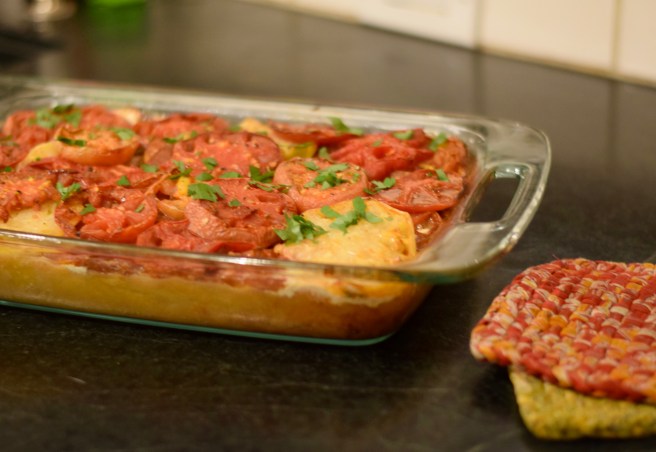
Bake for 50-60 minutes. Pie is done when the filling is bubbling, and the tomatoes are lightly browned.

Dinner is served!

Related Tomato Posts
Fresh Marinara Sauce with Pasta
Gazpacho Galore
Roasted Ratatouille
Roasted Roma Tomatoes

Always check the website for the most current version of a recipe. Thanks!

© 2014-2017 Judy Wright. All rights reserved. Photos and text may only be used with written consent.
Brooks’ Pork Tenderloin with her Amazing Marinade

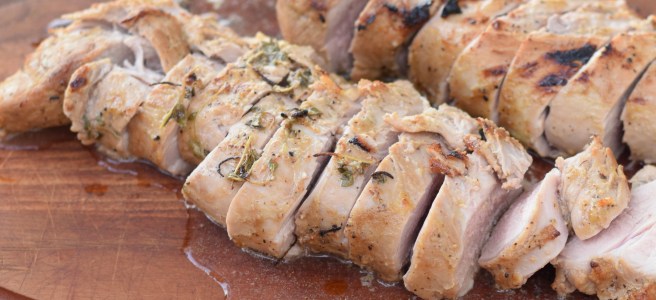
The first time I tasted my friend Brooks’s kickass grilled pork tenderloin was at a funeral reception. Good friend that Brooks is to so many, she showed up at the reception with a platterful of sliced, perfectly cooked, and beautifully seasoned grilled pork tenderloins. A few days later, I called her for the recipe. I wrote the list of ingredients down on a piece of paper and then promptly misplaced it. That was ten years ago, 1/18/06. I know this because I wrote the date on the recipe. You would think someone meticulous enough to date scrap paper would have a decent method for saving it.

I thought of Brooks’s juicy and flavorful recipe every time I cooked pork using my pathetic but quick get-some-food-on-the-table-after-driving-boys-around- town- all-afternoon method of throwing two pork tenderloins into a bag with a salty steak marinade and roasting them at 400º until they were very well-done. In fact, the pork was so salty and dry; I quit making pork tenderloins all together. That was until Brooks’s recipe resurfaced a few weeks ago, and I learned how to cook pork to the right temperature.

dsc_0058

Let’s talk about how pork came to be the dry, well-done, other white meat and not the juicy, tender pink meat we enjoy now.

Trichinosis; It’s no longer a health epidemic 

I grew up in the 60s and 70s. My mother and her mother before her cooked pork until it was well-done. They did so because of the prevailing fear of an illness known as Trichinellosis, aka Trichinosis, which came from the ingestion of parasitic roundworms known as Trichinella spiralis. Trichinae were found most commonly in the muscle tissue of pigs and wild game. The U.S. Public Health Service started counting Trichinellosis incidents in the mid-1940s, around the time my mother was coming of age. At the time, 400-500 cases were reported each year. Because of my mother and grandmother’s respect for and fear of this malady, I knew the word Trichinosis as a ten-year-old. It translated into a disease that could surely kill you dead if you did not cook pork until it was well-done.

This all begs the question, Where were pigs picking up this parasite?  The answer was garbage. In the old days, many pigs were fed raw garbage on pig farms. In the 50s and 60s, food laws changed, and the government said the garbage needed to be cooked, and BTW, no more feeding raw animal carcasses to pigs, either. New farm hygiene protocols were established, and rodents, like rats and raccoons, were no longer allowed to access the pigpen.

Along with tighter control over farm hygiene, the government embarked on a massive publicity campaign instructing Americans to cook pork until it was well-done. The message stuck. In 1987, another ad campaign came along this time from the National Pork Board. It pitched pork as a white meat alternative to chicken and turkey. “Pork, the other white meat,” became the slogan. That slogan served to reinforce the concept of cooking pork until it was white and well-done.

Technique Time: Heat Transfer

So, if you don’t need to overcook pork anymore, to what internal temperature should you cook it to get a moist, light-pink center? The U.S.D.A says a minimum of 145º for all pork roasts and 160º for ground pork and patties. When using a meat thermometer, it should be inserted into the loin’s thickest part without touching any bones. Finally, let the meat rest for 5-10 minutes before serving. During this time, the meat’s internal temperature will rise by about five degrees and finish cooking the meat to 150º. Theoretically, you could cook the meat to 140º and let it finish off to 145º, but I tried that, and it was too pink and chewy for me.

This five-degree temperature increase that happens when cooked meat rests is due to the rules of heat transfer. The temperature on the surface of the meat when you pull it out of the oven is the same as the inside of the oven, in this case, 400º. If the room temperature is 70º, the heat on the pork’s surface has to go somewhere for the meat’s temperature to equilibrate with room temperature. Some of that heat is released into the room, and some goes back into the center of the meat, raising its internal temperature to 150º.

Back to the recipe

When I finally got the chance to make Brooks’s marinade, a full ten years later, it wasn’t as kick-assy as I remembered. I think I had mismeasured on the side of timidity when it came to gauging how much was a glug or dollop of this and that (Brooks’s measurement terms!). I called Brooks for clarification and to ask if I could blog the recipe. The conversation started like this, “Brooks, do you remember making pork tenderloins for Buck’s mother’s funeral TEN years ago? [Yes.] Are you still making them the same way?” [Yes.] To my surprise and amusement, she told me her newlywed son Alex had just called for the same recipe, so the ingredients were fresh on her mind. That, Dear Reader, is what keeper-recipes and motherful moments in cooking are all about.

Yield: 1¼ cups marinade (for 2-3 pounds of meat or two logs)

Ingredients:

dsc_0019

¼ cup extra virgin olive oil
¼ cup bourbon or rye
1 tablespoon “Tamari” Soy Sauce (a refined, more delicate, gluten-free soy)
1 tablespoon Worcestershire Sauce
2 slightly heaping tablespoons Dijon Mustard
1 teaspoon Beau Monde Seasoning (a salt and spice blend made by Spice Islands)
2 teaspoons cracked black pepper
10 peppercorns
Pinch of crushed red pepper
2 tablespoons brown sugar
5-8 large garlic cloves, sliced (or a heaping tablespoon of jarred, minced)
5-6 stems fresh thyme, coarsely chopped (I use lemon thyme)
Zest and juice of one lemon
A dollop of cognac (optional)
2-3 pounds (2 logs from one package) pork tenderloin, rinsed and patted dry

Instructions:

Remove pork tenderloins from the package. Rinse under cold water and pat dry.

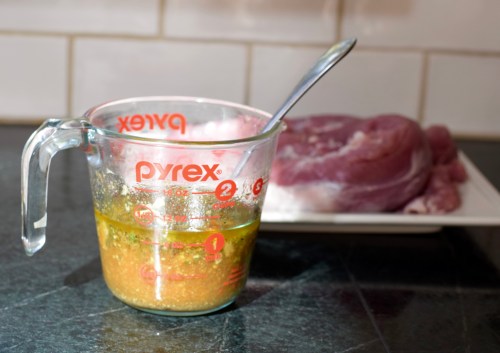
Into a two-cup liquid measure, add olive oil to the ¼ cup mark, then add bourbon to the ½ cup mark, and then all the other ingredients: Tamari, Worcestershire, Dijon, Beau Monde, red and black peppers, peppercorns, brown sugar, garlic, the zest and juice of one lemon, and the thyme. Do not add salt. There is plenty of salt in the Tamari, Worcestershire, Dijon, and Beau Monde. Stir marinade with a fork, being sure to mix in the brown sugar that settles to the bottom.

dsc_0027

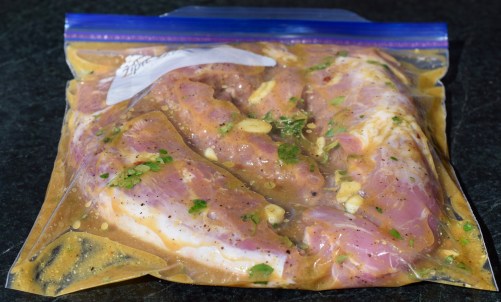
Mix pork and marinade together and allow to marinate in the refrigerator for eight hours or overnight. Turn it over and massage it every few hours.

dsc_0037

Cook in a preheated 400º oven or on the grill at the same temperature. Cook ten minutes on one side and turn over. Cook for another ten minutes, or until a meat thermometer inserted into the thickest part of the meat registers at least 145º. Let rest 5-10 minutes before serving. Our favorite degree of doneness was 148º, with a rise to 154º on the meat thermometer.

dsc_0254 dsc_0348

Even at 154º, the meat is still pink.

dsc_0363

If the meat is too salty, decrease the Tamari and Worcestershire Sauce to two teaspoons of each.

dsc_0072

Related Posts
Lemony Grilled Chicken Breasts
Mom’s Marinated and Grilled Lamb
Mom’s Roasted Lamb with Herb and Goat Cheese Topping
Lemony Grilled Chicken Breasts
Judy’s Mom’s Meatloaf
Brooks’s Pork Tenderloin Marinade

LET’S STAY CONNECTED!

Follow Judy’s Chickens on Instagram and Pinterest @JudysChickens.

Always check my blog for the latest version of a recipe.

If you enjoyed this post to become a follower, please be sure to press “confirm” on the follow-up letter that will be sent to your email address.

© 2014-2020 Judy Wright. All rights reserved. Photos, videos, and text may only be reproduced with the written consent of Judy Wright.