The Mosquito Bucket Hack That Works

These are mosquito buckets. The white, donut-shaped discs floating in them are called MosquitoDunks®.

MosquitoDunks® contain a mosquito-specific toxin, B.t.i. (Bacillus thuringiensis subspecies israelensis), a naturally occurring bacterium found in soil and known to kill mosquito larvae. B.t.i. will not kill adult mosquitos or their eggs; it stops mosquito reproduction only in the larval stage. The mosquito bucket system is a bee-friendly, vegetable garden-friendly, and pet-friendly way to eliminate mosquitos.

This post is for you IF:

  • You hate using Mosquito Joe-type fogger sprays to manage these pests because you suspect there is collateral damage to beneficial insects, but you hate mosquitoes more.
  • You hate to wear bug spray and socks, a long-sleeve shirt, and pants in the middle of a hot summer day when you weed your garden.
  • You worry about diseases spread by mosquitoes.
  • Mosquitoes love you.

I am very thankful for the day my naturalist friend, Joanna Brichetto, posted a story called The Mosquito Bucket of Doom on her blog, Sidewalk Nature. Joanna learned about the bucket system from famed etymologist Dr. Doug Tallamy.

Here is a link to Dr Tallamy’s explanation. He says companies that spray for mosquito removal kill 10% of adult mosquitoes and many beneficial insects.

I have four mosquito buckets spread around my half-acre backyard: one industrial-looking bucket in each vegetable garden and one attractive fiberglass bucket on our patio.

I’ve just added a fifth bucket to cover the area around our herb garden in the side yard.

HOW TO MAKE MOSQUITO BUCKETS

Supplies:
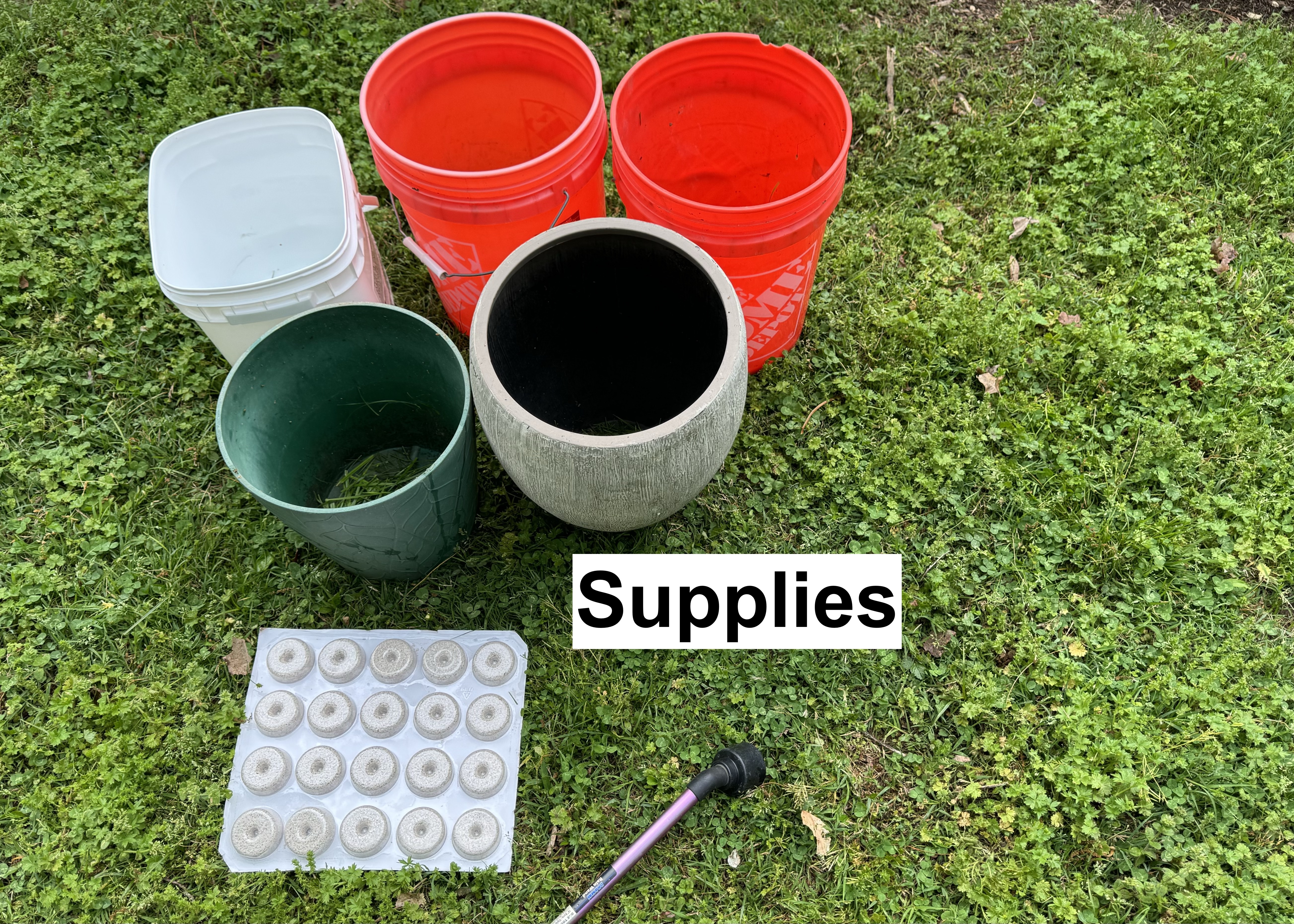
-Use a  3-5-gallon bucket, planter, or any container with a wide top
-ONE handful of grass clippings
-Water
-ONE Mosquito Dunks® (a larvicide)
-If you are concerned about wildlife falling in the bucket, Dr. Tallamy suggests placing a chicken wire screen over the top

Instructions:
Add a handful of greens and a Dunk® into each tall, wide-topped container.
.
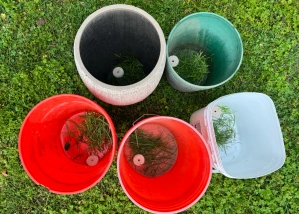
Half-fill the container with water. As the organic matter decomposes, it produces carbon dioxide, an attractant for female mosquitoes.
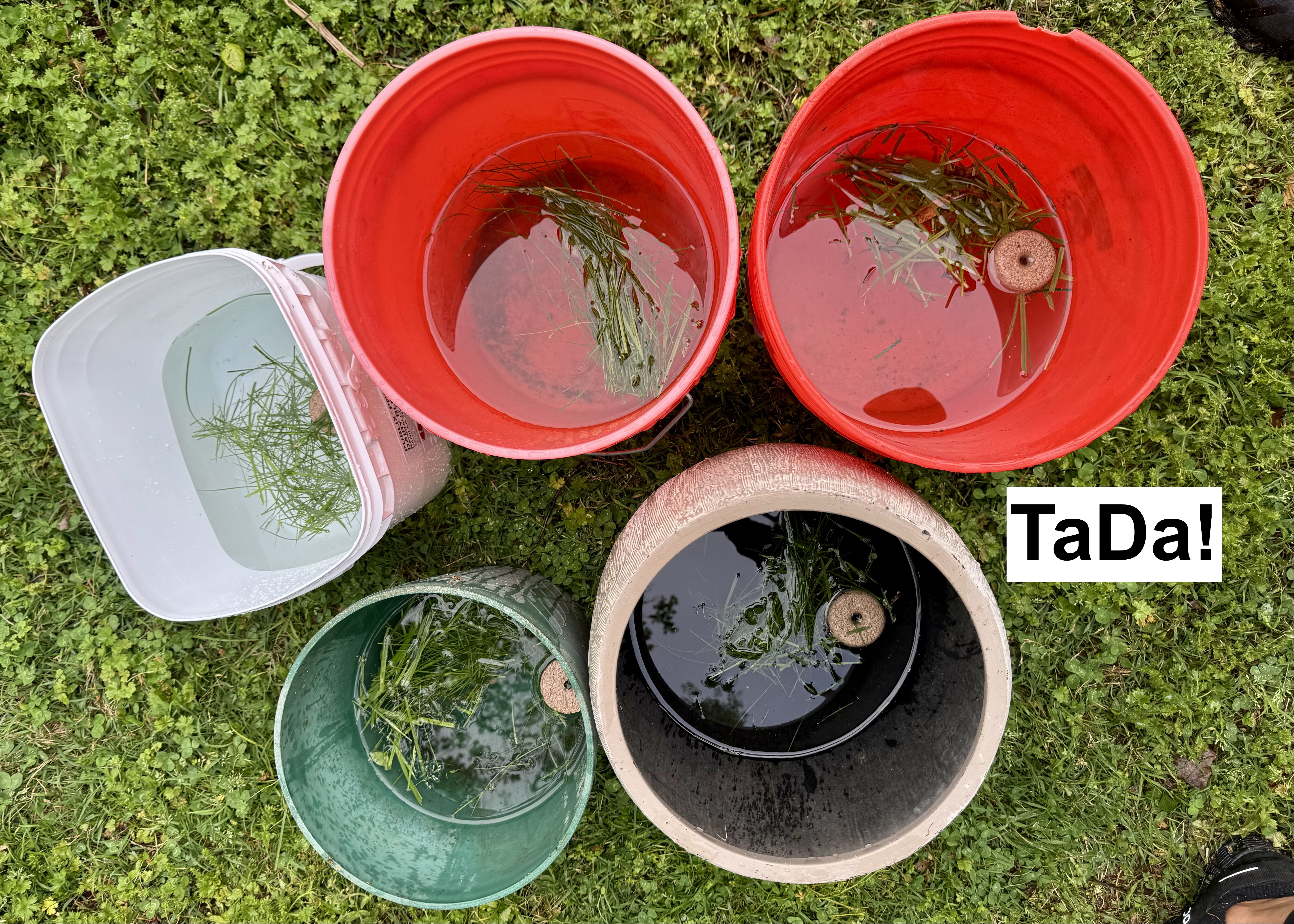
Place buckets near your seating and work areas. Thirty days later, add a new Dunk® to each bucket. Pro Tip: take a photo of the bucket when you add a new Dunk to help remember the date! For convenience, I purchase packages of 20 Dunks from an online source.

You do not need to change the water each month. You want swampy water, but it shouldn’t be smelly. Add more water to keep the buckets half full and pour off water after a heavy rain.

Testimonials:
We hosted my son’s rehearsal dinner in our backyard in the middle of July with just four buckets for mosquito control. We never saw a mosquito.

I volunteer at a community garden near a floodplain inhabited by many mosquitoes. I  showed the local residents how to set up mosquito buckets, and within two weeks, the mosquitoes were gone.

My friend, who lives in Sewanee, TN, known for having so many mosquitos people can’t sit and visit on their porches, now uses four buckets around the perimeter of her house and five more around an ephemeral pond on her property. She reports they now sit comfortably outside. I believe they will work for most residences if she says they work.

How Do Mosquito Buckets Work?

MosquitoDunks® work by killing mosquito larvae, not adult mosquitos; it is a larvicide.

It takes a few days for mosquito eggs to hatch into the little swimmers (larvae) seen in Joanna’s container, shown below.

Mosquitoes need ¼-inch of standing water to lay eggs. With that in mind, inspecting your property for hidden bodies of standing water and turning unused containers upside-down is essential for successfully using this system.

I want readers to succeed when using the buckets, so please comment if you have a question or feel the buckets are not working.

Related Stories:
How to Start Seeds in a Recycled Milk Jug
The Soil Your Undies Challenge- A Simple DIY Test for Soil Health
How to Build a Raised Garden Bed
The Asteraceae Family of Primo Pollinator Plants

Unrelated Stories:
Pistachio, Lemon, and Basil Butter Cookies
Award-Winning Chocolate Chip Cookies
Homemade Grape Jelly
A Birthday Tribute for My Mother: Knitting with Mom’s Stash
How to Knit Fingerless Mittens on Straight Needles

Follow Judy’s Chickens on Instagram and Pinterest @JudysChickens.
If you enjoyed this post, share it and sign up to become a follower. If you sign up, press “confirm” on the follow-up letter sent to your email address. 

© 2014-2024 Judy Wright. All rights reserved. Photos, videos, and text may not be reproduced without the written consent of Judy Wright.

The Asteraceae Family of Primo Pollinator Plants

Warning: Reading this may lead to a fondness for dandelions.

What do these flowers have in common?

Zinnias

Sunflowers

Cosmos

Marigolds

Asters

Goldenrod

Dandelions

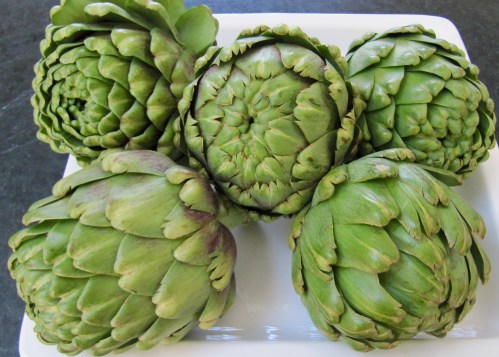
Artichokes

Artichokes?

I’ll give you a hint, the artichoke is a bud! If left to mature on the plant, it will produce hundreds of purple, narrow-tubed flowers cradled in one base.

These flowering plants are all part of the Asteraceae Family.

Plants are placed in families based on characteristics they share. These flower heads are all round and have a flat central disc. While each flower appears to be a single flower, all Asteraceae flowers are actually a composite of many small flowers, each with their own reproductive parts, packed densely into one receptacle.

The flowers in the center disc are called disc florets and those surrounding it are ray florets.

As beautiful as flowers are to us humans, flowers are trying to impress insects and birds. Pollination is the primary objective of a flower. Once pollination happens, the flower withers and dies. Pollination activates the fertilization of seeds, ensuring reproduction of the plant. Both ray and disc florets have all the necessary reproductive parts.

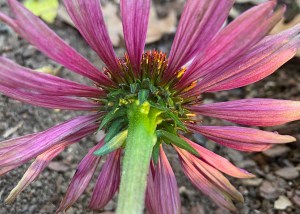
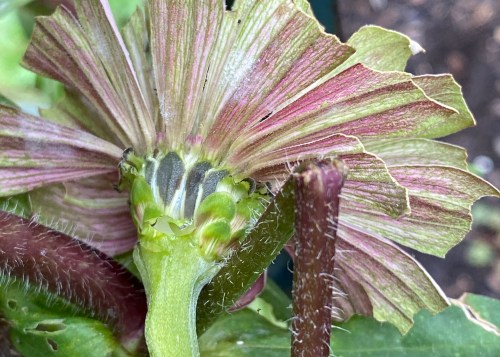
Another feature of plants in the Asteraceae family is their sepal-like leaves, called bracts, on the flower head’s underside. Bracts surround and protect the base of the plant where the seeds mature. They are arranged in either an overlapping or a linear pattern.


I took a few bracts off to see the seeds beneath — they are packed in there!

Rings of new disc florets emerge gradually in an orderly fashion from the disc’s outside perimeter to the center. A cone-shaped arrangement forms as the underlying seeds grow larger and require more space. This was a marvelous insight for me; one of the traits we love about zinnias is how long the flowers last. They last that long to ensure that every ovule (pre-seed) gets fertilized.

If you dissect a flower head, you can see the many seeds at various stages of maturation.

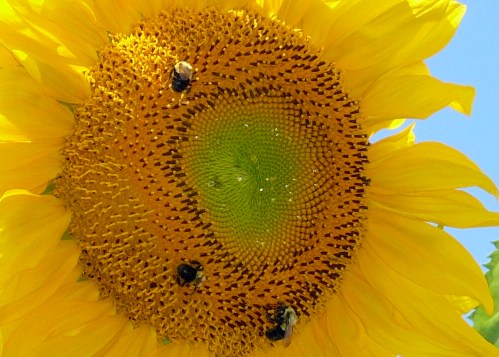
A good visual of a composite flower head is the sunflower.

Sunflowers are a bee magnet. We hear a lot about the benefits of growing “pollinator” plants in a garden. You need look no further than plants in the Asteraceae family for colorful flowers that attract insects.

The end result is hundreds of sunflower seeds to eat and ensure reproduction.

Not all Asteraceae plants have both ray and disc florets. A few species have one or the other. Dandelions, for example, are comprised of ray florets only. With my new appreciation of flowering plants, I don’t think I will be as quick to pull dandelions out of my vegetable garden anymore. After all, my Sicilian immigrant grandmothers picked dandelion leaves to eat. The leaves are a good source for vitamin C. During early times, the cool-weather plants were grown in kitchen gardens for settlers to eat to prevent scurvy.

Artichokes are comprised of all disc florets. The bristles that make up the choke are actually hundreds of very immature flowers.

Knowing this, I forevermore will say a prayer of gratitude when I remove those less edible filaments from a stuffed artichoke. For without the choke, we would not get seeds for more artichokes! THAT would be a travesty.

Studying and photographing the unfolding reproductive cycle of flowers in my garden has been a source of joy, a saving grace, and a silver lining of diversion while living through this crazy pandemic. I am grateful to my mother for instilling in me a love of gardening and to Mother Nature for providing everything I need to grow food in my backyard. I hope to inspire others, most especially children, to experience the peace and thrill of planting a seed, watching it grow, and being a witness to the beauty of the natural world.

A moth imbibing in nectar.

If there are cool-weather plants such as asters, cosmos, chickory, or chrysanthemums in your yard, maybe cut one open and see for yourself!

I am grateful to my fellow naturalist and Instagram friend, Rose Marie Trapani, for sending me a flowering artichoke in the MAIL so I could dissect it. That’s a whole ‘nother story! You can follow Rose Marie @oursiciliantable on Instagram.

Related Posts
How to Build a 4 x 4 Raised Garden Bed
Winter Floral Arrangements Using Greenery from the Yard
Lemon Tree Very Pretty
Family Dirt
Edible Landscaping with Nashville Foodscapes

© 2014-2020 Judy Wright. All rights reserved. Photos, videos, and text may not be reproduced without the written consent of Judy Wright.

Follow Judy’s Chickens on Instagram and Pinterest @JudysChickens.

If you enjoyed this post, consider becoming a follower. Be sure to press “confirm” on the follow-up letter sent to your email address.